


10 Best Sports for Kids in Singapore: Age-Appropriate Guide for Parents
- Vivo Kinetics
- Feb 5
- 12 min read
Table Of Contents
Why Sports Matter for Your Child's Development
How to Choose the Right Sport for Your Child
The 10 Best Sports for Kids in Singapore
1. Multi-Sport Programs (Ages 2-6)
2. Swimming (Ages 3+)
3. Soccer (Ages 4+)
4. Gymnastics (Ages 3-8)
5. Tennis (Ages 5+)
6. Basketball (Ages 6+)
7. Martial Arts (Ages 5+)
8. Athletics/Track and Field (Ages 6+)
9. Badminton (Ages 6+)
10. Rock Climbing (Ages 5+)
Age-Specific Sport Recommendations
Building a Foundation for Lifelong Active Living
Frequently Asked Questions
Choosing the right sport for your child can feel overwhelming. With Singapore's thriving youth sports scene offering everything from traditional team games to innovative movement programs, parents face countless options. But here's what matters most: the best sport for your child isn't necessarily the most popular one. It's the activity that matches their developmental stage, sparks their curiosity, and helps them build confidence through play.
Singapore's National Sports Participation Survey shows that 74% of Singaporeans aged 13 and above engage in sports weekly, the highest rate ever recorded. This culture of active living starts early, with over 66,000 student athletes competing in the National School Games across 29 sports. As parents, introducing your child to age-appropriate sports during their formative years sets the foundation for lifelong health, resilience, and joy in movement.
This guide explores the 10 best sports for kids in Singapore, organized by developmental suitability rather than popularity. We'll help you understand which activities align with your child's age, temperament, and growth stage, drawing on insights from award-winning children's fitness specialists who work with thousands of young Singaporeans every year.
Why Sports Matter for Your Child's Development
Beyond the obvious physical benefits, sports participation during childhood creates profound impacts across multiple developmental domains. When children engage in structured physical activity, they're not just building stronger muscles—they're developing neural pathways that support learning, emotional regulation, and social connection.
Research consistently shows that physically active children demonstrate improved executive function, including better working memory, cognitive flexibility, and inhibitory control. These are the same skills that help them focus during homework, navigate friendships, and manage frustration. In Singapore's competitive academic environment, sports provide a crucial counterbalance that actually enhances academic performance rather than competing with it.
The social-emotional benefits prove equally valuable. Through sports, children learn to read social cues, negotiate conflicts, celebrate teammates' successes, and handle disappointment. They discover that effort leads to improvement, that making mistakes is part of learning, and that belonging to a team creates meaningful connections. For many children, the sports field becomes where they first experience leadership, develop grit, and build genuine self-confidence.
How to Choose the Right Sport for Your Child
Selecting a sport requires understanding your child's unique combination of physical development, personality traits, and interests. A shy, detail-oriented six-year-old might thrive in individual sports like swimming or martial arts, while an energetic, social child of the same age might flourish in team environments like soccer or basketball.
Consider your child's developmental readiness. Young children (ages 2-5) benefit most from unstructured play and multi-sport exploration that builds fundamental movement skills—running, jumping, throwing, catching, and balancing. Specialized sport training before age 6 rarely provides advantages and can sometimes lead to early burnout. Instead, focus on programs that prioritize fun, variety, and age-appropriate skill development.
For children ages 6-8, gradual specialization becomes appropriate, though maintaining variety remains important. This age group can handle more structured coaching and basic strategy, but they still need frequent water breaks, shorter practice sessions, and plenty of encouragement. Watch your child during different activities. Do their eyes light up? Do they talk about it afterward? Do they ask when they can do it again? These natural indicators of engagement matter more than any external measure of talent or potential.
Parental pressure represents one of the biggest threats to long-term sports participation. When children feel they're playing to please parents rather than themselves, enjoyment decreases and dropout rates increase. Your role is to provide opportunities, encouragement, and unconditional support, whether your child scores the winning goal or spends the game watching butterflies.
The 10 Best Sports for Kids in Singapore
1. Multi-Sport Programs (Ages 2-6)
Why it's ideal for young children:
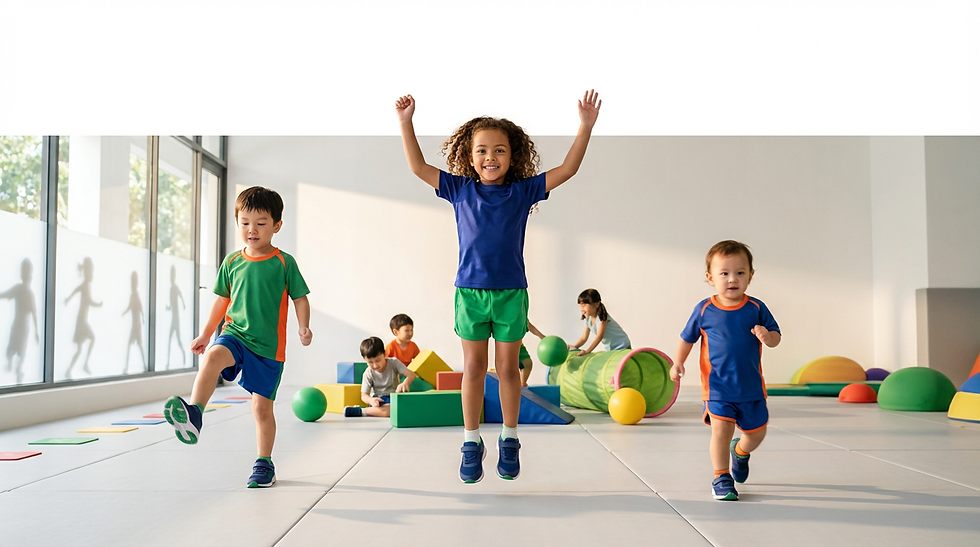
Multi-sport programs represent the gold standard for early childhood physical development. Rather than focusing on a single sport's specific skills, these programs introduce children to diverse movement patterns through play-based activities. A typical session might include obstacle courses, ball games, balance challenges, rhythmic movement, and cooperative activities, all designed to develop fundamental motor skills.
Young children's brains and bodies aren't ready for sport specialization. Their developing nervous systems need varied movement experiences to build comprehensive physical literacy. Multi-sport exposure also helps children discover their natural preferences and strengths without the pressure of competition or performance.
The Vivo Kids multi-sports programme exemplifies this approach, combining movement skill development with character education for children ages 2-6. Through age-appropriate activities led by expert coaches, children build confidence, creativity, and coordination while developing socially and emotionally.
Key developmental benefits:
- Develops fundamental movement skills essential for all future sports
- Builds body awareness and spatial orientation
- Encourages creativity and problem-solving through story telling and movement games
- Supports social skill development in a non-competitive environment
- Prevents early specialization and associated injury risks
What parents should know:
Look for programs with qualified early childhood movement specialists who understand developmental milestones. Small class sizes (8-12 children) ensure individual attention. The best programs balance structure with free play, incorporate music and sensory elements, and focus on effort and participation rather than outcomes.
2. Swimming (Ages 3+)
Why it's essential in Singapore:
As an island nation with year-round tropical weather, swimming represents both a crucial life skill and an excellent form of exercise for Singaporean children. Swimming develops cardiovascular fitness, builds full-body strength, and improves flexibility without placing stress on growing joints. The water's resistance provides natural muscle conditioning while its buoyancy makes movement accessible even for children with coordination challenges.
Swimming also offers unique sensory input that many children find calming and regulating. The rhythmic breathing, water pressure, and bilateral movement patterns support neurological development in ways land-based activities cannot replicate.
Key developmental benefits: - Builds cardiovascular endurance and lung capacity - Develops bilateral coordination and cross-body integration - Provides essential water safety skills - Offers low-impact exercise suitable for all body types - Builds independence and self-reliance
What parents should know:
Starting with parent-child classes for toddlers helps build water confidence in a secure environment. Look for programs with certified instructors, small class sizes (maximum 4-6 children per instructor for beginners), and warm, well-maintained pools. Progress should be individualized rather than age-based, as children develop swimming skills at vastly different rates.
3. Soccer (Ages 4+)
Why kids love it:
Soccer's combination of continuous movement, teamwork, and accessibility makes it one of Singapore's most popular youth sports. Children can begin learning basic ball control and kicking skills as young as 4, though tactical understanding develops gradually over many years. The sport's global appeal also means children see role models and can connect with peers worldwide through a shared language of play.
Soccer develops agility, balance, and coordination while teaching spatial awareness and strategic thinking. The constant decision-making required during play—when to pass, when to dribble, where to position—builds cognitive skills alongside physical ones.
Key developmental benefits: - Improves cardiovascular fitness and leg strength - Develops bilateral coordination (using both feet) - Teaches teamwork and communication - Builds spatial awareness and field vision - Encourages strategic thinking and quick decision-making
What parents should know:
Young children (ages 4-6) benefit from small-sided games (3v3 or 4v4) rather than full-field play. This increases touches on the ball and keeps all players engaged. The Vivo Kicks Academy offers age-appropriate soccer training for children ages 6-12, focusing on skill development, tactical understanding, and character building in a supportive environment. Programs should emphasize skill development and fun over competition for elementary-age children.
4. Gymnastics (Ages 3-8)
Why it builds exceptional body awareness:
Gymnastics provides unparalleled development of body control, spatial orientation, and physical confidence. Through activities like rolling, balancing, jumping, and climbing, children learn to move their bodies precisely through space. This kinesthetic awareness transfers to virtually every other sport and physical activity.
Gymnastics also builds exceptional upper body and core strength, flexibility, and discipline. The progressive skill development—mastering one element before moving to the next—teaches children the value of practice and persistence.
Key developmental benefits: - Develops strength, flexibility, and balance - Builds spatial awareness and body control - Improves concentration and focus - Teaches goal-setting and achievement - Provides foundation skills for many other sports
What parents should know:
Recreational gymnastics differs significantly from competitive training. For most children, recreational programs offering exposure to various apparatus (floor, beam, bars, vault) provide ideal development without the intensity of competitive pathways. Look for programs with certified coaches, proper safety equipment, and age-appropriate progressions.
5. Tennis (Ages 5+)
Why it develops hand-eye coordination:
Tennis challenges children to track a moving object, predict its trajectory, position their body, and make contact—all in split seconds. This complex coordination develops gradually, making tennis most appropriate for children ages 5 and older who have developed basic hand-eye coordination.
Modern tennis instruction uses modified equipment scaled to children's size and strength. Smaller courts, lower nets, and slower balls (foam or low-compression) allow young players to experience success and develop proper technique from the start.
Key developmental benefits: - Builds hand-eye coordination and reaction time - Develops strategic thinking and problem-solving - Improves agility and footwork - Teaches sportsmanship in one-on-one competition - Provides exercise that can continue throughout life
What parents should know:
Programs following the International Tennis Federation's "Play and Stay" methodology use age-appropriate equipment and court sizes. Private lessons accelerate skill development but can be costly; group classes (4-6 children) offer social interaction alongside instruction. Consistency matters more than frequency—two 45-minute sessions weekly typically outperform one longer weekly session.
6. Basketball (Ages 6+)
Why it builds teamwork:
Basketball's fast pace and constant position changes require players to communicate, support teammates, and adapt strategies in real-time. The sport develops both individual skills (dribbling, shooting) and team concepts (spacing, passing, defensive positioning). For children who enjoy social interaction and dynamic play, basketball offers ideal engagement.
The vertical element—shooting toward a raised goal—also develops depth perception and trajectory estimation in ways ground-based sports cannot.
Key developmental benefits: - Improves vertical jumping and lower body power - Develops hand-eye coordination and dribbling skills - Teaches teamwork and court awareness - Builds cardiovascular endurance - Encourages quick decision-making under pressure
What parents should know:
Lowered hoops (8 feet instead of 10 feet) and smaller balls help young players develop proper shooting form. Look for programs emphasizing skill development over scorekeeping for children under 9. Modified rules (no pressing, simplified violations) keep games fun and flowing for beginners.
7. Martial Arts (Ages 5+)
Why it builds discipline and confidence:
Martial arts offer unique benefits beyond physical conditioning. The structured environment, respect for instructors, and incremental belt progression teach discipline, focus, and goal achievement. For children who struggle with attention or impulse control, martial arts' structured repetition often proves particularly beneficial.
The individual nature of martial arts also removes social comparison. Students progress at their own pace, competing primarily against their previous performance rather than peers.
Key developmental benefits: - Builds self-discipline and focus - Improves balance, coordination, and flexibility - Teaches respect and self-control - Develops confidence and self-defense awareness - Provides clear goal progression through belt systems
What parents should know:
Different martial arts emphasize different elements. Taekwondo focuses on kicking; karate balances punching and kicking; judo emphasizes throws and grappling. Visit classes to observe teaching style and student engagement. Instructors should emphasize control and respect over aggression. Be wary of programs promising black belts within 2-3 years for young children—authentic progression takes longer.
8. Athletics/Track and Field (Ages 6+)
Why it celebrates individual progress:
Athletics programs introduce children to running, jumping, and throwing through developmentally appropriate activities. Unlike team sports where roles might limit a child's participation, athletics allows every child to run, jump, and throw. The sport celebrates personal improvement and effort rather than solely competitive outcomes.
Athletics also provides excellent foundation training for virtually every other sport. Speed, power, and coordination developed through athletics transfer directly to soccer, basketball, tennis, and beyond.
Key developmental benefits: - Develops speed, power, and explosive movement - Builds cardiovascular fitness - Improves running mechanics and efficiency - Teaches goal-setting and personal achievement - Provides foundation for multi-sport participation
What parents should know:
Youth athletics programs should focus on varied movement rather than event specialization. Programs offering exposure to sprinting, distance running, jumping, and throwing develop well-rounded athleticism. Avoid programs emphasizing intense training volumes for elementary-age children—fun and variety matter more than performance at this stage.
9. Badminton (Ages 6+)
Why it's ideal for Singapore:
Badminton's popularity in Singapore means abundant facilities, coaching expertise, and competitive opportunities. The sport develops quick reflexes, agility, and strategic thinking. Badminton's rally-based nature keeps players active throughout games, providing excellent cardiovascular exercise.
The sport also scales well—beginners can enjoy cooperative rallies while advanced players engage in competitive matches, making it suitable for mixed skill levels.
Key developmental benefits: - Builds hand-eye coordination and racquet skills - Develops agility and quick direction changes - Improves concentration and anticipation - Teaches singles and doubles strategy - Provides accessible competitive opportunities
What parents should know:
Children need sufficient grip strength and shoulder stability before beginning badminton, typically developing around age 6. Lighter racquets designed for children prevent injury and allow proper technique development. Indoor courts protect from Singapore's weather, making year-round participation feasible.
10. Rock Climbing (Ages 5+)
Why it builds problem-solving skills:
Rock climbing combines physical challenge with mental puzzle-solving. Each route requires children to plan their path, test solutions, and adjust strategies—all while managing fear and building confidence. The immediate feedback (success or failure) helps children learn from attempts and persist through challenges.
Climbing also builds exceptional upper body and core strength while developing spatial reasoning and body awareness.
Key developmental benefits: - Builds full-body strength, especially grip and core - Develops problem-solving and route planning - Improves flexibility and body positioning - Builds confidence and manages fear - Encourages perseverance and resilience
What parents should know:
Indoor climbing facilities offer controlled environments with safety equipment and trained staff. Auto-belay systems allow children to climb independently while remaining secure. Bouldering (climbing shorter walls without ropes, with thick mats below) provides accessible entry for beginners. Look for facilities with specific youth programs and age-appropriate wall features.
Age-Specific Sport Recommendations
Ages 2-4: Focus on Movement Exploration
Toddlers and preschoolers need unstructured play and guided movement exploration rather than sport-specific training. Programs incorporating music, sensory experiences, and parent participation build positive associations with physical activity. Activities should last 30-45 minutes maximum, with frequent transitions to maintain engagement.
Best options: Parent-child movement classes, swimming (parent-child), multi-sport programs
Ages 5-7: Introduce Structured Sports
Early elementary children can handle more structure and basic skill instruction, though the focus should remain on fun and variety. This age group benefits from trying multiple sports to discover preferences and build diverse movement skills. Sessions can extend to 60 minutes with water breaks and varied activities.
Best options: Multi-sport programs, swimming, soccer, gymnastics, martial arts
Ages 8-10: Develop Sport-Specific Skills
Older elementary children can focus more deeply on specific sports while maintaining some variety. Competitive opportunities become appropriate, though the emphasis should remain on skill development, effort, and sportsmanship rather than winning. Training can extend to 90-minute sessions for engaged children.
Best options: Any sport matching the child's interests and abilities; maintaining involvement in 2-3 sports still provides benefits over single-sport specialization
Ages 11-12: Support Growing Independence
Pre-teens develop stronger preferences and may choose to focus on one or two primary sports. This age group can handle more complex strategy, longer training sessions, and higher-level competition. Supporting their choices while ensuring they maintain balance with academics and social life becomes crucial.
Best options: Child-directed choices based on passion and aptitude; continued participation in at least one secondary sport reduces injury risk and burnout
Building a Foundation for Lifelong Active Living
The ultimate goal of youth sports isn't scholarships, trophies, or professional careers—it's developing humans who find joy in movement and maintain active lifestyles throughout their lives. Research shows that children who enjoy sports during elementary years are significantly more likely to remain physically active as adults.
This outcome depends heavily on the quality of early sports experiences. Children who feel competent, autonomous, and connected to teammates and coaches develop intrinsic motivation for physical activity. Those who experience excessive pressure, negative coaching, or early specialization often burn out before adolescence.
As parents, your role centers on providing opportunities, celebrating effort, and maintaining perspective. The child who tries five different sports before finding their passion has gained more than the child pushed into year-round intensive training in a single sport at age 6. The young athlete who learns to handle disappointment with resilience has developed skills more valuable than any medal.
Vivo Kinetics has built its award-winning reputation on understanding these principles. Whether through Vivo Kids multi-sports programmes that introduce young children to movement fundamentals or Vivo Kicks Academy that develops soccer skills alongside character, the focus remains on nurturing whole children through age-appropriate, play-based experiences.
Singapore's youth sports landscape offers exceptional opportunities for children to explore, grow, and thrive. By choosing activities aligned with your child's developmental stage and natural interests, you're investing in their health, confidence, and happiness—benefits that extend far beyond the playing field.
Selecting from the best sports for kids in Singapore doesn't require finding the "perfect" activity on the first try. Children's interests evolve, and the sport that captivates them at age 5 might differ from what engages them at age 9. What matters most is providing exposure to quality programs led by qualified coaches who prioritize development over performance.
Watch your child. Listen to their excitement (or lack thereof). Notice when they're fully engaged versus when they're going through motions. These observations guide better decisions than any external ranking or recommendation. The best sport for your child is ultimately the one they love enough to stick with, the one that builds their confidence, and the one that teaches them that their body is capable of amazing things.
Singapore's commitment to active living, reflected in record-high sports participation rates, creates an environment where children can explore movement in supportive, well-resourced settings. From structured academies to play-based programs, from individual pursuits to team sports, the options support every child's unique path to physical literacy and lifelong wellness.
Ready to introduce your child to the joy of movement? Explore Vivo Kinetics' award-winning programmes designed specifically for Singapore's young athletes. From toddlers taking their first steps in structured play to children developing soccer skills and character, our expert coaches create safe, nurturing environments where every child can thrive. Book a trial class today and discover why we're recognized as leaders in children's health and fitness across Southeast Asia.


Comments