


Basketball for Kids: When to Start and What to Expect
Table Of Contents
When Can Kids Start Playing Basketball?
Signs Your Child Is Ready for Basketball
Age-Appropriate Basketball Skills and Expectations
Ages 3-5: Foundation Through Play
Ages 6-8: Introduction to Basic Skills
Ages 9-12: Skill Development and Game Understanding
What to Expect in Your Child's First Basketball Sessions
Essential Equipment for Young Basketball Players
Benefits of Starting Basketball Young
Choosing the Right Basketball Program for Your Child
Common Concerns Parents Have About Kids' Basketball
Watching your child bounce a basketball for the first time, eyes lighting up with each successful dribble, is a moment many parents treasure. But when exactly should you introduce your little one to basketball, and what should you realistically expect from those early experiences?
Basketball offers children an incredible platform for physical development, social interaction, and confidence building. Unlike some sports that require extensive equipment or specific facilities, basketball can be practiced almost anywhere with just a ball and a hoop. However, understanding the right time to start and setting appropriate expectations can make the difference between a lifelong love of the game and early frustration.
This comprehensive guide will help you navigate your child's basketball journey, from recognizing developmental readiness to understanding what happens in those first sessions. Whether you're considering a specialized basketball program or a multi-sport approach that includes basketball fundamentals, you'll discover how to support your child's athletic development in a way that prioritizes fun, skill-building, and personal growth.
When Can Kids Start Playing Basketball?
The question of when to start basketball doesn't have a one-size-fits-all answer, as children develop at different rates both physically and cognitively. However, most child development experts and sports coaches agree that children as young as 3-4 years old can begin engaging with basketball in an age-appropriate, play-based format. At this stage, the focus isn't on structured games or complex rules but rather on fundamental movement skills that translate beautifully to basketball later on.
For very young children (ages 3-5), the emphasis should be on developing gross motor skills like running, jumping, throwing, and catching. These foundational movements form the building blocks for basketball-specific skills. Programs like the Vivo Kids multi-sports programme recognize this developmental reality by incorporating ball-handling activities, coordination exercises, and spatial awareness games that prepare children for basketball without the pressure of formal competition.
By ages 6-8, most children have developed sufficient hand-eye coordination and attention span to engage with structured basketball instruction. They can understand basic rules, follow multi-step directions, and practice specific skills like dribbling and shooting with child-sized equipment. This is often considered the optimal window for formal basketball introduction, where the sport becomes recognizable while remaining appropriately playful.
Children aged 9 and older typically have the cognitive maturity to understand team strategies, positional play, and game situations. At this stage, they can handle more complex drills and benefit from tactical instruction. However, starting basketball at this age is absolutely fine as the fundamentals can be learned quickly with proper coaching and enthusiasm.
Signs Your Child Is Ready for Basketball
Beyond age, several developmental indicators suggest your child is ready to begin their basketball journey. Recognizing these signs helps ensure a positive first experience that builds confidence rather than frustration.
Physical readiness is the first consideration. Your child should be able to run comfortably without frequent falls, jump with both feet leaving the ground, and throw a ball forward with some degree of accuracy. They don't need to be exceptionally athletic, but basic coordination makes learning basketball skills much more enjoyable. If your child can catch a medium-sized ball thrown gently from a few feet away, they likely have sufficient hand-eye coordination to begin.
Interest and enthusiasm are equally important. Does your child show curiosity about sports? Do they enjoy active play and movement-based activities? Basketball should never feel forced. Children who are genuinely interested in trying new physical activities tend to persist through early challenges and develop a healthier relationship with sports overall.
Social readiness matters too, especially for group classes. Can your child follow simple instructions from adults other than their parents? Are they comfortable in group settings with peers? Do they show willingness to take turns and share equipment? These social-emotional skills make structured basketball programs more effective and enjoyable for everyone involved.
Finally, consider your child's attention span. While we shouldn't expect marathon focus from young children, they should be able to engage with a single activity for at least 5-10 minutes. Quality basketball programs for young children use varied activities and frequent transitions to maintain engagement, but some baseline attention capacity helps children get the most from instruction.
Age-Appropriate Basketball Skills and Expectations
Understanding what children can realistically achieve at different ages helps parents set appropriate expectations and celebrate meaningful progress.
Ages 3-5: Foundation Through Play
At this stage, "basketball" looks quite different from what you might imagine. Children this age are developing fundamental movement skills that will eventually support basketball-specific techniques. Rather than formal dribbling or shooting instruction, activities focus on:
Ball familiarity: Rolling, tossing, catching, and bouncing balls of various sizes
Gross motor development: Running, jumping, stopping, and changing direction
Hand-eye coordination: Throwing bean bags or soft balls at targets
Spatial awareness: Moving through obstacle courses and navigating shared space
Following simple instructions: One or two-step directions in game contexts
Success at this age means children are engaged, moving joyfully, and gradually becoming more comfortable controlling their bodies and handling balls. The Vivo Kids multi-sports programme exemplifies this approach, using play-based activities that develop these foundational skills across multiple sports contexts, including basketball fundamentals.
Ages 6-8: Introduction to Basic Skills
This age group can begin learning recognizable basketball skills, though still in a simplified, child-friendly format. Coaches introduce:
Dribbling basics: Bouncing the ball with one hand while stationary, then adding walking
Passing fundamentals: Chest passes and bounce passes to partners at close range
Shooting introduction: Two-handed shooting at lowered hoops (6-8 feet high)
Defensive stance: Basic athletic position and footwork
Simple game concepts: Understanding boundaries, taking turns, basic rules
Children this age typically participate in modified games with smaller teams (3-on-3 rather than full 5-on-5), shorter playing periods, and simplified rules. The emphasis remains on participation, skill exploration, and fun rather than competitive outcomes. Expect lots of variation in ability levels, with some children picking up skills quickly while others need more repetition and encouragement.
Ages 9-12: Skill Development and Game Understanding
Older elementary children can handle significantly more complexity in both skills and strategy. Basketball instruction at this level includes:
Advanced ball-handling: Crossover dribbles, dribbling while running, protecting the ball
Shooting variety: Layups, set shots from different angles, free throws
Team concepts: Basic offensive plays, defensive positioning, understanding roles
Game situations: Recognizing when to pass versus shoot, court awareness
Physical conditioning: Age-appropriate strength, speed, and endurance development
For children who started basketball earlier, this is when previous foundational work really pays off. For those just beginning at this age, dedicated programs can still develop these skills effectively, though it may require additional practice to catch up with peers who started younger. The Vivo Kicks Academy, while soccer-focused, demonstrates how specialized sports programs for this age group can effectively develop advanced skills when children have the cognitive and physical readiness.
What to Expect in Your Child's First Basketball Sessions
Knowing what actually happens in early basketball classes helps ease both parent and child anxiety about starting something new. Most quality programs for young children follow a similar structure designed to maximize engagement and learning.
Warm-up activities typically begin each session with 5-10 minutes of movement-based games that raise heart rates and prepare bodies for activity. These might include tag variations, relay races, or dynamic stretching exercises presented as fun challenges rather than formal calisthenics. This approach helps children transition from arrival energy into focused activity mode.
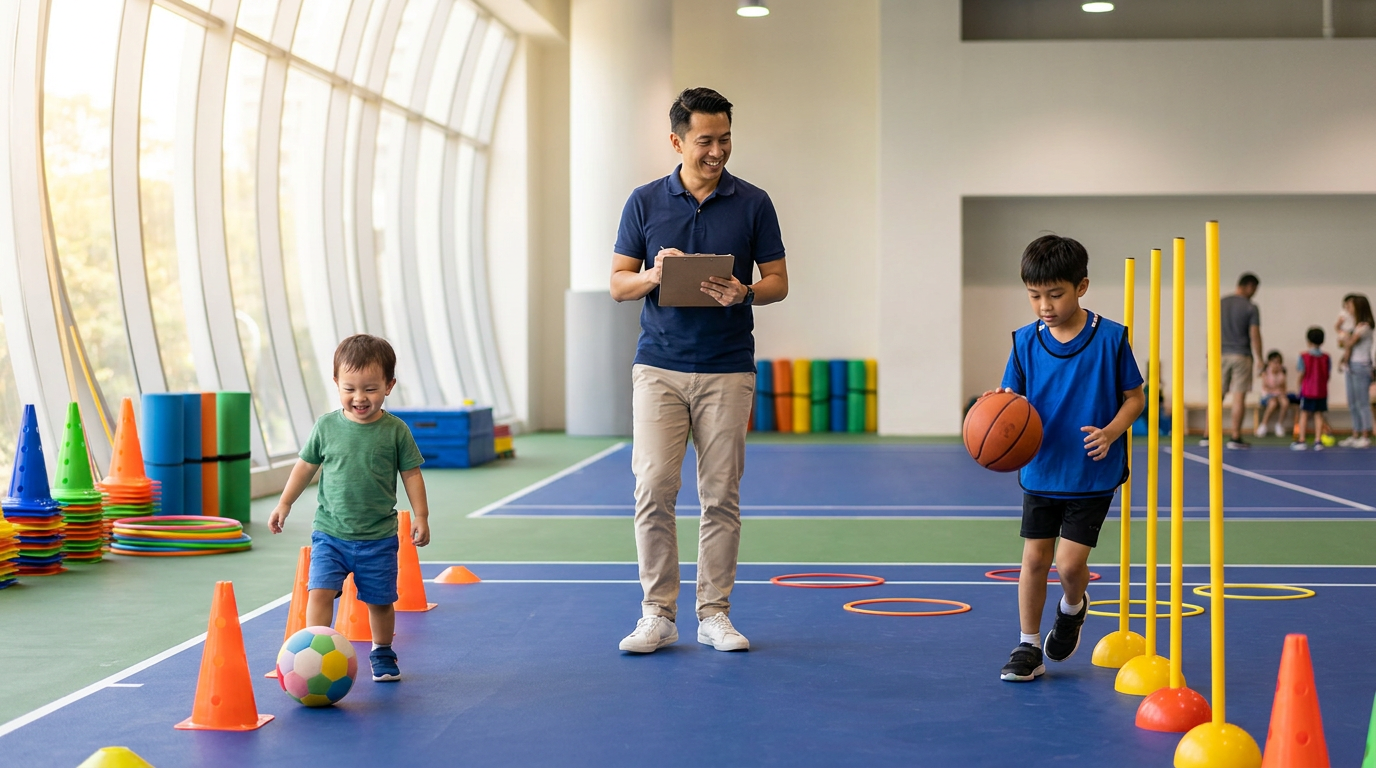
Skill stations or circuits form the core of most sessions. Rather than having all children practice the same skill simultaneously (which can lead to long wait times and wandering attention), effective programs rotate small groups through different activity stations. One group might practice dribbling through cones while another works on shooting at a low hoop and a third plays a passing game. This structure keeps everyone active and engaged while allowing coaches to provide individualized attention.
Modified games usually conclude sessions, allowing children to apply skills in a fun, low-pressure context. These aren't typically standard basketball games but rather creative variations that emphasize participation and skill use. Games might involve everyone scoring on the same hoop, accumulating team points rather than competing against each other, or incorporating multiple balls simultaneously to maximize touches and engagement.
Cool-down and reflection wrap up the session with a few minutes of slower activity and simple discussion about what children learned or enjoyed. This helps children transition out of high-energy play and reinforces key concepts from the session.
Expect your child to come home energized, possibly a bit sweaty, and hopefully enthusiastic about what they experienced. Don't be surprised if their description of activities differs from what you observed as young children often focus on the fun elements rather than the specific skills they practiced.
Essential Equipment for Young Basketball Players
One of basketball's advantages is its relatively minimal equipment requirements, but having the right gear in appropriate sizes makes a significant difference in children's early experiences.
Basketball size matters tremendously for young players. Adult-sized basketballs (size 7 for men, size 6 for women) are too large and heavy for children's developing hands. Recommended sizes include:
Size 3 (mini): Ages 4-8, circumference 22 inches, weight 10 oz
Size 5 (youth): Ages 9-11, circumference 27.5 inches, weight 17 oz
Size 6 (official women's): Ages 12+, circumference 28.5 inches, weight 20 oz
Using an appropriately sized ball allows children to actually grip, control, and shoot the ball properly rather than developing compensatory techniques to handle oversized equipment.
Footwear should prioritize fit and support over brand names or appearance. Basketball involves quick direction changes, jumping, and lateral movement, so shoes should have:
Good ankle support (mid-top or high-top styles)
Non-marking rubber soles with traction
Proper fit with about a thumb's width of space at the toe
Cushioning in the heel and forefoot
For very young children in introductory programs, regular athletic shoes often work fine. Specialized basketball shoes become more important as children advance to more intensive training and game play.
Clothing should allow full range of motion without being excessively baggy. Moisture-wicking materials help children stay comfortable during active play. Avoid clothing with drawstrings, loose jewelry, or anything that could pose a safety hazard during physical activity.
Water bottles are essential, as children need frequent hydration breaks during physical activity. Having a clearly labeled bottle prevents mix-ups and ensures your child drinks enough throughout the session.
Most programs provide all other necessary equipment including cones, hoops at various heights, and additional balls. Check with your specific program about what to bring versus what they supply.
Benefits of Starting Basketball Young
Introducing basketball to children offers advantages that extend well beyond the court, supporting development across multiple domains.
Physical development is the most obvious benefit. Basketball naturally builds cardiovascular endurance through continuous movement, develops coordination through dribbling and shooting, strengthens muscles through jumping and running, and improves agility through direction changes and defensive positioning. Unlike some youth sports that emphasize repetitive single movements, basketball engages the whole body in varied ways, contributing to well-rounded physical development.
Social skills flourish in team-based basketball settings. Children learn to communicate with teammates, cooperate toward shared goals, handle both success and disappointment, resolve conflicts with peers, and respect authority figures like coaches and referees. These social-emotional competencies transfer directly to school settings and other areas of life.
Cognitive development benefits from basketball's strategic elements. Even young children begin developing spatial reasoning (understanding court positioning), decision-making skills (choosing when to pass versus shoot), problem-solving abilities (figuring out how to get past a defender), and working memory (remembering plays and rules). The sport requires constant mental engagement, not just physical effort.
Character building happens naturally through sports participation. Basketball teaches persistence when skills don't come easily, resilience after mistakes or losses, discipline in attending practice and following instructions, and confidence as abilities improve. Quality programs intentionally emphasize these character elements, recognizing that developing good people matters more than developing elite athletes.
Lifelong activity foundation is perhaps the most valuable long-term benefit. Children who develop fundamental movement skills and positive associations with physical activity are more likely to remain active throughout their lives. Basketball specifically offers an accessible lifetime sport that can be played recreationally well into adulthood, either in organized leagues or casual pickup games.
Choosing the Right Basketball Program for Your Child
Not all youth basketball programs are created equal. Selecting the right one significantly impacts your child's experience and development.
Age-appropriate curriculum should be your first consideration. Quality programs differentiate instruction based on developmental stages rather than using a one-size-fits-all approach. For younger children, look for programs emphasizing play-based learning, fundamental movement skills, and variety rather than basketball-only focus. Multi-sport programs like Vivo Kids offer particular advantages for younger children by developing transferable athletic skills across different sports contexts, including basketball fundamentals within a broader framework of physical literacy.
Qualified coaching makes an enormous difference in children's learning and safety. Look for coaches with recognized certifications in youth sports coaching, experience working specifically with children (not just basketball expertise), understanding of child development principles, and commitment to positive coaching methods. The best coaches focus on effort and improvement rather than just outcomes, create inclusive environments where all skill levels feel welcome, and communicate clearly with both children and parents.
Program philosophy should align with your family's values and your child's needs. Some programs emphasize competition and winning from early ages, while others prioritize participation, skill development, and enjoyment. For most young children, programs focusing on fun, fundamental skills, character development, and inclusive participation produce better long-term outcomes than those emphasizing competitive success too early.
Class structure and size affect how much attention and practice time your child receives. Smaller class sizes (typically 8-12 children for younger ages) allow more individualized instruction and feedback. Programs using station-based or circuit formats keep children actively engaged rather than standing in long lines waiting for turns. Appropriate session lengths (30-45 minutes for younger children, 60 minutes for older elementary) match children's attention spans and physical endurance.
Safety measures should be clearly evident. This includes appropriate equipment for children's ages and sizes, adequate supervision ratios, clear emergency procedures, background-checked staff, and well-maintained facilities. Don't hesitate to ask about these elements when evaluating programs.
Trial sessions or observation opportunities offered by confident programs allow you to see their approach in action before committing. Take advantage of these opportunities to observe how coaches interact with children, whether your child seems engaged and happy, and how the program handles the inevitable challenges of working with young children.
Common Concerns Parents Have About Kids' Basketball
"My child isn't very coordinated. Will they struggle too much?" This is one of the most common concerns parents express, but it shouldn't prevent participation. Quality youth basketball programs accommodate varying skill levels and actually help children develop coordination through progressive, age-appropriate activities. Children don't need to arrive with advanced coordination; developing these skills is precisely what good programs do. If coordination is a significant concern, starting with a multi-sport program that builds fundamental movement skills across various activities might build confidence before specializing in basketball.
"Will basketball be too competitive and create pressure?" This depends entirely on the program you choose. Youth basketball exists on a spectrum from purely recreational and developmental to highly competitive. For younger children or those new to the sport, recreational programs focusing on skill development and enjoyment are most appropriate. These programs intentionally de-emphasize winning and losing, instead celebrating effort, improvement, and participation. As children grow older and express interest in more competitive play, you can gradually explore those options if desired.
"What if my child is smaller/taller than peers?" Basketball has space for children of all sizes, especially at younger ages when programs focus on skill development rather than competitive advantage. Smaller children often develop exceptional ball-handling and speed, while taller children may excel at rebounding and shooting. Quality coaches adapt instruction to each child's physical characteristics rather than expecting everyone to play the same way. Height becomes more relevant in competitive basketball at older ages, but even then, countless successful players have thrived despite being shorter than average for their position.
"How do I balance basketball with other activities?" This is an important consideration in our often over-scheduled culture. For younger children, limiting organized activities to one or two per season prevents burnout and allows time for unstructured play, family activities, and rest. Basketball doesn't need to be the only sport your child tries. In fact, multi-sport participation through elementary school typically produces better long-term athletic development than early specialization. Programs that incorporate basketball within a broader athletic development framework offer particular value for younger children.
"What if my child wants to quit after a few sessions?" It's natural for children to feel uncertain about new activities. If your child expresses reluctance after one or two sessions, encourage them to complete at least a few more before deciding. Often, initial hesitation fades as familiarity grows. However, if genuine disinterest or distress persists, it's okay to step back. Forcing continued participation can create negative associations with physical activity. You might try a different sport or return to basketball later when your child is developmentally ready or more interested.
"How much practice is appropriate at home?" For young children, basketball practice at home should be entirely optional and fun-focused. Having a ball available for them to play with when they choose supports skill development without creating pressure. As children grow older and express genuine interest in improving, you can support home practice while ensuring it remains enjoyable rather than feeling like forced work. The goal is fostering intrinsic motivation and love for the game, not checking off required practice hours.
Starting your child's basketball journey at the right time with appropriate expectations sets the foundation for a positive, enriching experience. While children as young as 3-4 can begin developing foundational skills through play-based activities, ages 6-8 typically represent the optimal window for structured basketball introduction. The key is matching activities to your child's developmental readiness rather than focusing solely on chronological age.
Remember that early basketball experiences should prioritize fun, fundamental skill development, and character building over competitive success. Whether your child becomes a lifelong basketball enthusiast or simply develops physical literacy and positive associations with sports, these early experiences shape their relationship with physical activity for years to come.
Look for programs with qualified coaches, age-appropriate curriculum, and philosophies that align with your values. For younger children especially, multi-sport approaches that develop transferable athletic skills often provide advantages over sport-specific training. Most importantly, follow your child's lead by supporting their interest and effort while keeping the experience enjoyable and pressure-free.
Ready to introduce your child to basketball and other foundational sports in a fun, developmentally appropriate environment? Vivo Kinetics offers award-winning programs designed specifically for children's physical, social, and emotional development. From multi-sport exploration for toddlers and preschoolers to specialized academies for older children, our expert coaches create nurturing environments where children build confidence, skills, and a lifelong love of active play. Discover how we can support your child's athletic journey today.
Comments