


Indoor Sports Activities for Kids: 25 Rainy Day Ideas to Keep Children Active
Table Of Contents
Why Indoor Sports Activities Matter for Children's Development
Ball-Based Indoor Sports Activities
Movement and Coordination Games
Balance and Strength-Building Activities
Creative Sports-Inspired Indoor Games
Team-Based Indoor Activities
Tips for Safe and Effective Indoor Play
Creating a Consistent Active Play Routine
When rain keeps children indoors, parents often face the challenge of channeling boundless energy into productive activities. Rather than defaulting to screen time, rainy days present a valuable opportunity to introduce indoor sports activities that support your child's physical, social, and emotional development. The key is transforming your living space into an engaging environment where movement meets fun.
Indoor sports activities for kids don't require elaborate equipment or gymnasium-sized spaces. With creativity and proper planning, you can help your children develop fundamental movement skills, improve coordination, build confidence, and maintain healthy active habits regardless of weather conditions. These activities lay the groundwork for lifelong fitness while keeping restlessness and boredom at bay.
This guide presents 25 indoor sports activities categorized by skill focus and age appropriateness. Whether you have toddlers exploring basic movements or older children ready for competitive challenges, you'll find activities that transform ordinary rainy days into extraordinary opportunities for growth and play.
Why Indoor Sports Activities Matter for Children's Development
Physical activity is essential for children's healthy development, and consistency matters more than location. When outdoor play isn't possible, indoor sports activities ensure children continue building the motor skills, strength, and coordination they need at every developmental stage.
Physical literacy develops through regular movement experiences. When children engage in varied indoor sports activities, they practice fundamental skills like running, jumping, throwing, catching, and balancing. These capabilities form the foundation for more complex athletic movements later in life. Research shows that children who develop strong physical literacy are more likely to remain active as teenagers and adults.
Beyond physical benefits, indoor sports activities support cognitive development. Following game rules, remembering sequences, solving movement challenges, and strategizing all engage young minds. Activities that combine physical and mental challenges help children develop executive function skills including focus, self-regulation, and problem-solving.
Social and emotional growth also flourishes through active play. Whether children are taking turns, cooperating toward shared goals, or learning to handle winning and losing gracefully, indoor sports activities create natural opportunities for character development. These experiences build resilience, confidence, and interpersonal skills that extend far beyond playtime.
Ball-Based Indoor Sports Activities
Ball activities develop hand-eye coordination, spatial awareness, and reaction time while offering endless entertainment value. These activities can be adapted for various age groups and skill levels.
1. Balloon Volleyball
Set up a "net" using string or tape stretched across your living room. Players use hands to keep a balloon from touching the ground on their side. This gentler version of volleyball is perfect for younger children (ages 3-6) who are developing tracking skills without the speed or impact concerns of traditional balls. Add challenge for older children by requiring specific body parts for hitting or reducing team sizes.
2. Indoor Basketball
Create basketball hoops using laundry baskets, buckets, or over-the-door organizers. Use soft foam balls or rolled-up socks as basketballs. Set up multiple "stations" at different heights and distances to practice shooting accuracy. This activity builds upper body strength, depth perception, and goal-setting skills as children challenge themselves to make increasingly difficult shots.
3. Hallway Bowling
Transform your hallway into a bowling alley using plastic bottles as pins and a soft ball. Children practice rolling technique, aim, and force control. Add complexity by assigning point values to different pins, creating patterns that must be knocked down in sequence, or introducing obstacle courses the ball must navigate. This activity works wonderfully for ages 4 and up.
4. Target Practice Throwing
Set up various targets using hula hoops hung from doorways, buckets placed at different distances, or taped circles on walls. Use bean bags, soft balls, or balled-up socks for safe indoor throwing. This activity develops throwing accuracy, distance estimation, and the ability to adjust force for different targets. Challenge older children to throw from farther distances or while incorporating movement.
5. Soccer Dribbling Course
Create an obstacle course using cushions, toys, or household items that children must dribble around using their feet. This confined-space version of soccer develops ball control, spatial awareness, and agility. For families exploring structured soccer development, programs like Vivo Kicks Academy offer age-appropriate coaching that builds these foundational skills alongside teamwork and sportsmanship.
Movement and Coordination Games
These activities emphasize whole-body movement, helping children develop gross motor skills, rhythm, and body awareness without requiring specialized equipment.
6. Animal Movement Game
Children move across the room imitating different animals: hop like a frog, waddle like a penguin, gallop like a horse, or slither like a snake. This imaginative activity builds strength, flexibility, and creativity while introducing varied movement patterns. Parents can create storytelling elements where children "travel through the jungle" or "visit the farm," making transitions between movements more engaging.
7. Freeze Dance Sports Edition
Play music while children perform specific sports movements: running in place, shooting baskets, swinging a pretend bat, or kicking motions. When music stops, they freeze in position. This game develops body control, listening skills, and introduces children to diverse sports movements in a playful context. Vary the sports movements to expose children to activities they might not otherwise encounter.
8. Indoor Obstacle Course
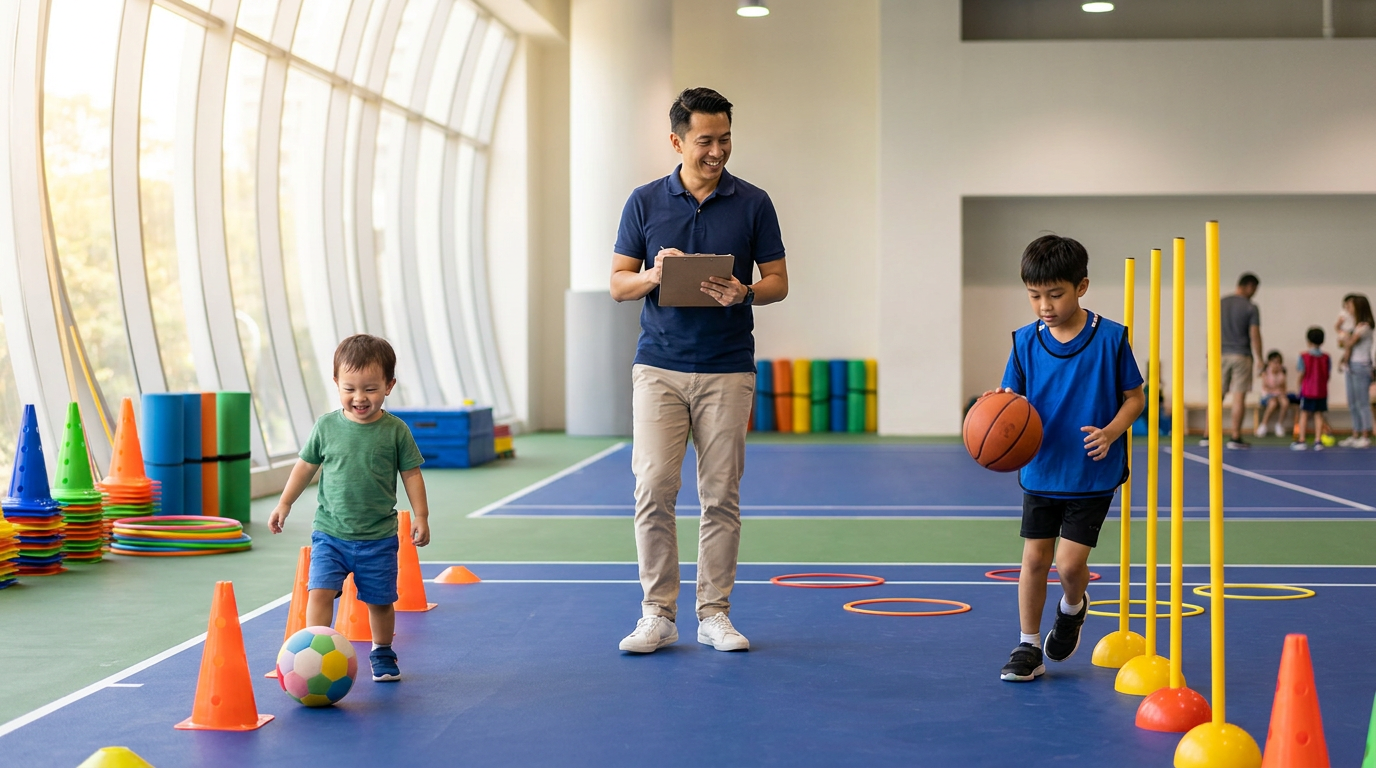
Design courses using furniture, cushions, tape lines, and household items. Include crawling under tables, jumping over pillows, balancing on tape lines, and weaving between chairs. Obstacle courses develop problem-solving, motor planning, and confidence as children navigate increasingly complex challenges. Time children to add competitive elements or encourage them to design their own courses to foster creativity.
9. Simon Says Sports Skills
This classic game takes on sports-specific movements: "Simon says touch your toes," "Simon says do three jumping jacks," or "Simon says pretend to swim." Beyond following directions and impulse control, this version introduces proper form for various athletic movements. Demonstrate correct technique and use this as teaching moments for body awareness.
10. Hallway Races
Organize races with different movement requirements: crab walk, bear crawl, hopping on one foot, backward running, or skipping. These variations challenge different muscle groups and movement patterns while adding excitement through friendly competition. Create relay races for multiple children or time trials for solo players working to beat personal records.
Balance and Strength-Building Activities
Developing core strength, stability, and balance creates a foundation for all physical activities while reducing injury risk in future athletic pursuits.
11. Tape Line Balance Beam
Create "balance beams" on the floor using painter's tape in straight lines, curves, or zigzag patterns. Children walk heel-to-toe along lines, attempting to stay on course. Progress to walking backward, sideways, or while balancing objects on their heads. This simple activity significantly improves proprioception and balance with zero equipment cost.
12. Pillow Path
Scatter cushions and pillows across the floor as "stepping stones." Children jump from pillow to pillow without touching the floor (which can be "lava," "water," or whatever imaginative scenario engages them). This activity builds leg strength, spatial judgment, and landing technique while remaining gentle on joints.
13. Yoga Poses for Kids
Introduce child-friendly yoga poses named after animals and objects: downward dog, cat-cow, tree pose, or cobra. Hold each pose for increasing durations to build strength and flexibility. Yoga improves body awareness, breathing control, and provides calming benefits alongside physical development. Create stories that flow from one pose to another for sustained engagement.
14. Wall Sits and Planks Challenge
For older children (ages 7+), introduce simple strength-building exercises. Wall sits develop leg strength and mental endurance, while planks build core stability. Start with short durations (10-15 seconds) and gradually increase. Make it engaging by timing together, creating charts to track progress, or incorporating these into larger game sequences.
15. Indoor Hopscotch
Use tape to create hopscotch patterns on the floor. This traditional game develops balance, coordination, and the ability to hop on one foot. Variations include alphabet hopscotch (jumping to spell words), math hopscotch (solving problems at each square), or creating unique patterns that require different jumping sequences.
Creative Sports-Inspired Indoor Games
These activities blend traditional sports concepts with imaginative play, making them particularly engaging for younger children while still building athletic skills.
16. Scavenger Hunt Races
Create lists of items children must find throughout the house, with physical challenges required between items: five jumping jacks before collecting the next item, or running in place for 30 seconds. This combines cognitive challenges with physical activity bursts, maintaining engagement while ensuring continued movement.
17. Indoor Hockey
Use pool noodles as hockey sticks and a soft ball or balloon as the puck. Set up goals using chairs or laundry baskets. Children practice hand-eye coordination, spatial awareness, and if playing with others, teamwork and strategy. This adapted version allows hockey skill development without the equipment requirements or safety concerns of traditional hockey.
18. Sock Sliding Races
On smooth floors, children wear socks and practice controlled sliding. Create racing courses, target destinations, or choreography that requires stopping at specific points. This develops leg strength, balance, and body control while feeling more like play than exercise. Ensure adequate space free from sharp corners or hard furniture edges.
19. Indoor Tennis Practice
Balloon tennis uses paper plates taped to popsicle sticks or paint stirrers as rackets. Children hit balloons back and forth, either cooperatively (keeping the balloon aloft together) or competitively (over a net). This builds hand-eye coordination, reaction time, and racket sport fundamentals in a slow-motion, safe format perfect for beginners.
20. Treasure Map Fitness Adventure
Create a treasure map with stations marking different physical activities. Children follow the map, completing challenges at each location: 10 toe touches at the kitchen, running in place for 30 seconds in the hallway, or three balance poses in the bedroom. This narrative-driven approach makes exercise feel like adventure, particularly engaging for ages 4-8.
Team-Based Indoor Activities
When multiple children are present, team activities teach cooperation, communication, and healthy competition while keeping everyone active.
21. Relay Races
Set up relay courses where teams compete to complete tasks: carrying objects balanced on heads, hopping to a destination and back, or completing a sequence of movements. Relay races teach teamwork, encourage peers, and create natural turn-taking opportunities. Rotate team compositions to ensure varied social interactions.
22. Cooperative Building Challenges
Combine physical activity with teamwork by challenging groups to build structures using cushions, boxes, or blocks while incorporating active elements: only one person can touch materials at a time (requiring constant movement between team members), or builders must perform jumping jacks before placing each piece. These activities develop collaboration alongside physical literacy.
23. Indoor Tag Variations
Adapt tag for indoor spaces with variations like freeze tag, tunnel tag (frozen players create tunnels others crawl through), or shadow tag (tagging shadows instead of bodies). These games develop cardiovascular fitness, agility, and strategic thinking. Establish clear boundaries and rules about gentle tagging to ensure safety in confined spaces.
24. Passing Challenges
Teams stand in circles or lines, passing balls using different techniques: overhead passes, bounce passes, rolling between legs, or using only non-dominant hands. Time how quickly teams complete sequences or how many passes they achieve without dropping the ball. This builds specific sports skills while emphasizing accuracy and teamwork.
25. Group Choreography
Children work together to create movement routines combining sports skills: three basketball shooting motions, followed by soccer kicks, then jumping jacks. Groups perform routines for family members. This activity blends creativity, memory, cooperation, and physical literacy while giving children ownership over their play experience.
Tips for Safe and Effective Indoor Play
Maximizing the benefits of indoor sports activities requires thoughtful setup and supervision to ensure safety and engagement.
Creating appropriate space is fundamental. Clear furniture and obstacles from play areas, remove breakable items, and establish clear boundaries for where activities occur. Consider noise levels in apartment settings and choose activities accordingly. Soft mats or rugs provide cushioning for jumping activities and protect floors from damage.
Selecting age-appropriate activities ensures children experience success and challenge in appropriate balance. Younger children (ages 2-4) benefit from basic movement exploration and simple games with few rules. Preschoolers (ages 4-6) can handle more complex instructions and enjoy imaginative elements integrated with movement. School-age children (ages 6+) appreciate competition, skill progression, and activities requiring strategy alongside physical ability.
For families seeking structured, age-appropriate programming, the Vivo Kids multi-sports programme offers expert-designed curriculum that introduces children ages 2-6 to fundamental movement skills through play-based learning. This professional approach ensures proper skill development while maintaining the fun, exploratory nature children need at these crucial developmental stages.
Safety equipment matters even indoors. Use soft balls, foam equipment, or household alternatives rather than hard sports equipment. Ensure children wear appropriate footwear (or socks on appropriate surfaces) to prevent slipping. Supervise activities involving jumping, climbing, or balance challenges, particularly with younger children.
Hydration and breaks maintain both safety and engagement. Children should have water available and take rest periods between intense activities. Watch for signs of fatigue or frustration, adjusting difficulty or switching activities to maintain positive experiences. Indoor play can be surprisingly intense, sometimes exceeding outdoor activity levels.
Creating a Consistent Active Play Routine
Transforming rainy day activities from occasional entertainment to developmental tools requires consistency and intentionality.
Establishing daily movement time helps children develop healthy habits regardless of weather. Designate specific times for active play, treating these as essential as meal times or bedtime routines. Consistency helps children anticipate and look forward to movement rather than viewing it as punishment or forced exercise.
Rotating activities maintains interest and ensures balanced skill development. Rather than repeating favorites exclusively, introduce new challenges regularly while revisiting previous activities to demonstrate progress. This approach prevents boredom while building diverse physical literacy.
Involving children in planning increases engagement and ownership. Let children choose activities from options, design obstacle courses, or suggest rule variations. This autonomy builds decision-making skills while ensuring activities match their interests and energy levels.
Tracking progress motivates continued participation. Simple charts showing completed activities, skills mastered, or personal records achieved help children visualize improvement. Celebrate milestones without creating excessive pressure, emphasizing personal growth over comparison to others.
Balancing structure and free play provides comprehensive development. While organized activities teach specific skills and rules, unstructured active play allows creativity, self-directed challenge, and intrinsic motivation to flourish. Children need both types of movement experiences.
Parents seeking expert guidance in creating comprehensive active play experiences can explore programs at Vivo Kinetics, where award-winning coaching combines structured skill development with play-based learning. Their approach recognizes that physical development intertwines with social, emotional, and intellectual growth, creating holistic experiences that extend far beyond simple exercise.
Rainy days need not disrupt children's physical development or energy release. With creativity, preparation, and understanding of developmental needs, indoor sports activities become powerful tools for building healthy, confident, capable children. The activities presented here offer starting points for families to discover what resonates with their children's interests, abilities, and available space. Whether implementing these ideas independently or complementing them with professional programs, the goal remains consistent: fostering lifelong love of movement through joyful, age-appropriate active play.
Indoor sports activities for kids transform rainy days from challenges into opportunities. The 25 activities presented here span skill levels, space requirements, and interests, ensuring every family can find options that work for their unique circumstances. From simple balloon volleyball to complex obstacle courses, each activity contributes to your child's physical literacy, confidence, and overall development.
Remember that consistency matters more than perfection. Even 20-30 minutes of daily active play significantly impacts children's health, mood, and development. Start with activities matching your child's current abilities, gradually introducing new challenges as skills develop. The goal isn't creating elite athletes but fostering children who view movement as enjoyable, natural, and rewarding.
As you implement these ideas, observe what energizes and engages your children. Their enthusiasm guides you toward activities that will sustain long-term participation. Some children thrive on competition, others prefer cooperative play, and many enjoy variety. Tailoring your approach to individual preferences creates positive associations with physical activity that extend throughout life.
Rainy days provide unique opportunities for focused, intentional play in controlled environments. Embrace these indoor sessions as valuable complements to outdoor activity, not inferior substitutes. The skills developed, memories created, and habits formed during indoor sports activities shape healthy, active futures for your children.
Looking for expert-guided programs that develop your child's physical literacy through play-based learning? Discover how Vivo Kinetics combines fun and skill development in award-winning multi-sport and soccer programs designed specifically for children's developmental stages. Give your child the foundation for lifelong active living in a nurturing, engaging environment.
Comments