


Physical Literacy for Kids Singapore: Complete Development Guide for Parents
- Vivo Kinetics
- Feb 5
- 13 min read
Table Of Contents
What is Physical Literacy and Why It Matters for Singapore Children
The Four Pillars of Physical Literacy Development
Age-Specific Physical Literacy Milestones
Toddlers (20 Months to 2 Years): Foundation Building
Preschoolers (2 to 6 Years): Skill Development Phase
Primary School Children (6 to 12 Years): Refinement and Specialization
Physical Literacy Challenges Unique to Singapore
How to Support Physical Literacy at Home
The Role of Structured Programmes in Physical Literacy
Assessing Your Child's Physical Literacy Development
Creating a Lifelong Foundation for Active Living
Every parent wants their child to thrive, not just academically but in every aspect of life. Yet in Singapore's achievement-oriented environment, one crucial area of development often takes a backseat: physical literacy. While we diligently teach our children to read books and write sentences, are we equally committed to helping them "read" their bodies and "write" their movement stories?
Physical literacy goes far beyond just being active or playing sports. It's the foundation that enables your child to move confidently and competently in a wide variety of physical activities, building not just physical capabilities but also cognitive skills, emotional resilience, and social confidence. Research shows that 90 percent of brain development occurs by age five, making the early years absolutely critical for establishing movement patterns that will serve your child throughout their entire life.
For Singapore parents navigating limited outdoor spaces, academic pressures, and busy schedules, understanding and prioritizing physical literacy can feel overwhelming. This comprehensive guide breaks down everything you need to know about developing physical literacy in your child, from toddlerhood through primary school years, with practical strategies tailored specifically for families living in Singapore's unique context.
What is Physical Literacy and Why It Matters for Singapore Children
Physical literacy is best understood as your child's ability to move with confidence and competence across a wide range of physical activities and environments. Just as traditional literacy enables a child to read any book and write any essay, physical literacy equips them with the fundamental movement skills needed to participate in any sport, navigate daily physical challenges, and maintain an active lifestyle throughout their lives.
This concept encompasses four interconnected dimensions. Your child needs the physical competence to perform various movements, the knowledge and understanding of how and why to move, the motivation and confidence to engage in physical activities, and the commitment to make physical activity a regular part of their life. When these elements work together, they create a solid foundation for lifelong health and wellbeing.
In Singapore's context, physical literacy takes on particular significance. Our urban environment, with its limited green spaces and emphasis on academic achievement, creates unique challenges for movement development. Children spend considerable time indoors, often engaged with screens rather than exploring physical capabilities. The competitive education system can inadvertently push structured physical activity to the margins of daily life, treating it as optional rather than essential.
The consequences of underdeveloped physical literacy extend well beyond missing out on sports. Children who lack fundamental movement skills often experience lower self-esteem, reduced social opportunities, and decreased cognitive performance. They're more likely to avoid physical activity as they grow older, setting the stage for sedentary lifestyles and associated health challenges. Conversely, physically literate children demonstrate better concentration, improved emotional regulation, stronger social skills, and enhanced academic performance.
The Four Pillars of Physical Literacy Development
Understanding the core components of physical literacy helps parents recognize what they're working toward and how different activities contribute to overall development.
Movement Competence forms the first pillar, encompassing the fundamental movement skills that serve as building blocks for all physical activity. These include locomotor skills like running, jumping, and skipping; stability skills such as balancing, twisting, and landing; and object control skills including throwing, catching, and kicking. A child with strong movement competence can transfer these skills across different activities and environments, adapting movements as situations require.
Knowledge and Understanding represents the cognitive dimension of physical literacy. This involves your child learning the "how" and "why" behind movements: understanding how their body moves through space, recognizing which muscles are working during different activities, knowing safety principles, and grasping basic concepts like force, speed, and direction. This pillar transforms random movement into purposeful, intelligent physical activity.
Motivation and Confidence addresses the psychological and emotional aspects of movement. Children need to feel capable and enjoy physical activity to sustain engagement over time. This pillar develops through positive experiences, age-appropriate challenges, supportive feedback, and opportunities for success. When children feel confident in their physical abilities, they're more likely to try new activities and persist through initial difficulties.
Engagement and Interaction focuses on making physical activity a valued, regular part of life. This includes developing the social skills for team play and group activities, understanding the health benefits of movement, and building habits that prioritize active living. Children who develop this pillar view physical activity not as a chore but as an enjoyable, essential part of their identity.
Age-Specific Physical Literacy Milestones
Physical literacy develops progressively, with each stage building upon the previous one. Understanding what to expect and encourage at each age helps parents provide appropriate support and recognize when children might benefit from additional structured guidance.
Toddlers (20 Months to 2 Years): Foundation Building
The toddler years represent a critical window for establishing the foundational movement patterns that will support all future physical development. During this stage, children are naturally curious explorers, using movement to learn about their world and their bodies' capabilities.
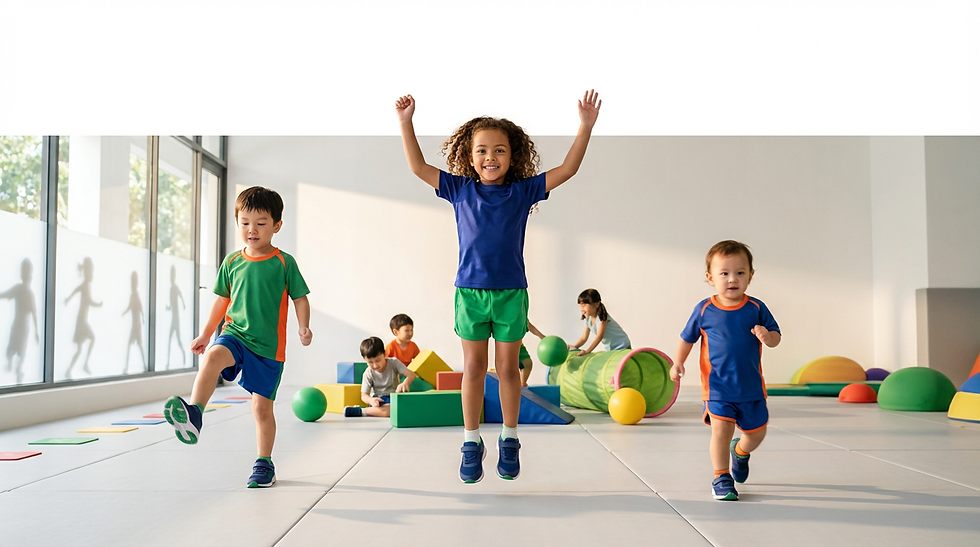
At this age, your child is refining basic locomotor skills: walking becomes more stable and confident, early running emerges with characteristic enthusiasm if not grace, and climbing becomes a favorite activity. They're also developing stability through activities like squatting to pick up objects, standing on one foot briefly, and attempting to jump with both feet. Object interaction is usually characterized by rolling balls, carrying toys, and beginning to throw (though accuracy is minimal).
Parents can support development during this stage through activities that encourage exploration in safe environments. Music and movement sessions, which combine rhythm, sensory experiences, and parent-child bonding, are particularly valuable. Creating obstacle courses with cushions, boxes, and furniture encourages problem-solving through movement. Simple games like "follow the leader" or dancing to different tempos help toddlers experience varied movement patterns in enjoyable contexts.
It's important to remember that toddlers have short attention spans and learn through repetition with variation. The goal isn't perfecting skills but rather exposing children to diverse movement experiences that build neural pathways and physical confidence.
Preschoolers (2 to 6 Years): Skill Development Phase
The preschool years represent the golden window for fundamental movement skill development. During this stage, children transition from basic movements to more refined, coordinated actions. Their improved balance, coordination, and body awareness enable increasingly complex physical activities.
By age three to four, most children can run smoothly with coordinated arm movements, jump forward and over small objects, balance on one foot for several seconds, catch a large ball with arms extended, and pedal a tricycle. As they approach five and six years old, capabilities expand to include skipping, hopping on one foot repeatedly, throwing with increased accuracy and force, kicking a moving ball, and beginning to understand basic game rules and strategies.
This is the ideal time to introduce multi-sport programmes that expose children to various activities without pressure for specialization. Through play-based approaches, children can develop fundamental skills across categories: ball skills through games involving throwing, catching, kicking, and striking; body management skills through activities requiring balance, coordination, and spatial awareness; and movement skills through running games, jumping challenges, and locomotor activities.
The Vivo Kids multi-sports programme specifically addresses this developmental stage by providing structured yet playful environments where children aged 2 to 6 can explore multiple sports and movement patterns. This approach prevents early specialization while building a broad foundation of physical competencies. The focus remains on enjoyment, exploration, and building confidence rather than competition or performance.
Character development naturally intertwines with physical skill development during this stage. As children navigate challenges, take turns, win and lose games, and work within groups, they're simultaneously developing resilience, cooperation, and emotional regulation alongside their physical capabilities.
Primary School Children (6 to 12 Years): Refinement and Specialization
As children enter primary school, physical literacy development shifts toward refining fundamental skills, combining movements into more complex sequences, and potentially beginning to specialize in preferred activities. However, maintaining variety remains important even as interests narrow.
Children in this age range typically demonstrate mature fundamental movement patterns, can learn and apply basic sports strategies, show improved hand-eye and foot-eye coordination, have sufficient strength and endurance for sustained activities, and begin developing sports-specific skills. Their cognitive development also allows them to understand more complex rules, think tactically, and self-assess their performance.
For children showing interest in specific sports, this is an appropriate time to increase focus while still maintaining a foundation of varied physical activity. A child passionate about soccer, for instance, still benefits from swimming, gymnastics, or athletics that develop different movement patterns and physical capacities.
Football academies designed for this age group, like the Vivo Kicks Academy, provide age-appropriate skill development within a specialized sport while maintaining emphasis on holistic growth. Quality programmes at this level should still prioritize enjoyment, skill development, and character building over competitive outcomes, ensuring that specialization enhances rather than limits overall physical literacy.
During these years, children also benefit from understanding the "why" behind physical activity. Discussions about fitness, health, body systems, and the connection between physical activity and wellbeing help develop the knowledge component of physical literacy. Children who understand that being active makes them stronger, helps them think more clearly, and improves their mood are more likely to maintain active lifestyles into adolescence and adulthood.
Physical Literacy Challenges Unique to Singapore
Singapore families face distinct challenges when it comes to developing children's physical literacy. Understanding these obstacles helps parents address them proactively rather than feeling defeated by circumstances beyond their control.
Space constraints significantly impact movement opportunities. Many Singaporean families live in apartments with limited indoor space for active play, while public outdoor areas may be crowded or not designed with children's varied movement needs in mind. The tropical climate, with its heat and frequent rain, further limits comfortable outdoor activity times, particularly during midday hours.
Academic pressure creates perhaps the most significant barrier. From preschool onward, Singapore children often face packed schedules filled with academic enrichment, leaving little time or energy for physical activity. Parents may consciously or unconsciously prioritize tuition and academic pursuits over sports and movement, viewing physical activity as less essential to future success.
Screen time has become increasingly pervasive, with digital devices providing easy entertainment that requires minimal physical effort. The convenience and engagement of screens can make physical activity seem less appealing by comparison, particularly for children who haven't developed strong movement competencies and confidence.
Limited parental engagement in physical activity sometimes compounds these challenges. Parents who were not encouraged to develop their own physical literacy may feel ill-equipped to guide their children's development in this area. Additionally, if parents are not regularly active themselves, children receive implicit messages that physical activity is not a priority.
Despite these challenges, many Singapore families successfully prioritize physical literacy by being intentional and creative. Utilizing community facilities like sport centers and playgrounds during cooler morning and evening hours, building active time into daily routines rather than treating it as optional, choosing programmes that efficiently develop multiple skills in limited time, and modeling active lifestyles as families all help overcome environmental and cultural barriers.
How to Support Physical Literacy at Home
Parents play the most crucial role in developing children's physical literacy. While structured programmes provide valuable instruction and social experiences, the daily home environment shapes habits, attitudes, and opportunities that ultimately determine whether children become physically literate.
Creating movement-friendly spaces, even in small apartments, makes regular physical activity more likely. Designating areas for active play, keeping simple equipment accessible (balls, jump ropes, bean bags), and establishing clear expectations about indoor and outdoor play times help normalize movement as part of daily life.
Incorporating movement into daily routines ensures consistency without requiring major schedule changes. Simple strategies include:
Taking stairs instead of elevators whenever possible, turning it into a game by counting steps or racing
Walking to nearby destinations rather than driving, letting children lead the way or navigate
Having movement breaks between homework or screen time sessions
Involving children in active household tasks like carrying groceries or washing cars
Playing active games before bedtime to help children expend energy and sleep better
Offering varied experiences prevents boredom and develops well-rounded capabilities. Rotating between activities that emphasize different skills ensures comprehensive development: ball games for object control, playground equipment for climbing and balancing, swimming for water confidence and full-body coordination, dance or martial arts for body awareness and control, and nature walks or hikes for endurance and environmental exploration.
Parental encouragement makes an enormous difference in children's willingness to persist through challenges and try new activities. Focus feedback on effort rather than outcomes, celebrate small improvements and milestones, avoid comparing children to siblings or peers, ask about what children enjoyed rather than who won or lost, and share your own physical activity experiences, including challenges and how you overcame them.
Most importantly, model the attitudes and behaviors you want to see. Children whose parents are regularly active, speak positively about physical activity, and prioritize movement in family life develop similar values and habits. Family active time, whether kicking a ball at the park, cycling around the neighborhood, or dancing in the living room, creates positive associations with movement that last a lifetime.
The Role of Structured Programmes in Physical Literacy
While home-based activities form the foundation of physical literacy development, structured programmes provide significant additional value through expert instruction, appropriate progressions, social learning opportunities, and comprehensive skill development that individual parents may find challenging to replicate.
Quality children's sports programmes offer several distinct advantages. Expert coaches trained in child development understand age-appropriate expectations and can identify and address movement deficiencies that parents might miss. Structured curricula ensure systematic skill development rather than random exposure to activities. Peer interaction provides social learning opportunities and motivation that solo or family-based activities cannot match. Safe, appropriate environments with proper equipment support optimal development while minimizing injury risk.
When evaluating programmes for your child, consider several key factors. Age-appropriate approaches that match activities and expectations to developmental stages ensure children experience success rather than frustration. Play-based methodologies keep young children engaged while effectively building skills through enjoyable experiences. Multi-sport exposure during early years prevents premature specialization and builds comprehensive movement foundations. Emphasis on character development alongside physical skills supports holistic growth. Qualified, enthusiastic coaches who genuinely enjoy working with children create positive environments where kids want to participate.
Vivo Kinetics exemplifies these principles through programmes designed specifically around children's developmental needs at different stages. For toddlers and parents, sensory exploration and music-based movement establish foundations in nurturing, bonding contexts. Preschoolers benefit from multi-sport exposure that develops fundamental movement skills across diverse activities without pressure to specialize. Primary-age children ready for more focused skill development can pursue specific interests while maintaining emphasis on enjoyment, character growth, and comprehensive athletic development.
Structured programmes work best when they complement rather than replace family-based physical activity. The combination of expert instruction, peer interaction, and systematic skill development from quality programmes with the daily movement opportunities, parental modeling, and positive associations built at home creates the ideal environment for developing physically literate children.
Assessing Your Child's Physical Literacy Development
Parents often wonder whether their child is developing appropriately or might benefit from additional support. While every child develops at their own pace, understanding general indicators of physical literacy at different stages helps identify potential areas for attention.
For toddlers and young preschoolers, look for willingness to explore new movements and environments, ability to perform basic movements like walking, running, and jumping (even if clumsily), interest in balls and moving objects, balance sufficient for age-appropriate activities, and enthusiasm for movement-based play and games.
In older preschoolers (ages 4-6), indicators include coordinated running with arm movements, ability to catch large balls and kick toward targets, balancing on one foot for several seconds, enthusiasm for playground equipment and varied activities, and beginning ability to follow simple game rules and take turns.
Primary school children demonstrating good physical literacy show competence in fundamental movements across categories (locomotor, stability, object control), ability to combine movements into sequences, willingness to try new physical activities, appropriate fitness for age (strength, flexibility, endurance), understanding of basic strategies in games and sports, and positive attitude toward physical activity and physical education.
Concern may be warranted if your child consistently avoids physical activity, frequently falls or seems uncoordinated beyond typical learning curves, shows significant reluctance to try new movements or activities, expresses negative feelings about their physical capabilities, or demonstrates marked differences from age-peers in basic movement competencies.
If you notice these signs, first consider whether your child has had sufficient opportunities and encouragement for physical development. Many apparent deficiencies simply reflect limited exposure rather than underlying issues. Consulting with pediatricians, physical education teachers, or children's movement specialists can help determine whether intervention is needed. In many cases, increased opportunities for play and movement, combined with positive encouragement and possibly structured instruction from quality programmes, successfully address concerns.
Remember that physical literacy development is a journey, not a destination, and children progress at different rates. The goal is not producing elite athletes but rather raising children who move confidently, enjoy physical activity, and will maintain active lifestyles throughout their lives.
Creating a Lifelong Foundation for Active Living
The ultimate goal of physical literacy development extends far beyond childhood. By helping your child develop comprehensive movement skills, positive attitudes toward physical activity, and habits that prioritize active living, you're setting the foundation for a healthy, vibrant adult life.
Physically literate children are significantly more likely to remain active as teenagers and adults, maintaining the health benefits of regular physical activity throughout their lives. They're better equipped to try new activities and sports as interests evolve, preventing the common pattern of becoming sedentary when childhood sports end. The confidence and competence developed through physical literacy transfer to other areas of life, supporting overall wellbeing and resilience.
In Singapore's context, where lifestyle diseases related to sedentary living are increasingly prevalent, raising physically literate children takes on public health significance. The habits and attitudes developed in childhood typically persist into adulthood, meaning today's active children become tomorrow's healthy adults.
As parents, the choices you make now about prioritizing movement, providing varied opportunities, offering encouragement, and modeling active lifestyles will influence your child's relationship with physical activity for decades to come. Despite the very real challenges of space, time, and academic pressure that Singapore families face, investing in your child's physical literacy represents one of the most valuable gifts you can provide.
Starting with age-appropriate activities, progressing through systematic skill development, maintaining variety and enjoyment, and building confidence through positive experiences creates the foundation every child needs to become physically literate. Whether through family activities, community facilities, or structured programmes designed around children's developmental needs, the opportunities exist for every Singapore child to develop the movement competencies and love of physical activity that will serve them throughout their entire lives.
Physical literacy represents far more than just the ability to play sports or pass physical education classes. It's a fundamental aspect of your child's development that influences physical health, cognitive performance, emotional wellbeing, and social confidence. For Singapore children growing up in an environment that presents unique challenges to movement development, intentional parental support becomes even more critical.
By understanding the components of physical literacy, recognizing age-appropriate milestones, providing varied movement opportunities at home, and complementing family activities with quality structured programmes when appropriate, you can ensure your child develops the competencies and confidence needed for lifelong active living. The early years represent a precious window of opportunity when fundamental movement patterns are established and attitudes toward physical activity take shape.
Whether your child is a toddler just beginning to explore their movement capabilities or a primary schooler refining skills and discovering passions, the investment you make now in their physical literacy will pay dividends throughout their entire life. In a world increasingly characterized by sedentary lifestyles and digital entertainment, raising physically literate children who move confidently, play enthusiastically, and value active living is one of the greatest gifts you can provide.
Give Your Child the Gift of Physical Literacy
Ready to support your child's physical literacy development with expert guidance and age-appropriate programming? Vivo Kinetics offers award-winning programmes designed specifically for Singapore children from 20 months to 12 years, combining play-based learning with systematic skill development in safe, nurturing environments.
From sensory exploration for toddlers to multi-sport foundations for preschoolers and specialized skill development for primary-age children, our expert coaches create engaging experiences that build not just physical competencies but also confidence, character, and a lifelong love of movement.
Explore Vivo Kinetics Programmes and Start Your Child's Active Journey Today


Comments