


Preschool Sports Program Singapore: Complete Guide for Ages 3-6
- Vivo Kinetics
- 6 days ago
- 12 min read
Table Of Contents
Why Sports Matter for Preschoolers
Physical Development Benefits
Cognitive and Social Growth
What Makes a Quality Preschool Sports Program
Age-Appropriate Curriculum Design
Types of Preschool Sports Programs in Singapore
Choosing the Right Program for Your Child
What to Expect in Your Child's First Classes
Supporting Your Child's Sports Journey at Home
When your preschooler bounces with endless energy, climbing furniture and racing through hallways, you're witnessing more than just childhood exuberance. You're seeing their innate need for movement, exploration, and physical challenge. Between ages 3 and 6, children experience critical developmental windows where structured physical activity can profoundly shape their motor skills, confidence, and lifelong relationship with fitness.
For Singapore parents navigating busy schedules and competitive academic pressures, finding the right balance between early learning and active play presents a unique challenge. Preschool sports programs offer a solution that goes far beyond simply burning off excess energy. These specialized programs provide age-appropriate physical education that builds fundamental movement skills, fosters social development, and cultivates character traits like perseverance and teamwork.
This comprehensive guide explores everything you need to know about preschool sports programs in Singapore. We'll examine the developmental benefits specific to ages 3-6, decode what separates exceptional programs from average ones, and provide practical guidance for selecting the perfect fit for your child's personality and needs. Whether you're considering your child's first structured activity or looking to enhance their current routine, you'll find expert insights to make confident, informed decisions.
Why Sports Matter for Preschoolers
The preschool years represent a golden opportunity for physical development that parents simply cannot afford to miss. During this period, your child's brain forms neural pathways at an unprecedented rate, with physical activity serving as a catalyst for cognitive, emotional, and social growth. Research consistently demonstrates that children who engage in regular structured movement during early childhood develop stronger foundational skills that benefit them throughout their academic and personal lives.
In Singapore's increasingly sedentary environment, where screen time competes with active play, establishing healthy movement habits early becomes even more critical. Preschool sports programs counteract sedentary tendencies while teaching children that physical activity can be joyful, social, and rewarding. These positive early experiences create lasting associations that encourage lifelong fitness habits.
Beyond the immediate joy of play, structured sports programs introduce preschoolers to concepts like following instructions, taking turns, and respecting boundaries. These lessons occur naturally within the context of games and activities, making them more memorable and meaningful than abstract discussions. Your child learns valuable life skills while having too much fun to realize they're being educated.
Physical Development Benefits
Preschoolers who participate in quality sports programs develop fundamental movement skills (FMS) that form the foundation for all future physical activities. These skills include locomotor movements like running, jumping, hopping, and galloping, as well as object control skills such as throwing, catching, and kicking. Mastering these basics during the critical ages of 3-6 ensures your child can confidently participate in sports and recreational activities as they grow older.
Gross motor development accelerates dramatically when children engage in varied physical challenges. Their large muscle groups strengthen, coordination improves, and spatial awareness expands as they navigate obstacle courses, balance on different surfaces, and manipulate balls and equipment. This physical literacy translates directly to improved performance in everyday activities from climbing playground equipment to riding bicycles.
Fine motor skills also benefit from preschool sports programs, particularly through activities that require precise movements and hand-eye coordination. Gripping balls of different sizes, manipulating sports equipment, and performing targeted actions all contribute to the dexterity needed for writing, drawing, and self-care tasks. The connection between physical activity and academic readiness becomes evident when children who've developed strong motor skills demonstrate better pencil control and desk-based focus.
Body awareness and proprioception develop as preschoolers learn to control their movements with increasing precision. They begin understanding where their body exists in space, how much force different actions require, and how to adjust their movements based on environmental feedback. This kinesthetic intelligence reduces injury risk and builds the confidence necessary to attempt new physical challenges without excessive fear or hesitation.
Cognitive and Social Growth
Executive function skills receive substantial boosts from preschool sports participation. Activities that require children to follow multi-step instructions, remember sequences, switch between different movements, and inhibit impulses directly strengthen the prefrontal cortex regions responsible for planning, working memory, and self-regulation. These cognitive abilities predict academic success more reliably than early literacy or numeracy skills.
Sports programs create natural opportunities for social-emotional learning in ways that classroom settings cannot replicate. Your child practices sharing equipment, waiting for turns, celebrating peers' successes, and managing disappointment when activities don't go as planned. They learn to read social cues, cooperate toward common goals, and navigate the complex dynamics of group interactions. These experiences build emotional intelligence that serves them in every future relationship and collaborative situation.
The structured challenge of age-appropriate sports activities teaches resilience and growth mindset. When your preschooler attempts to kick a ball and misses, then tries again with encouragement and eventually succeeds, they internalize the powerful lesson that effort leads to improvement. This understanding becomes a core belief that challenges are opportunities rather than threats, fostering the perseverance needed to tackle difficult academic, social, and personal obstacles throughout life.
Language development accelerates in sports environments where children must listen to instructions, ask questions, describe their actions, and communicate with peers and coaches. The vocabulary of movement, spatial relationships, and emotional expression expands naturally through repeated exposure and practice. Bilingual programs offer additional cognitive benefits by strengthening neural pathways associated with language processing and cognitive flexibility.
What Makes a Quality Preschool Sports Program
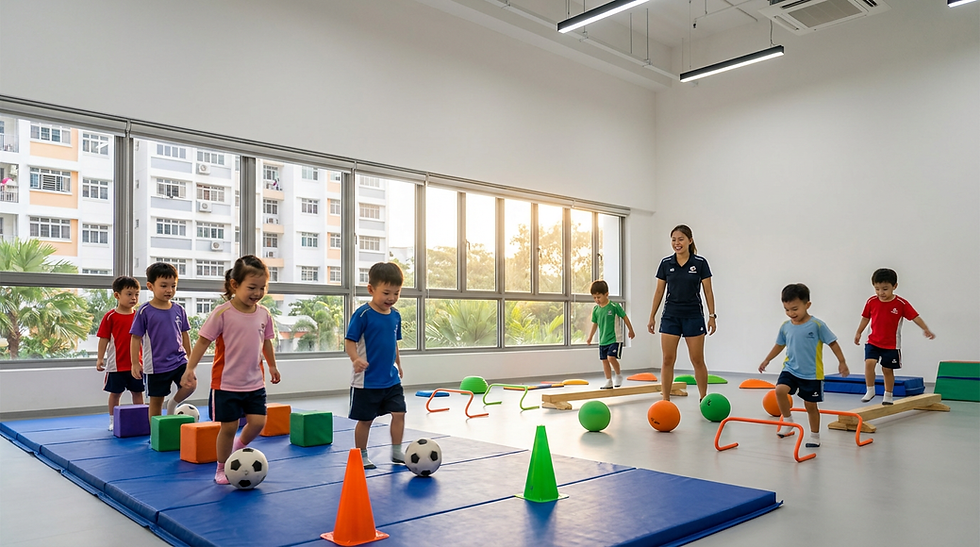
Play-based learning methodology distinguishes exceptional preschool sports programs from rigid, drill-focused approaches. Quality programs recognize that young children learn most effectively through exploration, imagination, and fun. Activities incorporate storytelling, games, and creative themes that engage preschoolers' natural curiosity while systematically developing motor skills. When a coach transforms a relay race into a dinosaur adventure, children participate with enthusiasm while unknowingly practicing running form, spatial awareness, and turn-taking.
The coach-to-child ratio directly impacts both safety and learning outcomes. Superior programs maintain small group sizes that allow instructors to provide individualized attention, correct form gently, and ensure every child receives adequate practice opportunities. Look for programs with ratios no higher than 1:8 for preschoolers, as this ensures coaches can monitor safety while adapting activities to different skill levels within the group.
Qualified, specialized instructors represent perhaps the most critical program element. Coaches working with preschoolers need specific training in early childhood development, age-appropriate teaching methods, and positive behavior guidance. Technical sports knowledge matters less than understanding how 3-6 year-olds learn, communicate, and process emotions. The best programs invest heavily in coach training and carefully select individuals who combine expertise with genuine warmth and patience.
Safety protocols and equipment standards should meet or exceed industry benchmarks. Quality programs conduct thorough risk assessments, maintain age-appropriate equipment in excellent condition, implement clear emergency procedures, and ensure adequate supervision at all times. The facility should feature proper flooring, adequate space for activities, and equipment sized correctly for preschool bodies. Programs should transparently communicate their safety measures and welcome parent questions about their protocols.
Age-Appropriate Curriculum Design
Understanding developmental stages allows quality programs to design curricula that challenge without overwhelming. Three-year-olds typically benefit from activities emphasizing basic locomotor skills, simple object manipulation, and very short instructional sequences. They thrive with frequent activity changes, imaginative themes, and abundant positive reinforcement. Programs for this age prioritize building comfort with the sports environment and developing basic body control.
Four and five-year-olds demonstrate greater attention spans, improved coordination, and emerging competitive interests. Appropriate curricula introduce more complex movement patterns, basic game concepts with simple rules, and activities that require sequential thinking. Children this age begin enjoying relay races, team challenges, and activities that involve strategy elements, though the emphasis remains firmly on participation and effort rather than winning.
Six-year-olds transitioning toward primary school readiness can handle longer instruction periods, more sophisticated skill combinations, and introduction to sport-specific techniques. Quality programs for this age group begin preparing children for structured sports like soccer, basketball, or athletics while maintaining the playful, encouraging atmosphere essential for continued engagement. The curriculum balances skill development with maintaining the joy and creativity that keeps children intrinsically motivated.
Progressive skill development ensures children experience continuous growth without frustration or boredom. Exceptional programs assess each child's current abilities and provide differentiated activities that meet them at their level while gently extending their capabilities. This individualized approach prevents the discouragement of tasks that are too difficult and the disengagement that comes from activities that are too easy.
Types of Preschool Sports Programs in Singapore
Multi-sport programs expose children to diverse activities spanning different movement categories and skills. These programs typically rotate through various sports and movement types, allowing preschoolers to discover their interests while developing well-rounded physical literacy. The Vivo Kids multi-sports programme exemplifies this comprehensive approach, offering ages 2-6 systematic exposure to fundamental movement skills through engaging, play-based activities that build both physical competence and character development.
Multi-sport formats provide particular advantages for preschoolers who haven't yet developed specific athletic preferences. Rather than committing to a single sport prematurely, children experience basketball, soccer, athletics, gymnastics elements, and more, building diverse skills while discovering what genuinely excites them. This exploration prevents early specialization that can lead to burnout and overuse injuries while fostering adaptability and broad physical confidence.
Sport-specific programs focus on developing skills within a particular discipline. Soccer academies, swimming lessons, gymnastics classes, and martial arts programs offer deeper technical instruction for children showing strong interest in specific activities. The Vivo Kicks Academy provides structured soccer training for children ages 6-12, offering a natural progression for preschoolers who discover a passion for football through multi-sport exposure.
When considering sport-specific programs for preschoolers, ensure the curriculum remains age-appropriate rather than simply replicating older children's training in simplified form. Quality programs maintain playfulness, creativity, and variety even within a single-sport focus, avoiding the repetitive drills that cause young children to lose interest and motivation.
School-readiness programs intentionally bridge physical development and academic preparation. These specialized offerings combine movement activities with early learning concepts, helping children develop the focus, following instructions, social skills, and emotional regulation needed for successful kindergarten transition. Programs integrating physical literacy with cognitive readiness provide comprehensive preparation that purely academic preschools cannot match.
Holiday camps and short-term programs offer flexible options for families wanting to supplement regular activities or explore sports programming before committing to ongoing enrollment. These intensive formats pack substantial skill development and social experiences into condensed timeframes, making them ideal for school breaks, trial periods, or children whose schedules don't accommodate weekly classes.
Choosing the Right Program for Your Child
Begin by honestly assessing your child's temperament and interests. Energetic, social children often thrive in dynamic multi-sport environments with plenty of peer interaction, while more cautious or introverted preschoolers might prefer smaller groups with gradual introductions to new activities. Consider whether your child gravitates toward team collaboration or individual challenges, structured activities or free exploration, competitive elements or purely recreational participation.
Trial classes provide invaluable insights that marketing materials and websites cannot convey. Observe how coaches interact with children, whether your child appears engaged and happy, how transitions between activities are managed, and whether the overall atmosphere feels positive and encouraging. Notice if coaches differentiate instruction for varying skill levels and how they handle behavioral challenges or emotional moments. Your child's enthusiasm during and after the trial offers crucial feedback about program fit.
Location and scheduling convenience significantly impact long-term program sustainability. Even the perfect program becomes problematic if getting there causes family stress or requires unrealistic schedule gymnastics. Consider travel time during typical attendance hours, parking availability, proximity to home or school, and whether class times align naturally with your family's routine. Programs closer to home encourage attendance consistency that maximizes developmental benefits.
Investigate the program's philosophy and values alignment with your family priorities. Some programs emphasize competition and performance, while others prioritize participation and character development. Neither approach is inherently superior, but misalignment between program philosophy and family values creates friction. Quality programs clearly articulate their educational philosophy and can explain how their approach serves children's developmental needs during the preschool years.
Cost considerations extend beyond program fees to include equipment requirements, uniform purchases, registration fees, and potential competition or event costs. Understand the complete financial commitment before enrolling, and verify what's included in stated pricing. Higher fees don't automatically guarantee superior quality, just as budget-friendly options aren't necessarily inferior. Focus on value—the relationship between cost and the specific benefits your child receives.
What to Expect in Your Child's First Classes
Initial sessions typically focus on building comfort and familiarity rather than immediate skill development. Coaches introduce routines, establish behavioral expectations, tour the facility, and create positive associations with the sports environment. Your child learns where to sit during instruction, how to ask questions, bathroom locations, and other practical details that reduce anxiety. This orientation phase is crucial for long-term success, so don't worry if minimal actual sports activity occurs during the first class or two.
Separation anxiety affects many preschoolers beginning new activities. Quality programs handle this sensitively, allowing gradual transitions that might include parent observation for initial sessions. Coaches experienced with young children use distraction, engagement, and gentle encouragement rather than forcing participation. Expect some initial clinginess or tears, but trust that most children adjust within 2-4 sessions once they feel safe and discover the fun awaiting them.
Early classes emphasize basic skills and simple games that ensure success for all participants regardless of prior experience. Activities are designed so every child can participate meaningfully, building confidence through achievable challenges. Coaches provide abundant positive reinforcement, celebrating effort and improvement rather than perfect execution. This encouraging atmosphere helps children associate sports with positive feelings, laying groundwork for continued participation.
Your child's focus and participation may fluctuate significantly during early sessions. Preschoolers have limited attention spans and varying energy levels, so some distraction, sitting out briefly, or needing water breaks is completely normal. Quality programs accommodate these developmental realities rather than demanding unrealistic sustained focus. Coaches skilled in working with young children redirect attention gently and maintain activity variety that prevents boredom.
Supporting Your Child's Sports Journey at Home
Emphasize effort over outcomes in all sports-related conversations. Praise your child for trying hard, showing perseverance, being a good teammate, and having fun rather than focusing on winning, being the best, or perfect skill execution. This approach builds intrinsic motivation and resilience while preventing the anxiety and pressure that causes many children to quit sports. Ask questions like "What was the most fun part today?" and "What new skill did you practice?" rather than "Did you win?" or "Were you the best one?"
Create opportunities for unstructured active play outside of formal classes. Sports programs provide structured skill development, but free play allows children to experiment, take risks, and apply learned skills creatively. Visit playgrounds, play catch in the park, set up simple backyard obstacle courses, or simply dance to music together. This unstructured movement complements formal instruction while keeping physical activity joyful rather than regimented.
Model active living through your own choices and family activities. Children whose parents demonstrate that movement is enjoyable and valuable naturally adopt similar attitudes. Take family walks, play active games together, choose physical activities for weekend outings, and speak enthusiastically about your own exercise experiences. Your attitudes toward fitness and sports profoundly influence your child's developing beliefs about physical activity.
Avoid applying pressure or living vicariously through your child's sports participation. Remember that preschool sports serve your child's developmental needs, not adult ego or ambitions. If your child shows disinterest in continuing a program, explore why before insisting they persist. Perhaps the specific program isn't the right fit, the timing doesn't work, or they need a break before trying again. Forcing continued participation when genuine problems exist can damage their long-term relationship with physical activity.
Communicate regularly with coaches about your child's experiences, progress, and any concerns. Quality programs welcome parent partnership and can offer insights into your child's social interactions, skill development areas, and appropriate home practice activities. Share relevant information about your child's temperament, preferences, or challenges that might help coaches provide better support. This collaborative approach ensures consistency between the sports environment and home reinforcement.
Selecting the right preschool sports program represents a significant investment in your child's physical, cognitive, social, and emotional development during their most formative years. The benefits extend far beyond improved coordination and fitness, shaping their confidence, resilience, social skills, and lifelong attitude toward active living. By understanding what distinguishes quality programs and carefully considering your child's unique needs and personality, you can find an environment where they'll thrive, grow, and discover the joy of movement.
The preschool years pass quickly, but the foundations established during this period last a lifetime. Whether your child is naturally athletic or still developing basic coordination, enthusiastically social or cautiously observant, there's a sports program designed to meet them where they are and gently expand their capabilities. The key lies in finding that perfect match between your child's needs and a program's approach, philosophy, and environment.
Remember that the ultimate goal isn't creating the next Olympic athlete but rather raising a confident, capable child who views physical activity as an enjoyable, natural part of healthy living. Success looks like your child eagerly anticipating their sports class, trying new challenges without excessive fear, developing friendships through shared activities, and learning that effort and practice lead to improvement. These outcomes matter infinitely more than technical skill mastery during the preschool years.
Ready to give your preschooler the gift of confident, joyful movement? Vivo Kinetics offers award-winning, play-based sports programs specifically designed for Singapore children ages 20 months to 12 years. Our expert coaches create nurturing environments where your child can explore, build fundamental skills, and develop character through age-appropriate activities. As the recognized leaders in children's health and fitness in Southeast Asia, we understand what young learners need to thrive physically, socially, and emotionally. Book a trial class today and discover why parents trust Vivo Kinetics to lay the foundation for their children's lifelong love of active living.


Comments