


Spatial Awareness Games: Helping Kids Navigate Space
Table Of Contents
What Is Spatial Awareness and Why Does It Matter?
How Spatial Awareness Develops in Early Childhood
Signs Your Child May Need More Spatial Play
Top Spatial Awareness Games for Different Age Groups
Ages 2–4: Sensory and Body-Based Games
Ages 4–6: Movement and Direction Games
Ages 6–12: Strategy and Sport-Based Challenges
Everyday Environments That Build Spatial Skills
How Structured Sports Programmes Support Spatial Development
Tips for Parents: Encouraging Spatial Play at Home
Spatial Awareness Games: Helping Kids Navigate Space
Watch a young child dart through a busy playground, weave between swings, and land a jump without bumping into anything—that is spatial awareness in action. It is one of the most fundamental skills a child develops in their early years, quietly shaping how they move, learn, and interact with the world around them. Yet for many parents, spatial awareness remains an invisible skill: easy to overlook until a child struggles with it.
From navigating a crowded classroom to judging the distance of a football mid-flight, spatial awareness underpins far more of daily life than most people realise. The good news is that building this skill does not require expensive equipment or specialist training. The right games, activities, and environments can make an enormous difference—and children genuinely enjoy every moment of the process.
This article explores what spatial awareness actually is, why it matters deeply for child development, and which games work best at different ages. Whether your child is a toddler taking their first confident steps or a school-age kid discovering team sports, there is something here to help them grow.
What Is Spatial Awareness and Why Does It Matter?
Spatial awareness is the ability to understand one's own position in space relative to the surrounding environment, objects, and other people. It involves knowing how much room your body takes up, judging distances accurately, and coordinating movement accordingly. For children, this skill is not just about physical safety—it is closely connected to cognitive development, academic readiness, and social confidence.
Research in child development consistently links strong spatial skills to performance in mathematics, reading, and problem-solving. When children practise navigating physical space through play, they are also building the mental frameworks needed to understand maps, patterns, and abstract concepts later in life. In short, a game of obstacle course tag today may be quietly preparing a child for geometry class tomorrow.
Beyond academics, spatial awareness helps children feel safe and competent in their bodies. A child who understands where their limbs are, how fast they are moving, and how close they are to others is less likely to stumble, collide with friends, or feel overwhelmed in busy spaces. That physical confidence has a direct knock-on effect on emotional wellbeing and social ease.
How Spatial Awareness Develops in Early Childhood
Spatial development begins remarkably early. Infants start building rudimentary spatial understanding simply by reaching for objects and tracking movement with their eyes. By the toddler years, children begin to understand basic concepts like near and far, over and under, and big and small. These are not just vocabulary lessons—they are the building blocks of spatial cognition.
Between ages two and six, children enter a particularly sensitive period for spatial learning. During this window, physical play is the primary vehicle for development. Climbing, crawling, jumping, and tumbling all give the brain rich, real-time feedback about how the body relates to the world. This is precisely why play-based programmes that prioritise movement are so valuable during the preschool years.
By the time children reach primary school age, spatial skills become more refined. They can anticipate the movement of objects, coordinate with teammates, and navigate complex environments with increasing confidence. These skills continue developing well into adolescence, but the foundation laid in the early years has a lasting impact on the trajectory of that growth.
Signs Your Child May Need More Spatial Play
Every child develops at their own pace, but certain patterns may suggest a child needs more opportunities to build spatial awareness through active play. Being aware of these signs early helps parents take gentle, playful steps in the right direction.
Look out for:
Frequently bumping into furniture, walls, or other children in familiar spaces
Difficulty judging distances when catching, throwing, or kicking a ball
Reluctance to try physical activities like climbing or jumping
Trouble following directional instructions such as "stand behind the cone" or "move to your left"
Challenges with puzzles, building blocks, or activities that require visualising how pieces fit together
None of these signs indicate a serious problem on their own—they simply signal that a child would benefit from more varied, intentional movement play. The solution is almost always more active play, not less.
Top Spatial Awareness Games for Different Age Groups
Ages 2–4: Sensory and Body-Based Games
At this age, the goal is helping children understand their own body in relation to space. Games should be simple, repetitive, and full of sensory feedback. The younger the child, the more important it is that the activity feels like pure fun with no pressure to perform.
Tunnel Crawl: Set up a fabric play tunnel or create one from chairs and a blanket. Encourage your child to crawl through, turn around, and navigate their way in and out. This builds an understanding of confined spaces and helps children gauge how their body fits through an opening.
Over and Under: Place a broomstick or pool noodle between two chairs and alternate between having your child jump over it and duck under it. Introduce simple language like "high," "low," "over," and "through" to connect physical experience with spatial vocabulary.
Stepping Stone Paths: Lay out flat cushions, towels, or coloured circles on the floor and encourage your child to hop from one to the next without touching the ground. Vary the spacing to challenge their judgement of distance and build coordination.
Ages 4–6: Movement and Direction Games
Children at this age are ready for more structured challenges involving direction, distance, and coordination with others. Games can involve simple rules and mild competition, though the emphasis should remain on participation and discovery.
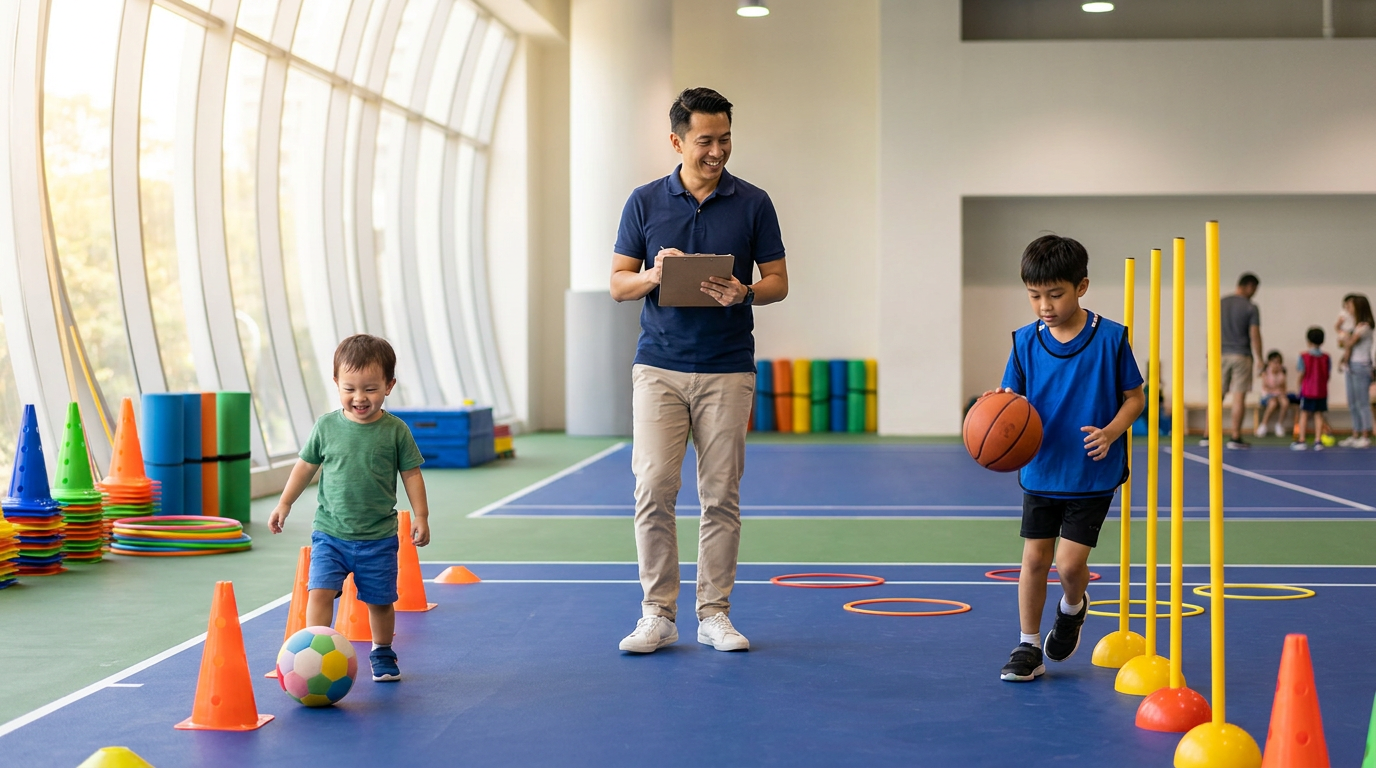
Obstacle Courses: Arrange cones, hula hoops, balance beams, and soft hurdles in a sequence for children to navigate. Obstacle courses are one of the most effective tools for spatial development because they require children to plan their movement in advance, adjust speed, and respond to their environment in real time.
Freeze Dance with Shapes: Play music and instruct children to move freely around the space. When the music stops, call out a shape or position—"make yourself as small as possible," "stretch as wide as you can," "stand inside the hoop"—that requires them to think about their body in space.
Simon Says (Movement Edition): Rather than static poses, make all instructions movement-based. "Simon says take three steps to the left," "Simon says move backwards until you reach the wall," or "Simon says jump over the rope" builds directional awareness and listening skills simultaneously.
This age group thrives in structured play environments with experienced coaches who understand how to guide movement development. The Vivo Kids multi-sports programme is designed specifically for children aged two to six, combining age-appropriate physical challenges with character development in a nurturing, expert-led setting—making it an ideal complement to spatial play at home.
Ages 6–12: Strategy and Sport-Based Challenges
Older children are ready for games that layer spatial awareness with tactical thinking, teamwork, and higher-level coordination. Sport-based activities are particularly effective at this stage because they require children to track multiple moving objects and people simultaneously.
Ball Relay Races: Teams must dribble, carry, or balance a ball through a course before passing it to the next player. The competitive element encourages children to move purposefully and read the space around them.
Capture the Flag: This classic outdoor game demands constant spatial awareness—children must track their own position, their teammates, opponents, and the target location all at once. The cognitive load is high, which makes the spatial gains equally significant.
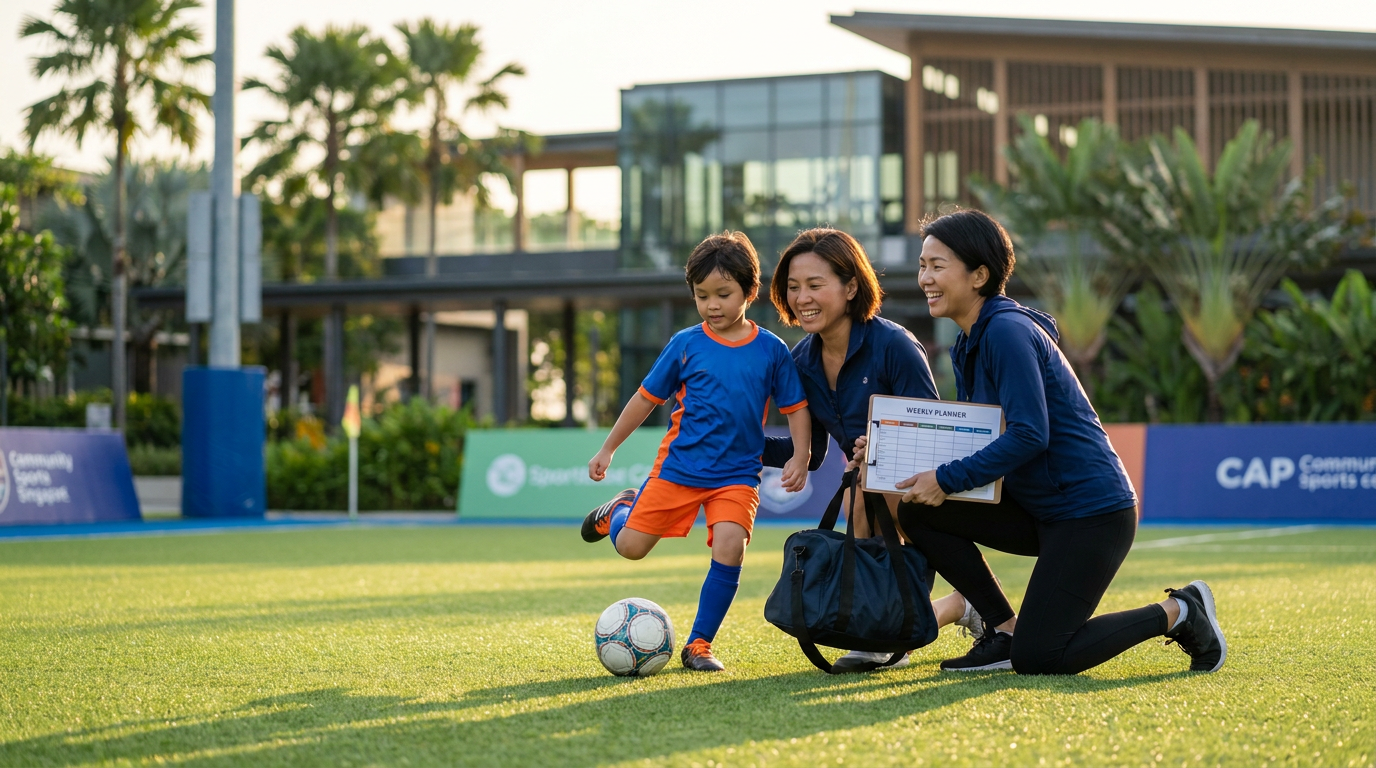
Target Kicking and Passing Drills: Setting up targets at varying distances and angles, then practising kicking or passing accurately toward them, directly builds the distance judgement and body control that underpin strong sports performance. Football, in particular, is an outstanding vehicle for spatial development at this age.
For children who love the ball and want to develop real footballing intelligence, the Vivo Kicks Academy offers a structured soccer programme for ages six to twelve. Through progressive drills and game scenarios, young players naturally develop spatial awareness as part of mastering the beautiful game.
Everyday Environments That Build Spatial Skills
Games are powerful, but the environments children spend time in every day also shape spatial development significantly. A child who has regular access to varied outdoor spaces—parks with uneven terrain, playgrounds with climbing structures, open fields for running—accumulates thousands of micro-moments of spatial learning without a single formal activity being planned.
Indoor environments matter too. Encouraging children to help set the table (judging spacing and placement), build with blocks or LEGO, or navigate furniture while carrying objects all quietly reinforce spatial understanding. Even creative activities like drawing, cutting, and folding paper engage spatial cognition in meaningful ways.
The key is variety. Children who experience a wide range of spaces, surfaces, and physical challenges build a richer and more adaptable spatial toolkit than those whose movement is limited to predictable, flat environments. Whenever possible, say yes to the messy park, the new playground, and the slightly wobbly balance beam.
How Structured Sports Programmes Support Spatial Development
While free play is essential, structured sports and movement programmes offer something that unplanned play cannot always guarantee: intentional, progressive skill-building guided by experts who understand child development. A well-designed programme does not just keep children active—it creates deliberate challenges that stretch spatial capability just beyond a child's current comfort zone, encouraging growth without frustration.
Expert coaches who specialise in early childhood movement understand how to sequence activities so that each session builds on the last. They create environments where children feel safe to try, fail, and try again—which is exactly the mindset spatial development requires. The confidence a child gains from successfully navigating a new physical challenge in a supportive environment carries over into every other area of their life.
Vivo Kinetics, recognised as the Best Children's Multi-sport Programme of 2024 and a leader in children's health and fitness across Southeast Asia, is built on this philosophy. Their programmes combine expert coaching, age-appropriate curriculum, and genuine play to help children develop physically, intellectually, socially, and emotionally.
Tips for Parents: Encouraging Spatial Play at Home
You do not need a sports hall or specialist equipment to support your child's spatial development at home. Small, consistent choices make a meaningful cumulative difference.
Narrate movement: When playing with your child, use directional and spatial language naturally. "You climbed all the way to the top," "Let's go around the puddle," and "Can you fit through that gap?" all reinforce spatial vocabulary.
Limit screen time during peak play hours: Passive screen time does not build spatial skills. Protecting time for active, physical play—especially outdoors—ensures children accumulate the movement experiences they need.
Play alongside your child: Children learn spatial concepts faster when a trusted adult models movement, offers encouragement, and gently introduces new challenges.
Rotate toys and activities: Novelty is a powerful teacher. Introducing new puzzles, building sets, and outdoor games regularly keeps spatial learning fresh and engaging.
Celebrate effort over outcome: A child who tries to jump across a gap and lands short is still building spatial judgement. Praising the attempt rather than the result keeps children motivated to keep exploring.
Building Confident, Capable Movers
Spatial awareness is one of those foundational skills that shapes a child's entire experience of the world—from how confidently they move through a playground to how readily they grasp mathematical concepts in the classroom. The most powerful thing about developing it is also the most reassuring: it happens through play. The games, environments, and activities outlined in this article are not extra homework for parents to schedule—they are simply an invitation to let children move, explore, and discover what their remarkable bodies can do.
Whether you are rolling out a homemade obstacle course in your living room, heading to the park for an afternoon of tag, or enrolling your child in a structured sports programme, every active moment contributes to a child who moves through the world with greater ease, joy, and confidence. That is a gift worth giving—one game at a time.
Give Your Child the Space to Grow
At Vivo Kinetics, we believe that every child deserves a safe, expert-led environment where movement becomes a joy and confidence grows naturally. Whether your little one is two or twelve, our programmes are designed to meet them exactly where they are and help them thrive.
Explore our programmes and register today at Vivo Kinetics

Comments