


Sports Assessment Tests for Kids: How to Measure and Celebrate Every Child's Progress
Table Of Contents
Why Sports Assessment Tests Matter for Children
Assessment Is Not the Same as Judging
What Does a Good Children's Sports Assessment Actually Measure?
Age-Appropriate Assessment: What to Expect at Each Stage
Common Sports Assessment Tests Used with Young Children
How Assessment Builds Confidence and Motivation
The Role of Expert Coaches in Meaningful Assessment
How Often Should Children Be Assessed?
Turning Test Results Into Real Progress
Picture this: your child runs across the field, kicks the ball, then looks back at you with the biggest grin on their face. What changed? Not the skill alone — it's the moment they felt themselves getting better. That feeling of measurable growth is exactly what sports assessment tests are designed to capture and celebrate.
For parents of young children, the word "assessment" can sometimes sound intimidating — conjuring images of clipboards, stopwatches, and pressure. But when done the right way, sports assessment tests are one of the most powerful tools available to support a child's physical, emotional, and social development. They answer one simple but important question: Is your child growing?
This article breaks down what children's sports assessment tests actually measure, how they should look across different age groups, and why tracking progress — not performance rankings — is the key to helping every child thrive in sport.
Why Sports Assessment Tests Matter for Children
Every child's developmental journey is unique. Without a way to track progress over time, it becomes very difficult — for coaches, parents, and even children themselves — to see how far they've come. Sports assessment tests create a clear before-and-after picture that transforms invisible effort into visible growth.
Research consistently shows that physical fitness has important implications beyond the sports field. High levels of physical fitness in young people can positively affect both health and cognitive function, meaning that monitoring fitness levels in youth can help increase quality of life well into adulthood. When children receive regular, developmentally appropriate assessments, their coaches gain the data needed to tailor programs, identify emerging strengths, and address areas that need extra support — all without the child feeling singled out or pressured.
Perhaps most importantly, assessments give children a personal baseline to beat. Rather than comparing themselves to teammates, they begin to compete against their own previous best — a mindset that builds resilience and intrinsic motivation far more effectively than league tables or rankings ever could.
Assessment Is Not the Same as Judging
One of the most common misconceptions parents hold is that sports assessment = talent identification. It doesn't — at least not for children in the 2–12 age range. The goal of a well-designed sports assessment for young children is not to label a child as gifted or untalented. The goal is to establish a starting point, track progress, and keep young athletes excited about moving and improving.
This distinction matters enormously. The Long-Term Athlete Development (LTAD) framework — a gold standard used by national sports organisations worldwide — makes clear that the early years of athletic development should centre on building physical literacy and enjoying movement. Children who do not develop their fundamental motor skills by around age 12 are unlikely to fully reach their athletic potential later in life. Assessments conducted during these foundational years should therefore focus on motor skill acquisition and movement quality, not on selecting winners.
Furthermore, every child of the same chronological age can differ by several years in their biological maturation level. A child who appears less physically capable at age 7 may simply be developing on a slightly different timeline — and an assessment that penalises that difference does real harm. Good sports assessments account for individual development, not just age-group averages.
What Does a Good Children's Sports Assessment Actually Measure?
A high-quality children's sports assessment looks beyond raw speed or strength. It evaluates a range of interconnected physical and movement abilities that together paint a comprehensive picture of a child's athletic development. Research on physical fitness batteries for young people typically includes assessments across several key domains:
Locomotor skills — running, jumping, hopping, skipping, and overall movement efficiency
Ball skills — catching, throwing, kicking, and dribbling with coordination and control
Balance and stability — the ability to maintain body control in both static and dynamic positions
Lower-body power — explosive strength shown through activities like broad jumps and leaping
Upper-body strength and coordination — pushing, pulling, and overall arm control relevant to sports performance
Agility and coordination — the ability to change direction, respond quickly, and move with fluency
Flexibility — range of motion, particularly important during rapid growth phases
For younger children in the toddler and preschool range, assessments lean heavily toward locomotor and stability skills because, as research confirms, the preschool age is a critical period for the acquisition of fundamental motor skills. For older primary-school-age children (roughly 6–12), skill-related components like agility, coordination, and sport-specific abilities become increasingly measurable and meaningful.
Notably, the best assessments also observe how a child moves — not just how far or how fast. Movement quality, body mechanics, and technique all matter as much as measurable outcomes, particularly in the younger age groups.
Age-Appropriate Assessment: What to Expect at Each Stage
Children are not small adults, and their assessments should never look like scaled-down versions of adult fitness tests. The LTAD framework identifies distinct developmental stages, each calling for a different emphasis in assessment and training.
The Active Start Stage (Ages 2–5)
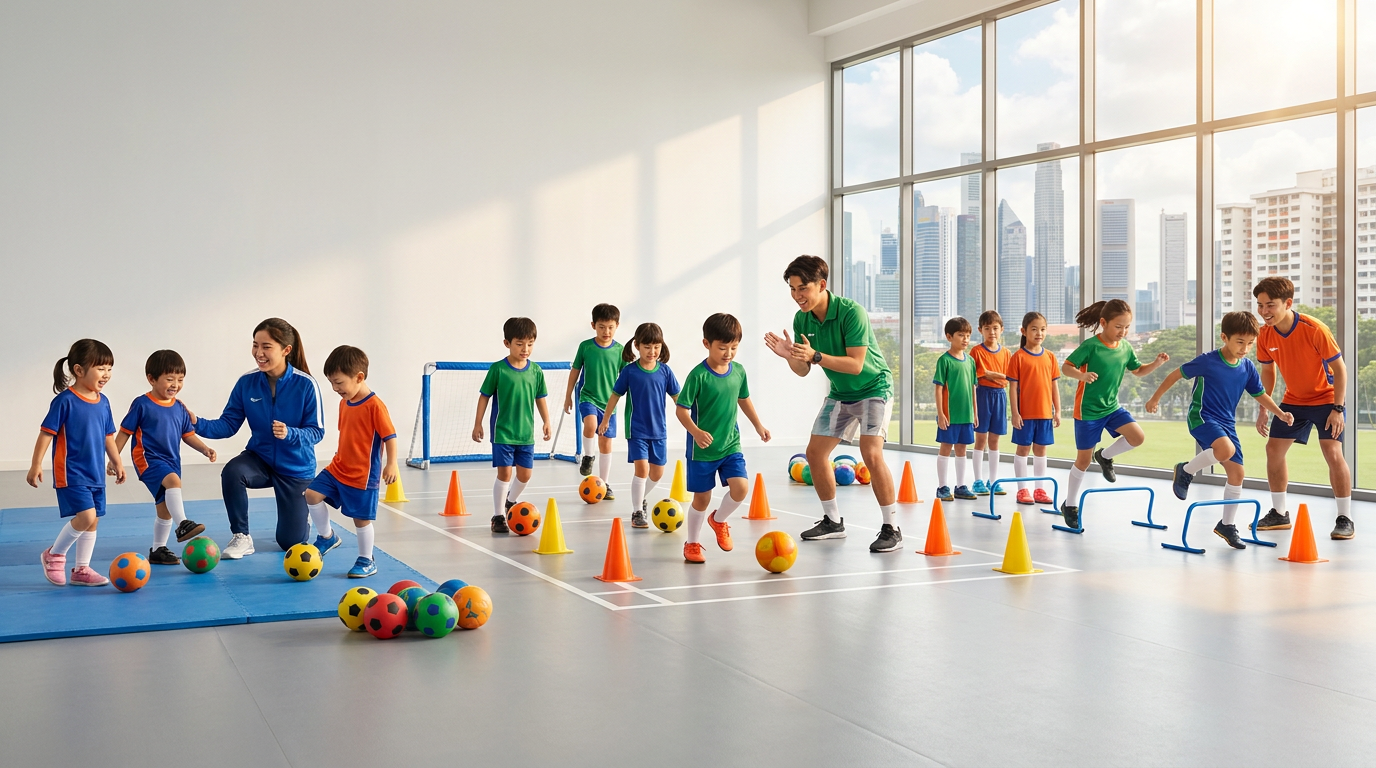
At this age, the goal is movement exploration and play. Formal testing is not appropriate; instead, assessment is observational and play-based. Coaches watch for the development of fundamental movement skills — running, jumping, throwing, and catching — and note how confidently and freely children move through space. The question is not "how far can they jump?" but "are they willing to try jumping, and do they enjoy it?"
This is precisely the philosophy behind Vivo Kinetics' Vivo Kids multi-sports programme, which serves children aged 2–6. Through structured play and expert coaching, children in this stage are gently assessed on movement milestones while keeping every session fun, safe, and encouraging.
The FUNdamental Stage (Ages 6–9)
From ages 6 to 9, children are ready for more structured movement assessment. This stage focuses on learning fundamental movement skills and building overall motor skills — including agility, balance, and coordination. Simple, repeatable tests become meaningful at this age: how well does a child balance on one foot? Can they catch a ball consistently? How efficiently do they run?
Research confirms that there are three stages of fundamental movement skill development — initial, elementary, and mature — and that children in this window should be working toward mastering the mature stage of key locomotor and ball skills. Assessment at this stage helps coaches ensure no gaps in the foundation are overlooked.
The Learn to Train Stage (Ages 8–12)
From approximately ages 8 to 12 (varying slightly by gender and individual maturation), children are ready to begin developing foundational sport skills more intentionally. The emphasis should be on acquiring a wide range of skills across multiple sporting activities. Assessment here becomes more structured, measuring specific physical qualities like agility T-tests, sprint speed, jumping power, and sport-specific coordination.
For children in this age range who have a passion for football, Vivo Kinetics' Vivo Kicks academy provides an expert-led environment where sport-specific skill assessments are woven naturally into training — giving kids clear benchmarks to work toward without ever losing the joy of the game.
Common Sports Assessment Tests Used with Young Children
While assessment approaches vary by age and developmental stage, several foundational tests appear consistently across research-backed fitness batteries for school-age children. Here are the most widely used and appropriate assessments for the 5–12 age group:
Standing broad jump — measures lower-body explosive power and coordination; children simply jump as far forward as they can from a standing position
Vertical jump — assesses leg power and athleticism; a universal marker used across nearly every sport
10 x 5m shuttle run — evaluates speed, agility, and change of direction simultaneously
Sprint tests (10–20m) — measure acceleration and early speed development
Catch-and-throw tasks — assess hand-eye coordination, ball control, and upper-body coordination
Balance assessments — single-leg stands and dynamic balance tasks reveal stability and core control
Push-up or flexed-arm hang — age-appropriate indicators of upper-body strength and endurance
For very young children (ages 2–5), formal versions of these tests are replaced by structured observation during play activities. Coaches watch for key movement milestones — a confident leap, a well-controlled kick, an independent balance — rather than measuring distances or recording times.
The key principle across all ages is to keep assessments simple, repeatable, and joyful. A child who dreads assessment day will not give an honest performance, and the data becomes meaningless. When assessments feel like games, children engage fully, and the results reflect their genuine capabilities.
How Assessment Builds Confidence and Motivation
One of the most powerful — and often overlooked — benefits of sports assessment is what it does for a child's confidence and intrinsic motivation. When children can see, in concrete terms, that they have improved, something shifts fundamentally in how they see themselves.
Research on the relationship between sport participation and self-esteem finds that the effect is strongest when the sport environment is structured, supportive, and focused on personal improvement rather than purely on winning. Assessment done well creates exactly this environment. A child who broad-jumped 90cm three months ago and now clears 110cm doesn't just have better legs — they have proof that effort produces results. That identity — I am someone who can get better — transfers far beyond the sports field into school, friendships, and future challenges.
Positive support from parents and coaches, especially when it focuses on effort and progress rather than winning, further boosts a child's confidence. Assessment results, shared with warmth and encouragement, become a celebration of commitment, not a verdict on talent. Even a modest improvement is meaningful, because it confirms the most important lesson sport can teach a young child: consistent work leads to measurable growth.
Children also benefit enormously from competing against their own previous performances rather than against peers. Rather than comparing themselves to others, they begin chasing their own personal bests — a mindset that builds confidence and teaches that success comes from consistent improvement, not instant perfection.
The Role of Expert Coaches in Meaningful Assessment
Sports assessment is only as good as the person delivering it. An expert coach understands not just how to measure, but how to observe, interpret, and respond to what they see — and critically, how to deliver feedback in a way that uplifts rather than deflates a young child.
This is where the quality of a child's programme makes an enormous difference. Expert coaches use assessment data to do several things simultaneously: they adjust training plans to match each child's developmental stage, they celebrate personal progress, they identify movement patterns that need correction before they become habits, and they help children understand that every measurement is a starting point, not a final score.
Quality instruction and supervision of youth programmes should include assessment and monitoring of fundamental movement skill acquisition, physical performance, and psychosocial well-being. In other words, a great coach is watching the whole child — not just the numbers on a clipboard.
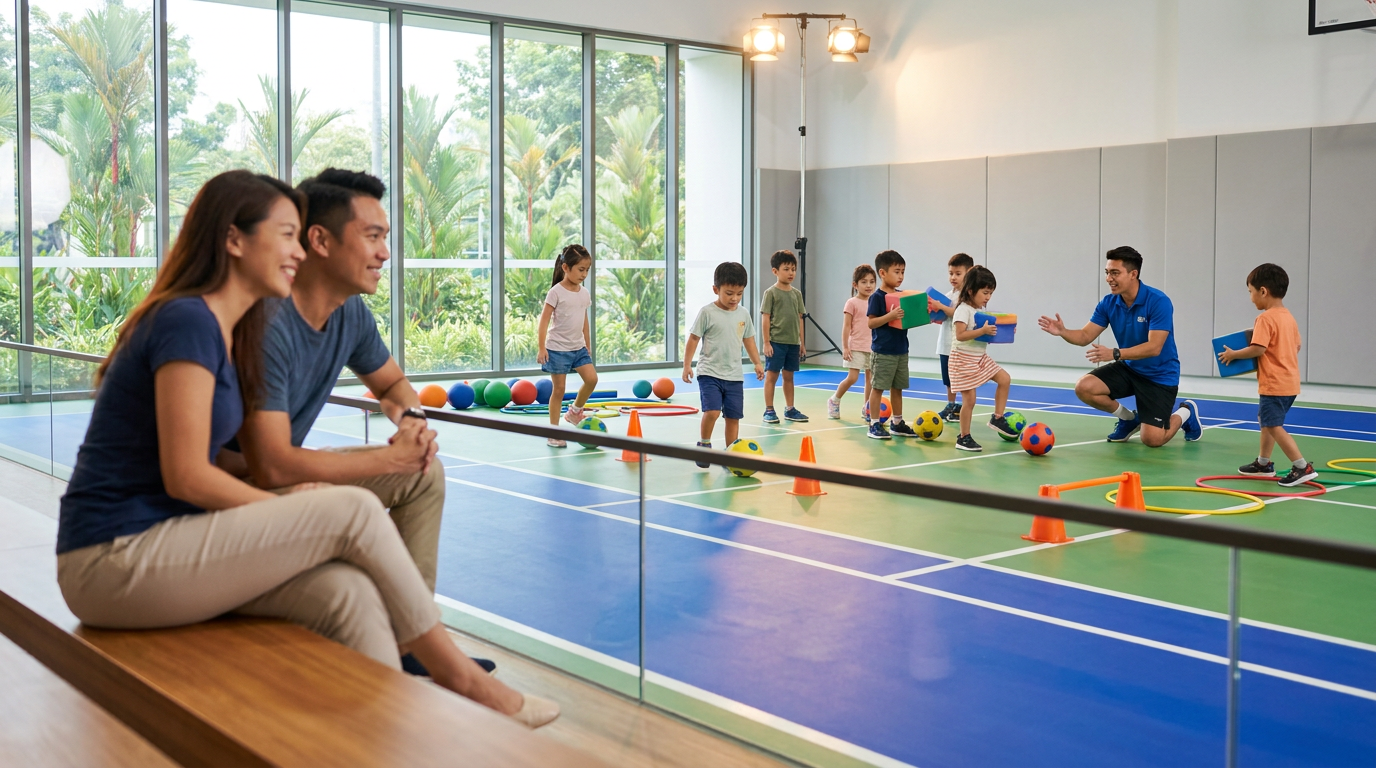
At Vivo Kinetics, expert coaches are trained to deliver age-appropriate assessments within nurturing, play-based environments. Whether a child is taking their first steps in sport through Vivo Kids, or developing serious soccer skills through Vivo Kicks, every assessment is designed to inform and inspire — not to compare or sort.
How Often Should Children Be Assessed?
One of the most common mistakes in youth sports programmes is assessing children too frequently. Assessment should support training — not replace it, and not dominate it. When children are constantly being measured, training sessions lose their exploratory, playful quality and start to feel like tests. That anxiety is counterproductive at every age, but especially for young children.
A good rule of thumb is to establish a baseline at the beginning of a programme or training cycle, allow several weeks of focused development, and then reassess. For children in the 2–6 range, informal observation can happen continuously within sessions without children being aware of it. For older children in structured sport programmes (6–12), formal reassessment every 6–12 weeks provides meaningful data while keeping the focus on training.
This rhythm — baseline, develop, reassess — teaches children a powerful lesson about how progress works. Improvement takes time, consistency, and patience. Watching the numbers shift every few months is far more motivating than obsessing over tiny weekly fluctuations. The goal is never to collect data for its own sake. The goal is to develop better, happier, more confident young movers.
Turning Test Results Into Real Progress
Data without action is just numbers. The final — and most important — step in any children's sports assessment is translating the results into a smarter, more personalised training plan.
When a coach sees that a child's balance and stability scores are lagging behind their locomotor skills, that insight shapes the next block of training. When a child's broad jump improves by 15cm over eight weeks, that result gets celebrated explicitly — reinforcing the connection between effort and outcome in a way the child will remember. And when results show that a child is excelling in coordination but needs more confidence in ball skills, the programme pivots accordingly.
This is the genuine promise of sports assessment: not rankings, not labels, not early talent spotting — but a continuous, responsive loop of observe, develop, and celebrate. When children experience this process in a warm, expert, play-rich environment, they don't just become better at sport. They become children who believe they can become better — at anything they put their minds to.
The Bottom Line
Sports assessment tests, when done right, are one of the greatest gifts you can give a young child's development. They turn invisible progress into visible proof, transform effort into personal bests, and give coaches the insights they need to nurture every child — not just the most naturally athletic ones.
The key is always the approach. Assessments should be age-appropriate, play-based for younger children, technically grounded for older ones, and always framed around personal growth rather than comparison. Children who experience assessment this way don't fear the process. They look forward to it, because it tells them something true and encouraging about themselves.
Whether your child is exploring movement for the first time or refining sport-specific skills, the right programme will assess them with care, celebrate every step forward, and use those insights to keep them growing — in sport and in life.
Ready to watch your child grow?
At Vivo Kinetics, every programme is designed with expert coaches, age-appropriate curricula, and a nurturing environment that celebrates each child's unique development. From our play-based Vivo Kids multi-sports programme for ages 2–6 to our skills-focused Vivo Kicks academy for ages 6–12, we give every child the foundation to move, improve, and love sport for life.
👉 Explore our programmes at Vivo Kinetics and take the first step toward your child's best athletic journey.

Comments