


Backyard Sports Activities: Making the Most of Your Outdoor Space
Table Of Contents
Why Backyard Sports Activities Matter More Than Ever
Setting Up Your Space: Small Yard, Big Possibilities
Backyard Sports Activities by Age Group
Ages 2–4: Movement Foundations Through Play
Ages 4–6: Skill-Building Games and Multi-Sport Fun
Ages 6–12: Structured Games and Friendly Competition
Classic Backyard Sports That Work in Any Space
DIY Obstacle Courses: The Ultimate Backyard Activity
How Backyard Play Connects to Bigger Sports Goals
Tips for Keeping Backyard Play Fresh and Engaging
From Backyard to the Big Field
Backyard Sports Activities: Making the Most of Your Outdoor Space
There is something quietly powerful about a child who steps outside, picks up a ball, and simply starts moving. No screen time. No structured schedule. Just open space, fresh air, and the freedom to explore. For parents, that moment is gold — and with a little planning, your backyard (no matter the size) can become one of the most valuable developmental tools your child has access to.
Backyard sports activities are far more than a way to burn off energy after school. The garden or yard you already have is a ready-made arena for all of that growth — you just need to know how to use the space well.
This guide covers everything from simple toddler movement games to skill-building sports activities for school-age kids, with practical tips for maximising even a compact outdoor area. Whether you are working with a sprawling lawn or a modest HDB-style yard, you will find age-appropriate ideas that match where your child is developmentally — and help them build the physical literacy they will carry for life.
Why Backyard Sports Activities Matter More Than Ever
In an era where screens compete with everything, getting children outside and active has become one of the most important things parents can do. , and the benefits compound quickly across multiple areas of development.
Beyond the physical gains, time spent moving outside has been linked to improved sleep, reduced anxiety, and sharper focus in the classroom.
Even simple backyard games like tag or a kicking contest teach children how to take turns, handle winning and losing, and collaborate toward a shared goal. These early lessons in sportsmanship and emotional resilience are foundational — and they begin right in your own outdoor space.
For Singapore families where outdoor space may be limited, the key is not how big the yard is, but how intentionally it is used. A small paved area, a stretch of grass, or even a rooftop terrace can become a rich play environment with the right activities and a little creative setup.
Setting Up Your Space: Small Yard, Big Possibilities
Before diving into specific activities, it helps to think strategically about your outdoor space. The good news is that most backyard sports activities require very little room to be highly effective.
Here are a few principles for setting up a small backyard for active play:
Define zones clearly. Use chalk lines, cones, or potted plants to mark off a kicking area, a throwing lane, or a running track. Defined boundaries actually help young children feel secure and focused during play.
Use vertical space. Hang targets from fences or walls for throwing and kicking practice. A simple hoop or a chalk bullseye on a fence works brilliantly even in tiny spaces.
Keep equipment accessible. Store balls, cones, hoops, and jump ropes in an open basket so children can self-initiate play. Children who can access equipment independently are more likely to stay active.
Rotate your setup. Changing the layout regularly — even just shifting the goal, adding a cone course, or switching the game — keeps curiosity and engagement high over weeks and months.
Prioritise safety underfoot. Ensure the surface is clear of obstacles. Grass, rubber matting, or smooth pavement all work well for most activities in this guide.
You do not need a multi-purpose sports court to give children a meaningful movement experience. A single outdoor area that is clean, safe, and stocked with a few versatile pieces of equipment is all it takes.
Backyard Sports Activities by Age Group
Ages 2–4: Movement Foundations Through Play
For toddlers and young children, the goal is not technique — it is exposure. Every time a two-year-old chases a rolling ball or tries to kick toward a target, they are building the physical vocabulary they will use for the rest of their lives.
Great backyard sports starters for this age group include:
Rolling and chasing: Simply roll a large soft ball across the grass and encourage your toddler to chase, stop, and roll it back. This builds early tracking, spatial awareness, and directional kicking.
Target kicking: Place a wide, soft goal (a cardboard box on its side works perfectly) a short distance away and let children kick a large ball toward it. Keep it short, keep it simple, and celebrate every attempt.
Balloon volleyball: Hitting a slow-moving balloon back and forth is an age-appropriate introduction to hand-eye coordination without the frustration of a fast ball.
Animal movement walks: Call out an animal and ask your child to move like it across the yard — hop like a frog, gallop like a horse, crawl like a bear. while building core strength and body awareness in a way that feels entirely like play.
Sensory movement paths: Use stepping stones, patches of grass, a small sand tray, or textured mats to create a short path your toddler can explore. Walking across different surfaces builds proprioception and balance in a rich, multisensory way.
At this age, keep sessions short (10–15 minutes is plenty), follow your child's lead, and prioritise joy over any measurable outcome.
Ages 4–6: Skill-Building Games and Multi-Sport Fun
Children in this age range are ready to engage with more defined games while still needing plenty of free-play time. Their hand-eye coordination is developing quickly, their spatial awareness is sharpening, and they are beginning to enjoy cooperative play with peers and siblings.
Backyard sports activities that work well for this group include:
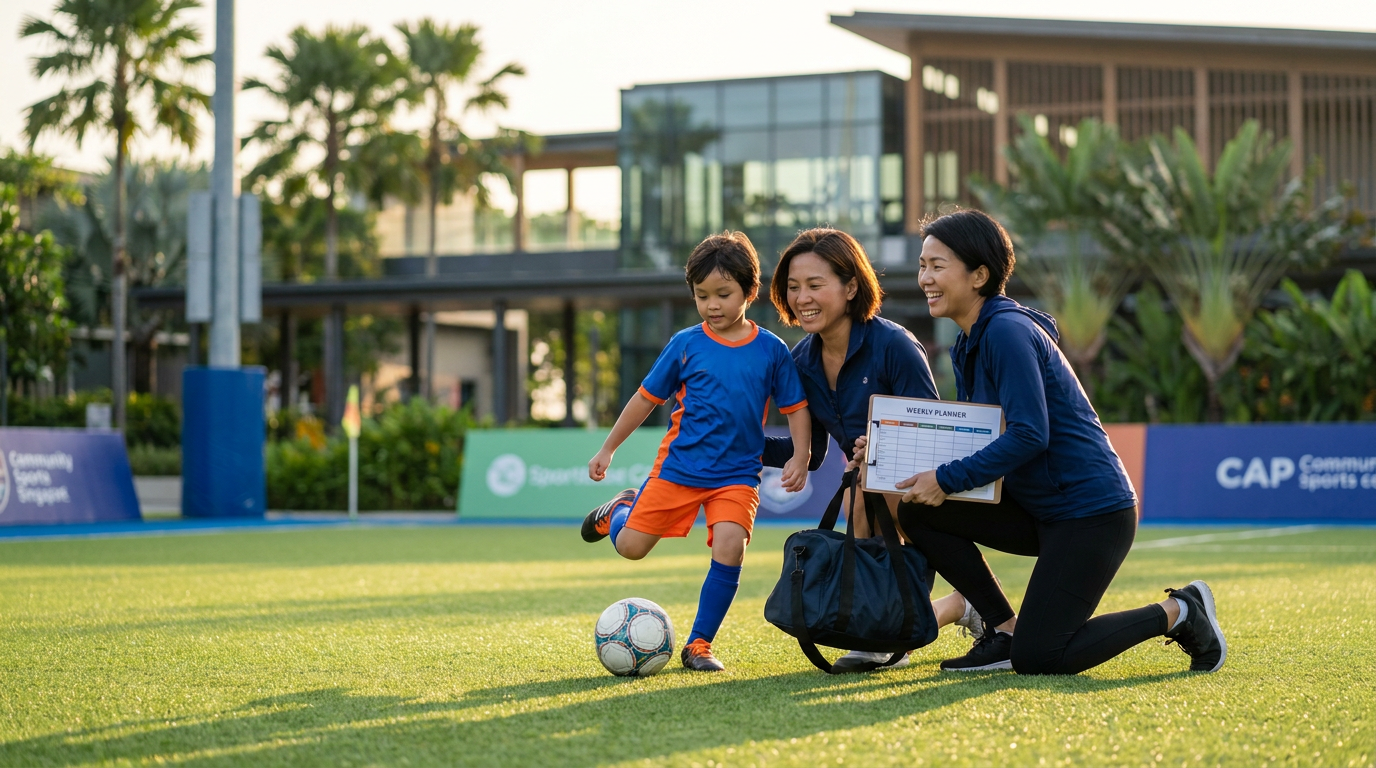
Mini soccer: Set up two small goals (or mark them with cones) and play relaxed 1v1 or 2v2 games with no goalkeeper. This format gives every child constant ball contact, which is far more developmentally valuable than big-sided games.
Hopscotch with a twist: Draw a traditional hopscotch grid in chalk, then add sport-specific actions to each square — jump on two feet, balance on one foot, do three claps before moving on. This layers coordination and sequencing skills into a familiar format.
Hoop toss and ring activities: Throwing rings or beanbags into a hoop teaches aim, force control, and patience. Space the target at varying distances to keep the challenge appropriately progressive.
Jump rope: One of the most underrated backyard sports tools, a jump rope builds cardiovascular fitness, rhythm, timing, and bilateral coordination simultaneously. Start with basic jumping and add counting games to keep motivation high.
Relay challenges: Even with just two players, relay-style games (run to the cone, come back, high-five) build speed, direction-change agility, and the delightful experience of cheering for and with another person.
At the Vivo Kids multi-sports programme, children aged 2–6 experience this kind of varied, play-based movement in a structured and nurturing environment — exactly the approach you can replicate in spirit in your own backyard.
Ages 6–12: Structured Games and Friendly Competition
School-age children are ready for more clearly defined rules, longer activity sessions, and the genuine thrill of competition (handled well). , and well-designed backyard sports satisfy that hunger while continuing to develop fundamental movement skills.
Activities that shine for this age group:
Backyard soccer challenges: Set up dribbling cone courses, shooting accuracy targets, or simple 1v1 battles. Focus on skill repetition disguised as challenge — who can score five goals first, or complete the cone course in the fastest time?
Dodgeball variations: Using soft foam balls, dodgeball in a small backyard space is an excellent way to develop spatial awareness, reaction time, and agility. Even a solo version (trying to dodge a ball thrown by a parent) builds useful athleticism.
Spikeball or bouncing net games: It is also a fantastic upper-body and reaction-speed workout for children aged 8 and up.
Target accuracy challenges: Set up a series of targets at different distances (chalk circles, stacked cans, hanging rings) and have children practice throwing, kicking, or hitting with a bat or racket. Measuring accuracy over time builds focus and discipline.
Capture the flag: Works brilliantly in any outdoor space. It develops strategic thinking, teamwork, sprinting, and the ability to handle game pressure in a fun, low-stakes context.
Classic Backyard Sports That Work in Any Space
Some activities transcend age groups and space limitations. These are the evergreen backyard sports that families return to year after year because they just work:
Kicking and dribbling: A football and two improvised goals are all you need. Kicking practice — passing against a wall, controlling bouncing balls, stopping a rolling ball with the sole of the foot — builds foundational soccer technique and can occupy children of any age for extended periods. If your child develops a genuine love for the beautiful game, the Vivo Kicks Academy offers a dedicated soccer programme for ages 6–12 that builds those backyard skills into real game intelligence.
Throwing and catching: Use anything from a soft foam ball to a tennis ball. Throwing and catching practice is rich in developmental value — it trains hand-eye coordination, spatial judgement, force modulation, and bilateral brain coordination. Progress from rolling to underarm throwing to overarm as skill develops.
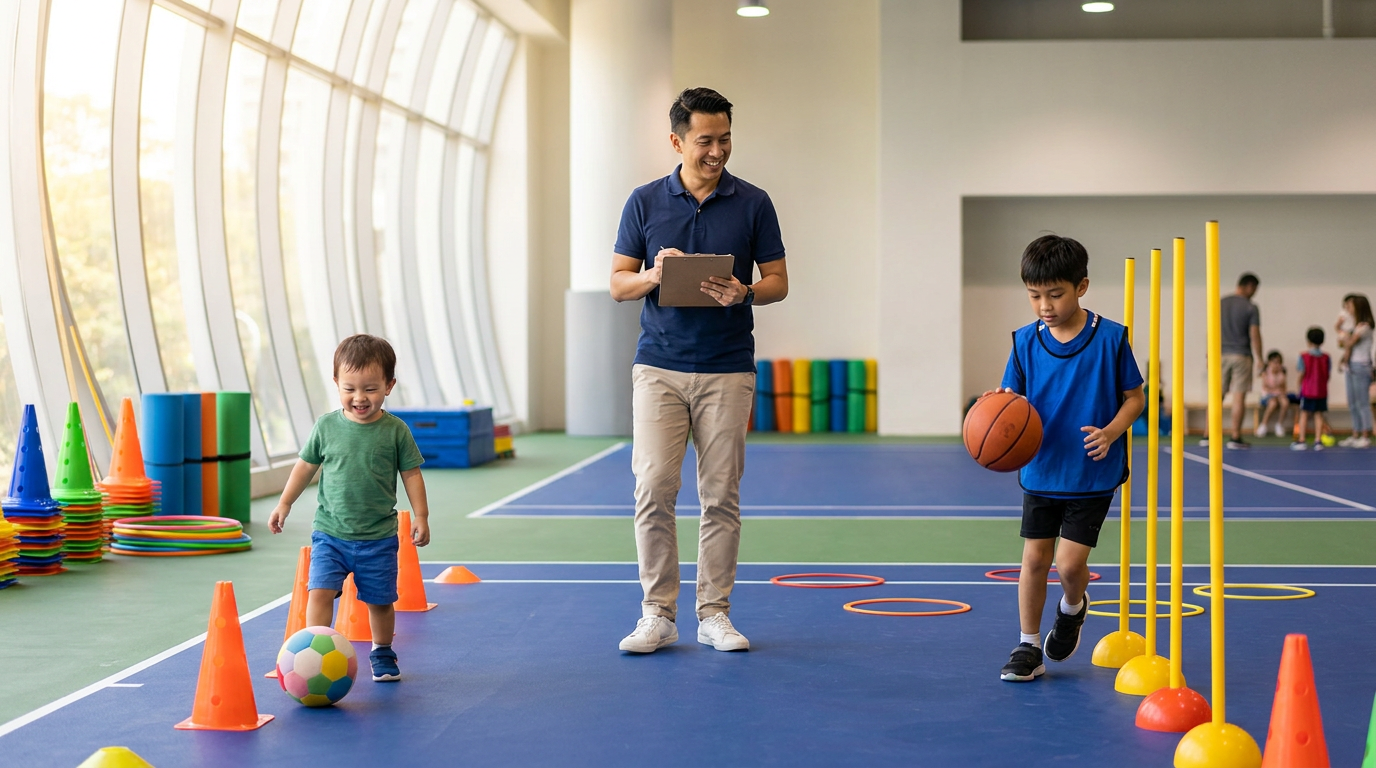
Obstacle courses: One of the most versatile backyard sports setups available. Change the layout regularly to keep the challenge fresh, and time children's runs to introduce a fun competitive element.
Jump rope and skipping games: Deceptively simple and deeply developmental, skipping builds cardiovascular fitness, coordination, timing, and rhythm simultaneously. Older children can progress to double-dutch or timed challenges.
Balancing challenges: A low balance beam (a plank of wood, a row of stepping stones, or a chalk line on the ground) is endlessly engaging. Balance activities develop core strength, proprioception, and concentration — skills that underpin every sport a child will ever play.
DIY Obstacle Courses: The Ultimate Backyard Activity
If you invest in just one backyard sports concept, make it the obstacle course. It is infinitely customisable, scales perfectly with age and ability, and delivers a full-body workout wrapped in the experience of adventure.
Here is how to build a simple but effective backyard obstacle course:
Start with a crawl section — use a tunnel, a low rope tied between two chairs, or a pair of cones to weave through on hands and knees.
Add a jumping challenge — chalk circles to leap between, a row of hula hoops to hop through, or a simple line to jump over.
Include a balance element — a beam, a row of stepping stones, or a chalk tightrope to walk along.
Incorporate a ball skill — dribble through cones, kick a ball through a goal, or throw a beanbag into a bucket before moving on.
Finish with a sprint — a short run to a finish line gives the whole sequence a satisfying, energetic ending.
Time the course with a stopwatch, challenge siblings to beat each other's scores, or run the course themed to a favourite sport or character. Rearranging the elements every few days keeps children eager to come back and try again.
How Backyard Play Connects to Bigger Sports Goals
Backyard sports activities are not just weekend entertainment — they are the foundation of every skill your child will use in structured sport. which is precisely why the free-form, multi-activity nature of backyard play is so valuable in the early years.
When a child spends afternoons kicking, throwing, jumping, and balancing in the backyard, they are building physical literacy — the ability to move confidently and competently in a range of physical situations. A child who is physically literate enters any new sport — soccer, swimming, gymnastics, tennis — with a movement vocabulary that accelerates their learning.
The connection between free backyard play and structured sport is therefore not a replacement relationship but a reinforcing one. Unstructured play builds the raw material; structured, expert coaching helps children refine it into genuine sporting skill. Both environments — the backyard and the coaching session — are essential ingredients in a well-rounded active childhood.
Tips for Keeping Backyard Play Fresh and Engaging
Even the most enthusiastic child will occasionally need a nudge to stay engaged with outdoor play. These strategies help maintain momentum across weeks and months:
Introduce a new challenge weekly. A slight variation — a new obstacle course layout, a target placed at a different distance, a new rule in an existing game — resets curiosity without requiring new equipment.
Play alongside your child. Children are far more motivated when a parent or caregiver participates. You do not need to coach; just join in. Your presence signals that physical activity is valuable and enjoyable.
Use a simple progress tracker. For older children, noting their best jump rope count, fastest obstacle course time, or most accurate throw in a week adds a layer of self-competition that sustains engagement.
Invite friends and cousins. Many backyard sports activities become dramatically more fun with two or more children. Social motivation is a powerful driver of physical activity at every age.
Celebrate effort, not just outcome. Praise the attempt, the persistence, and the willingness to try something new — not just the goal scored or the race won. This builds the intrinsic motivation children need to stay active for life.
From Backyard to the Big Field
Every confident young athlete started somewhere small — a stretch of grass, a paved driveway, a courtyard with a makeshift goal. The activities in this guide are not just ways to fill an afternoon; they are the earliest chapters of a physical story your child is writing every time they step outside to move, explore, and play.
Your backyard is the first chapter. Expert-guided sport programmes are where those early instincts and abilities get shaped into genuine skill, confidence, and a love of movement that lasts a lifetime.
When your child is ready to take their backyard enthusiasm into a structured, nurturing sporting environment, Vivo Kinetics is here to support that next step — with programmes designed by expert coaches and built around the same play-first principles that make backyard sports so powerful.
Quick Reference: Backyard Sports by Age
Age Group
Best Activities
Key Developmental Focus
2–4 years
Ball rolling, balloon games, animal walks, sensory paths
Gross motor foundations, body awareness
4–6 years
Mini soccer, hopscotch, jump rope, relay games
Hand-eye coordination, cooperative play
6–12 years
Obstacle courses, dodgeball, target challenges, capture the flag
Speed, agility, strategy, competition
Ready to Take Backyard Fun to the Next Level?
If your child loves moving, exploring, and playing outdoors, they are ready to discover what structured sports coaching can do for their development. At Vivo Kinetics, we create safe, nurturing environments where children aged 20 months to 12 years build physical skills, grow in confidence, and develop the character traits that matter both on and off the field.
Ages 2–6? Explore our award-winning Vivo Kids multi-sports programme — a play-based, multi-sport experience built around the way young children actually learn.
Ages 6–12? Discover the Vivo Kicks Academy — expert soccer coaching that turns backyard ball skills into real game ability.
Visit Vivo Kinetics to Learn More →

Comments