


Child Development Stages: A Parent's Guide to Physical Milestones from 0 to 12
Table Of Contents
Why Physical Milestones Matter More Than You Think
Stage 1 (0–20 Months): From Tummy Time to First Steps
Stage 2 (20 Months–3 Years): Moving with Purpose
Stage 3 (3–6 Years): The Golden Window for Movement Skills
Stage 4 (6–12 Years): Building Coordination, Confidence & Teamwork
Quick-Reference: Physical Milestone Infographic (Ages 0–12)
Red Flags: When to Seek Extra Support
How Structured Play Accelerates Physical Development
Supporting Your Child's Physical Journey
Child Development Stages: A Parent's Guide to Physical Milestones from 0 to 12
Every parent has felt it — that rush of joy when your baby takes their first wobbly step, or the pride of watching your six-year-old finally kick a ball with real intention. These moments aren't just milestones to photograph and share; they are windows into the remarkable, stage-by-stage story of your child's physical development.
Physical development in children from 0 to 12 years is far more than growing taller and getting stronger. It is the foundation upon which everything else is built: confidence, coordination, social connection, and even academic readiness. The gross motor skills your child masters as a toddler directly influence their ability to write, play team sports, and navigate the world as they grow.
In this guide, we break down the key physical milestones across each developmental stage — from infancy all the way to the preteen years — explaining what to expect, why it matters, and how you can actively support your child's growth. Whether your little one is just finding their feet or your older child is ready to take on more complex sports, you will find practical, research-backed guidance here.
Why Physical Milestones Matter More Than You Think
Physical milestones are behaviours and motor skills that children typically develop within certain age ranges. They cover everything from lifting the head during tummy time to executing a soccer pass with precision. Tracking these milestones gives parents and caregivers a valuable reference point — a sense of what is typical and when additional support might be helpful.
But the significance of physical development runs much deeper than a checklist. Research consistently shows that gross motor competence in early childhood is linked to brain connectivity, cognitive development, academic outcomes, and lifelong physical activity habits. A child who builds confidence in their movement abilities early is, according to studies, significantly more likely to stay active as a teenager and adult. Conversely, children who struggle with physical skills may withdraw from sport and activity over time, creating a gap that widens with age.
The physical domain also does not develop in isolation. As children move, they are simultaneously building social bonds, practising communication, learning to manage frustration, and developing focus. Movement and play are, in every real sense, the classroom of early childhood.
Stage 1 (0–20 Months): From Tummy Time to First Steps
What's Happening in the Body
At birth, your baby arrives with a set of reflexes and rapidly developing systems. The brain, which begins at just 25% of its adult size at birth, will grow to approximately 90% of adult size by age five — and this explosive neural growth is reflected directly in physical development. Movement milestones in the first 20 months follow a predictable head-to-toe, centre-to-edges pattern: babies first gain control of their neck and trunk, then progress to their shoulders and arms, and finally to their hands, fingers, legs, and feet.
Key physical milestones by age:
0–3 months: Lifts head during tummy time; kicks both legs; begins to bring hands to mouth
4–6 months: Rolls from front to back; pushes up on hands from tummy; sits with support; begins reaching for objects
7–9 months: Sits independently; begins crawling; pulls to stand with support
10–12 months: Stands independently for brief moments; walks along furniture; may take first unassisted steps
12–20 months: Walks independently; begins to run (stiffly at first); climbs stairs with help; bends and recovers without falling
What Parents Can Do
Tummy time from the very first weeks at home is one of the most impactful things you can do for your infant's gross motor development. It strengthens the neck, shoulder, and core muscles that form the foundation of everything from sitting to crawling to walking. Keep sessions short and frequent, always while your baby is awake and supervised, and make it playful by getting down on the floor with them.
As your baby grows toward walking, resist the urge to keep them still or in carriers for extended periods. Babies and toddlers need enormous amounts of floor time and free movement to build strength, balance, and coordination. Every roll, reach, and supported stand is a mini workout that shapes the neural pathways for movement.
Stage 2 (20 Months–3 Years): Moving with Purpose
Physical Development
Once toddlers are confidently on their feet, the world becomes an obstacle course they are desperate to explore. This stage is defined by increasing confidence in locomotion — running becomes less stiff, climbing becomes more daring, and the first attempts at jumping and kicking begin to emerge. Simple fundamental motor skills such as throwing objects, tumbling, and pushing and pulling develop naturally through play during this period.
From the age of 1 to 3 years, children's increasing mobility makes way for experiences that develop these early fundamental motor skills. At this stage, development can vary widely — even children of the same age may be up to 18 months apart in their speed of progress, which is entirely normal.
Key physical milestones:
Runs with more control and fewer falls
Jumps with both feet off the ground
Kicks a stationary ball
Climbs onto low furniture and playground equipment
Walks up and down stairs with assistance
Throws a ball overhand
Begins pedalling a tricycle
What Parents Can Do
At this age, free play is non-negotiable. Toddlers learn movement primarily through exploration and imitation — they watch you, and they copy you. Outdoor time, soft play areas, and simple ball games are all ideal for this stage. Avoid over-scheduling or putting pressure on specific skill outcomes; what matters most right now is that your child has lots of joyful opportunities to move.
Program-wise, toddlers at this stage benefit most from structured play environments that weave skill development into imaginative, parent-involved sessions. The Vivo Kids multi-sports programme starts as young as 20 months, offering a nurturing, play-based environment where little ones can explore movement at their own pace — alongside a caring coach and often with a parent nearby for confidence.
Stage 3 (3–6 Years): The Golden Window for Movement Skills
Physical Development
Researchers consistently identify the ages of approximately 2 to 7 years as a critical window for fundamental movement skill (FMS) development. During this phase, children establish the basic skills of stability, locomotion, and object manipulation that serve as building blocks for every sport and active pursuit later in life. Research on Singaporean children specifically has confirmed significant, accelerated motor development within this age range — with especially pronounced gains observed between ages 3.5 and 4.
This is the golden window because children in this stage can achieve high levels of competence in all fundamental motor skills, giving them the confidence and physical vocabulary to play and learn any sport. However, these skills do not develop automatically through natural maturation alone. They require guided instruction and varied practice opportunities.
Key physical milestones:
Runs with rhythm and improved direction-changing
Hops on one foot
Skips and gallops
Balances on one leg for several seconds
Catches a ball with both hands
Kicks a moving ball
Throws with improved aim and distance
Pedals a bicycle with training wheels
Climbs and descends playground equipment with confidence
What Parents Can Do
Expose your preschooler to as wide a variety of movement challenges as possible. This is the age where multi-sport play truly shines: each different type of movement — throwing, kicking, balancing, swinging — builds a different part of the motor skill repertoire, and children who experience variety at this stage develop broader physical competence than those focused on one activity alone.
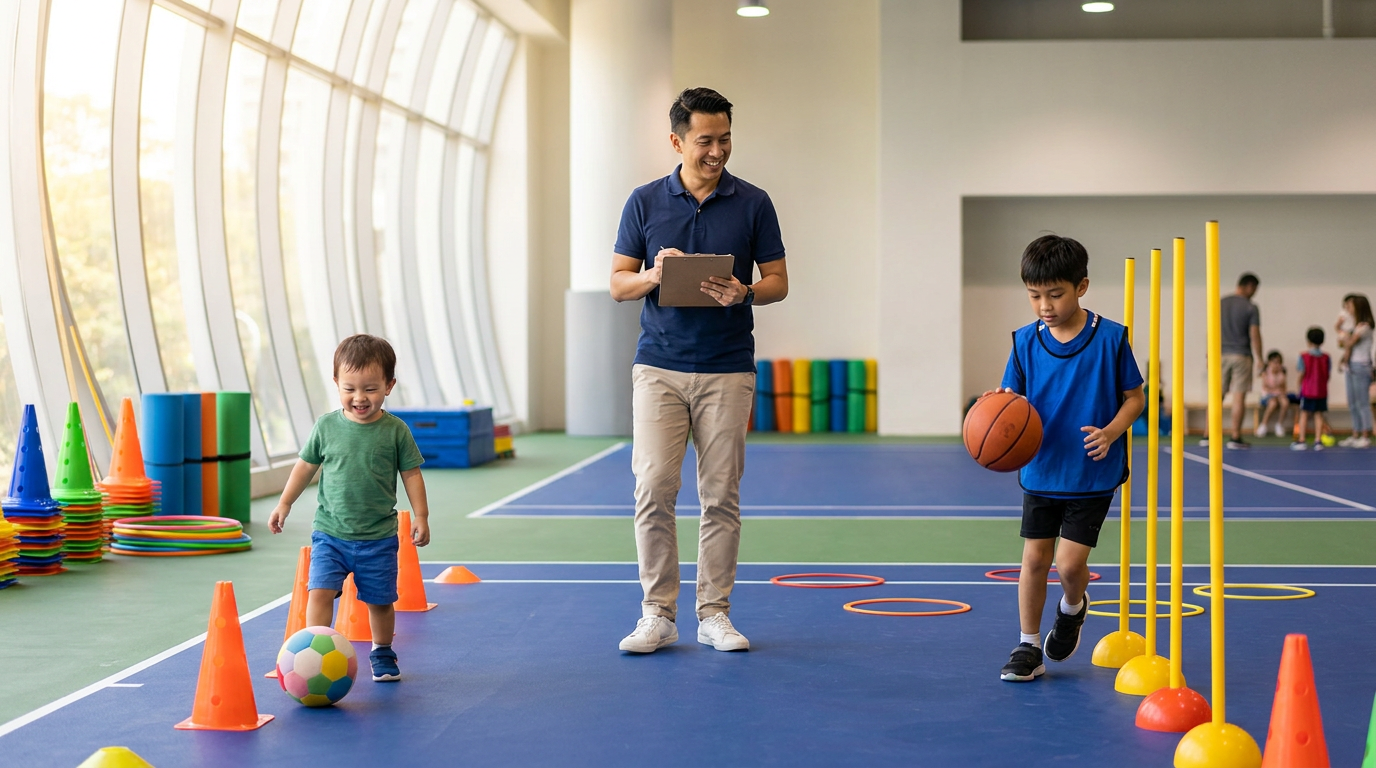
Preschoolers in this window are also ready to follow coach-led instruction without the constant presence of a parent, making this an ideal time to enrol in a structured, age-appropriate programme. The Vivo Kids multi-sports programme is designed precisely for children aged 2 to 6, using an expert-designed curriculum that builds movement skills through fun, imaginative play. Children explore a range of sports and movement challenges in a safe, encouraging environment — ensuring no child misses this crucial developmental window.
Stage 4 (6–12 Years): Building Coordination, Confidence & Teamwork
Physical Development
As children enter the school years, their physical development shifts from laying the foundations to refining and combining them. Coordination, strength, endurance, and balance continue to grow, enabling children to progress from fundamental movement skills to what researchers call transitional and eventually complex movement skills — skills that involve multiple body parts working together fluidly.
For children aged 6 to 8, this looks like combining gross motor skills into actions with purpose — running and then kicking, catching and then throwing. By 8 to 12, children begin to master complex movement sequences: a serve in tennis, a layup in basketball, or a controlled pass in soccer. The motor and cognitive systems are now developed enough to manage longer attention spans, rule-based play, basic strategy, and teamwork.
Key physical milestones (6–8 years):
Rides a bicycle without training wheels
Skips, hops, and jumps with control and rhythm
Throws and catches with accuracy
Runs and kicks simultaneously
Shows developing strength and endurance in sustained play
Fine motor skills allow for neat handwriting and detailed drawings
Key physical milestones (8–12 years):
Executes complex multi-step motor sequences (e.g., running to kick, jumping to catch)
Demonstrates improved reaction time and spatial awareness
Builds sustained stamina for longer activities
Shows greater coordination between upper and lower body
Girls and boys begin to show gradual, modest differences in strength as puberty approaches
What Parents Can Do
This stage is about exploration and expanding complexity. Encourage your child to try multiple sports rather than specialising early — children who sample a variety of sports continue to develop broader motor competence and are less susceptible to overuse injuries and burnout. Introduce rule-based games and team activities, and ensure any programme or sport focuses on skill development and enjoyment before competition.
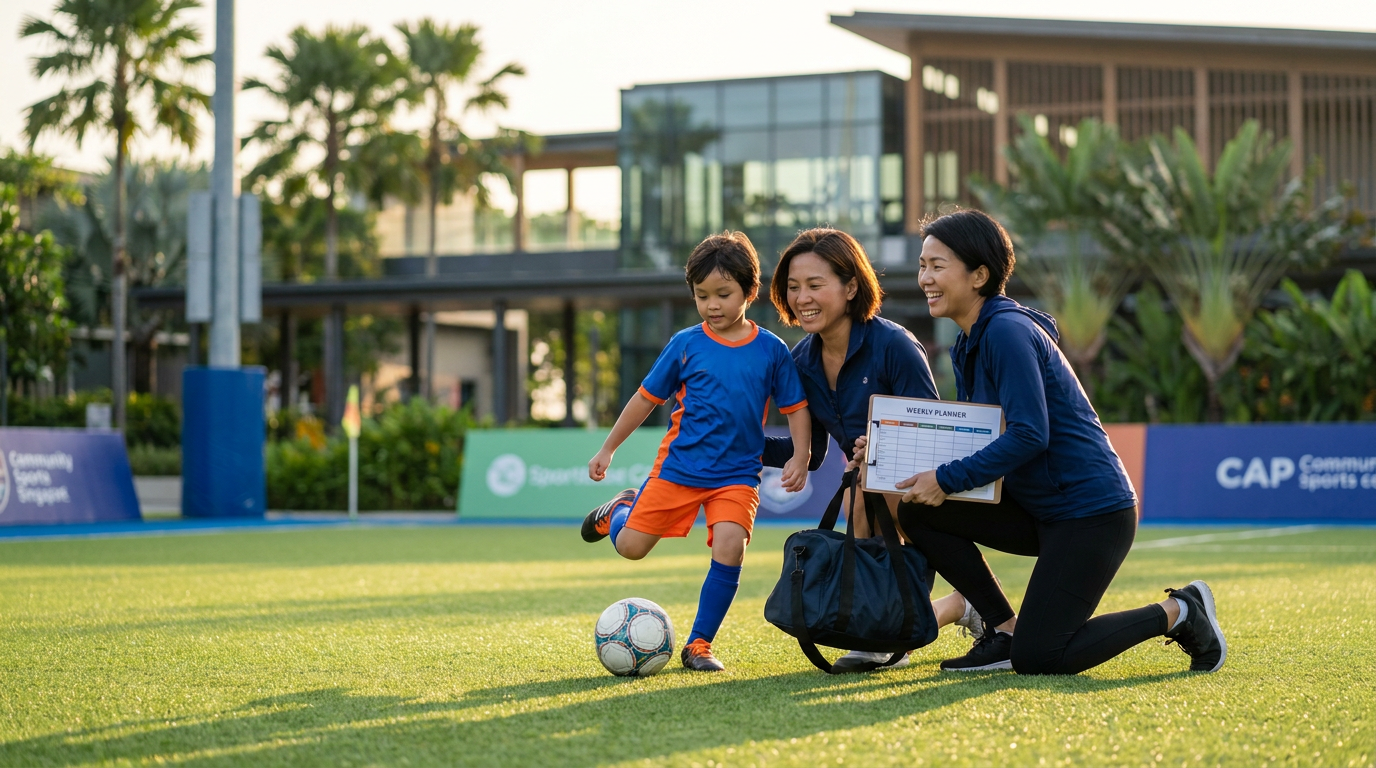
For children aged 6 and above who have a love for football, the Vivo Kicks Academy offers a focused, age-appropriate soccer programme that builds technical skills, teamwork, and on-field confidence in a fun, structured environment. Expert coaches work with each child at their developmental level — keeping the emphasis firmly on learning and enjoyment.
Quick-Reference: Physical Milestone Infographic (Ages 0–12)
Red Flags: When to Seek Extra Support
Developmental milestones exist on a spectrum, and no two children follow exactly the same timeline. A child who walks at 10 months and one who walks at 16 months are both within the normal range. What parents should watch for are persistent patterns of delay across multiple skills, or the loss of skills a child previously had.
Consider speaking with your paediatrician if your child:
Has not walked independently by 18 months
Cannot jump with both feet by age 3
Consistently avoids physical play or tires very quickly
Shows marked asymmetry in how they use their arms or legs
Has not mastered basic ball skills (kicking, catching) by age 5
Frequently trips, falls, or appears very uncoordinated for their age
Early intervention matters enormously — the sooner any developmental concern is identified, the more effective support tends to be. Your child's paediatrician can refer you to a physiotherapist or occupational therapist who specialises in childhood motor development.
How Structured Play Accelerates Physical Development
One of the most important things parents can take away from the science of child development is this: fundamental movement skills do not develop automatically. Natural maturation alone is not sufficient. Children need opportunities to practise, with guidance, across a variety of movement challenges.
Research shows that structured movement programmes and FMS-focused interventions produce significantly better outcomes in motor skill proficiency for young children compared to unstructured free play alone. This is especially true during the ages of 2 to 6, where quality instruction in movement not only develops physical ability but also improves perceptual, social, and cognitive skills. The connection between motor competence and academic outcomes is well-documented: early fine motor skills predict later visuospatial reasoning, and cognitively challenging motor activities enhance executive functioning and mathematical problem-solving.
For school-age children, sport and structured physical activity go even further. Multiple studies confirm that children involved in sports programmes have higher social skill scores than those who don't participate in extracurricular activities. They develop confidence, learn to manage emotions around winning and losing, practise teamwork, and build the kind of resilience that carries over into every area of life.
The key is choosing programmes that are age-appropriate, skill-progressive, and play-based — not overly competitive or focused on performance outcomes before the child is developmentally ready.
Supporting Your Child's Physical Journey
Physical development from 0 to 12 years is one of the most dynamic, exciting, and impactful journeys your child will take — and you have a significant role in shaping it. Understanding what is happening in your child's body and brain at each stage helps you respond with the right activities, the right encouragement, and the right environment at the right time.
A few principles to carry with you:
Follow your child's lead. Enthusiasm and enjoyment are the most powerful motivators for sustained physical activity.
Prioritise variety over specialisation, especially before age 10. Children who explore many types of movement build the broadest physical foundation.
Choose programmes led by coaches who understand child development — not just the sport. The quality of the coaching relationship matters enormously for confidence and long-term engagement.
Celebrate effort, not just achievement. A child who tries, falls, and tries again is building something far more valuable than any single skill.
Every child who grows up with confidence in their body — who knows they can kick, run, balance, catch, and play — carries that confidence into adolescence and adulthood. The physical milestones of childhood are not just developmental checkboxes. They are the roots of a healthy, active, joyful life.
Ready to Support Your Child's Physical Development?
At Vivo Kinetics, we have built award-winning programmes around exactly these developmental stages — so every child gets the right movement experiences at the right time.
For children aged 20 months to 6 years, our Vivo Kids multi-sports programme combines play-based learning, expert coaching, and an age-appropriate curriculum to build fundamental movement skills and lasting confidence — right in that golden developmental window.
For children aged 6 to 12 years, Vivo Kicks Academy offers a structured, joyful soccer environment where growing athletes develop technical skills, teamwork, and a genuine love of the game.
Recognised as Best Children's Multi-sport Programme 2024 and Recognized Leaders in Children's Health & Fitness in Southeast Asia, Vivo Kinetics is Singapore's trusted partner in raising healthy, active, confident children.
👉 Explore our programmes at vivokinetics.com and give your child the physical foundation they deserve.

Comments