


Childcare Sports Activities: What's Included and Why It Matters for Your Child
Table Of Contents
Why Sports Activities Belong in Childcare
What Sports Activities Are Typically Included
Age-Appropriate Sports: Matching Activities to Development
The Four Pillars of Development That Sport Builds
From Multi-Sport to Specialist: How Children Progress
What to Look For in a Quality Childcare Sports Program
How Vivo Kinetics Brings It All Together
Childcare Sports Activities: What's Included and Why It Matters for Your Child
You've probably watched your child tear across the living room at full speed, climb everything in sight, or kick a ball into the furniture with remarkable enthusiasm — and thought: there has to be somewhere to channel this energy. There is. Childcare sports activities are structured, play-based programs designed to give children aged as young as 20 months the physical outlet, social experiences, and developmental foundations they need to thrive. But with so many options available, parents often wonder: what exactly is included, and is it actually worth it?
The short answer is yes — and the detail behind that answer is what this guide covers. From the specific activities that feature in quality programs, to the developmental milestones they support, to how you choose the right fit for your child's age and personality, you'll find everything you need here. Whether your little one is a toddler just finding their feet or a confident primary-school-age child ready for their first soccer academy, understanding what good childcare sports programming looks like is the first step to making a great choice.
Why Sports Activities Belong in Childcare
For a long time, physical activity in early childhood was thought of as simply "letting kids play." We now understand it's far more deliberate and far more important than that. Participating in a sport allows young children to build skills and challenge themselves as they learn the rules, physical techniques, and importance of teamwork — and preschool-aged children who play sports or take part in organised physical activities appear to have better emotional health, social skills, and self-regulation abilities.
That's a remarkable set of outcomes from what, to a child, simply feels like fun. Preschoolers should be active throughout the day to build a strong foundation for a healthy lifestyle, and regular movement lowers the risk of childhood obesity, improves anxiety management, and fosters social skills. When sports are woven into a childcare or enrichment setting — with qualified coaches, age-appropriate activities, and a nurturing environment — the benefits compound quickly.
Early sports exposure also helps children get used to structure. Even a very simple game teaches them that there is a beginning, a few rules, a turn to wait for, and an ending — and that pattern is valuable for preschool and kindergarten readiness, because classroom learning works in much the same way. In other words, the sports field and the classroom are far more connected than they might appear.
What Sports Activities Are Typically Included
Quality childcare sports programs don't focus on one sport — especially not for younger children. The gold standard approach is multi-sport exploration, which introduces children to a rotating variety of activities so they build broad physical literacy rather than narrow, premature specialisation. A multi-sports program allows children to experience and train in a variety of sports instead of focusing on just one, emphasising the development of fundamental movement skills like running, jumping, throwing, and catching — while keeping the focus on fun, variety, and overall growth.
Here's what you can expect to find included across well-designed childcare sports programs:
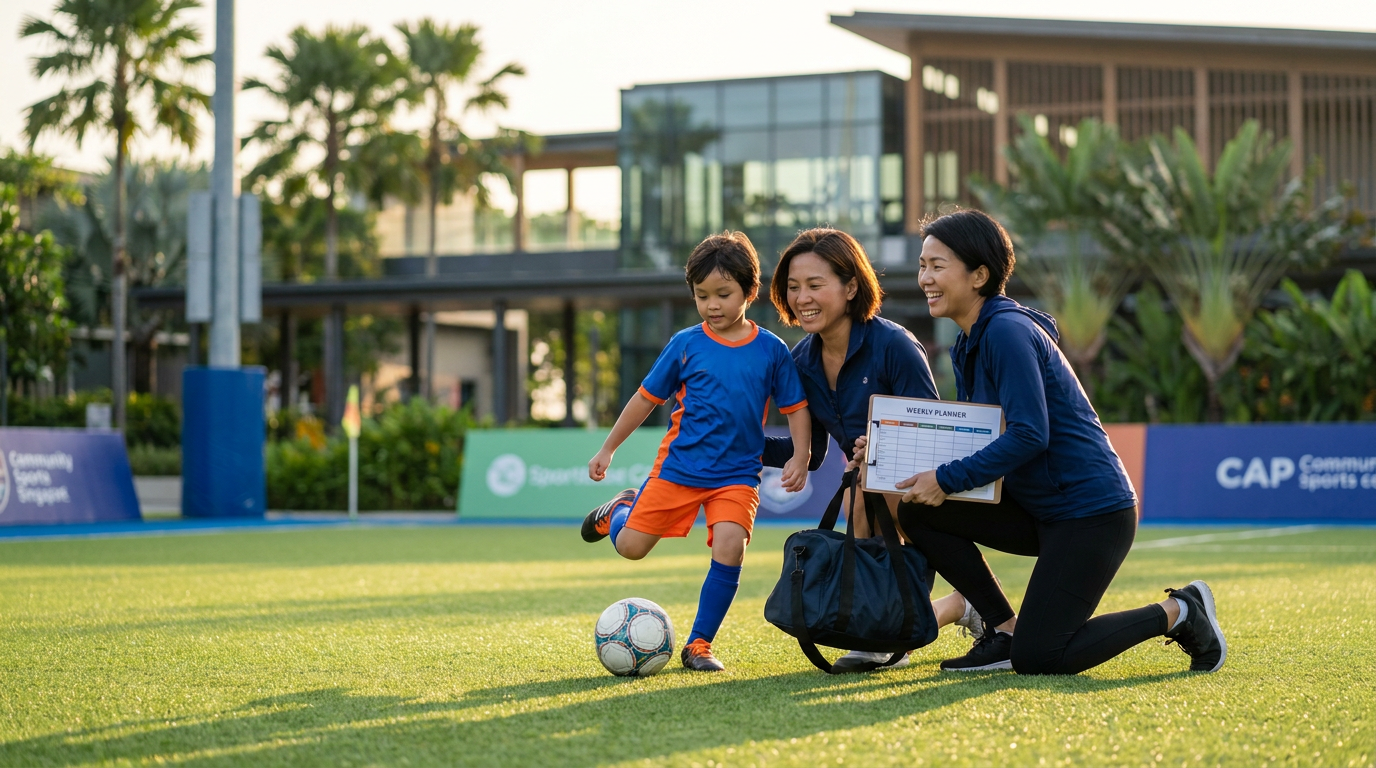
Soccer and ball games — Kicking, passing, dribbling, and simple team activities that build foot-eye coordination and spatial awareness.
Basketball and target games — Throwing, catching, and aiming activities that develop hand-eye coordination and upper-body strength.
Athletics fundamentals — Running games, relay races, jumping, and hopping exercises that build cardiovascular fitness and gross motor control.
Gymnastics and movement play — Rolling, tumbling, balancing, and climbing activities on padded, age-appropriate equipment.
Hockey and striking skills — Using soft sticks and lightweight balls to develop bilateral coordination and tracking skills.
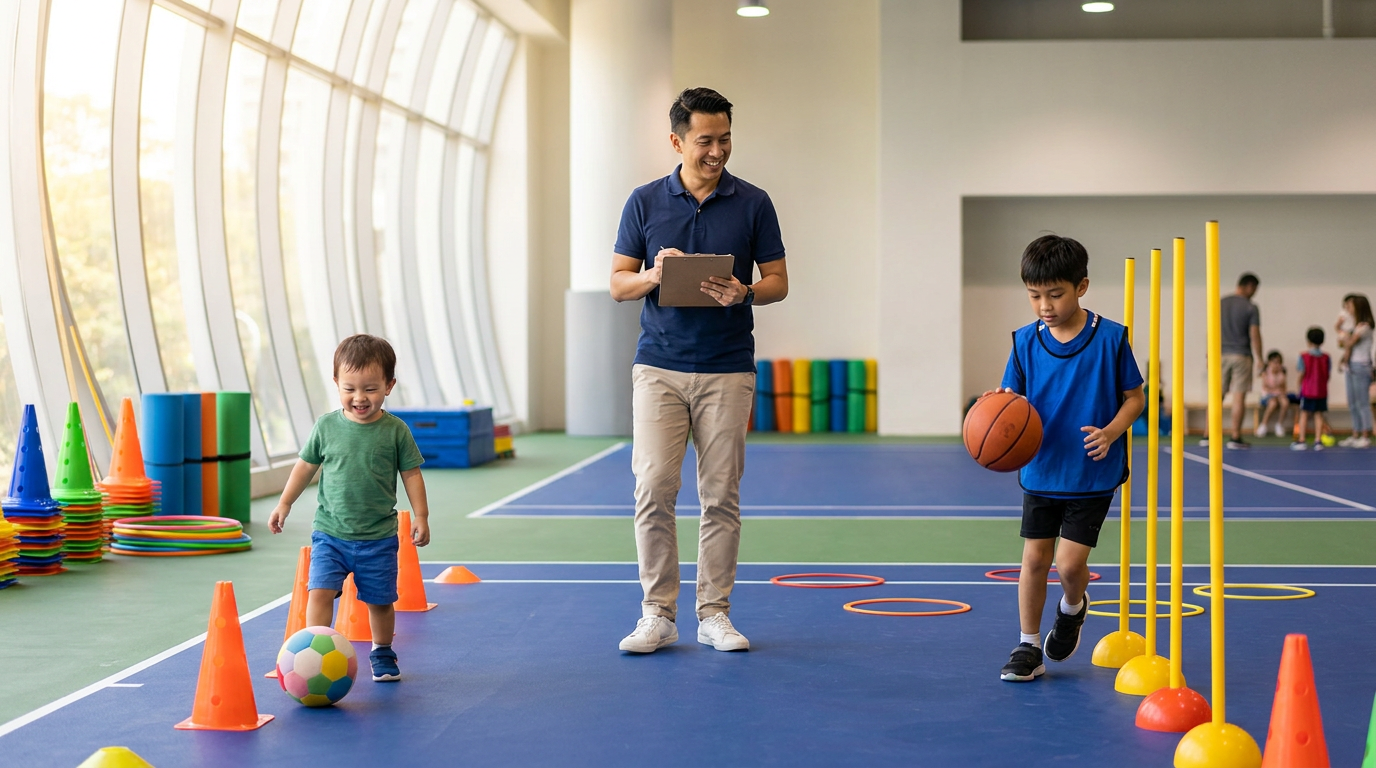
Obstacle courses and agility circuits — Obstacle courses and agility activities build spatial awareness and body confidence; crawling through tunnels, jumping over soft barriers, and navigating simple routes teach children to read and respond to their environment.
Music and movement sessions — Rhythm-based games that integrate physical expression with listening and coordination skills, especially effective with toddlers.
Relay games and team challenges — Cooperative games that introduce turn-taking, basic rules, and the joy of working together.
Multi-sport programs teach kids fundamental movement skills such as kicking, running, jumping, throwing, catching, and skipping — all within a single, structured session. The variety keeps children engaged while ensuring no single movement pattern is overworked at a formative age.
Age-Appropriate Sports: Matching Activities to Development
One of the most important features of any quality childcare sports program is age-appropriateness. Not all activities suit all children, and the most effective programs tailor their curriculum closely to developmental stage.
Toddlers (20 months – 3 years)
Kids aged 2–3 are walking, running, kicking, and throwing. They're naturally active, so the goal is to provide lots of chances to practise and build on these skills. At this stage, activities should be gentle, play-led, and repetitive in the best sense — short circuits of ball play, simple balance tasks, and movement games that feel more like imaginative play than structured sport. Rotating through activities like kicking a ball, balancing on a beam, throwing, catching, and simple agility courses helps children build a wide base of motor skills without the pressure of mastering one sport prematurely.
Preschoolers (3 – 6 years)
This stage is all about play-based, multi-movement activity — parent-and-child sessions, gentle gymnastics or movement play, and multi-sport sessions that mix running, balancing, and ball games. The aim is exposure and fun, not technique. Children at this age are beginning to understand simple rules, enjoy peer interaction, and can sustain attention for slightly longer activities. Soccer-style games, basic basketball skills, and team relays become increasingly engaging.
Primary School Age (6 – 12 years)
By this stage, children are ready for more structured skill development. Pre-kindergarten to school-age children benefit from skill-based circuits, cooperative games, and small-sided sports that emphasise rules, turn-taking, and strategy. They can handle proper technique coaching, positional awareness in team sports, and the healthy challenge of light competitive play. This is where a dedicated sport like soccer becomes highly rewarding.
The Four Pillars of Development That Sport Builds
Ask any early childhood expert what makes childcare sports activities genuinely valuable, and they'll point well beyond physical fitness. Great programs develop children across four interconnected dimensions.
1. Physical Development The most obvious benefit of sports is physical activity — but for young kids, the value is deeper than just burning energy. Regular movement helps strengthen muscles, improve balance, and build coordination; it also supports heart health, sleep quality, and healthy growth. These physical foundations carry children through school, sport, and everyday life.
2. Social Development Being on a team of their peers comes with major benefits for preschoolers. Interacting with others their age to work together fosters everything from empathy and creativity to a strong sense of self. At the same time, children learn to take turns, wait for their own turn, and follow directions. These are skills that transfer directly into classroom and home life.
3. Emotional Development Children's reactions to sports activities range from delight to disappointment. This experience fosters emotional resilience from a young age by helping them understand and effectively manage their emotions. Learning to handle a missed goal, cheer on a teammate, or try again after a stumble are micro-lessons in emotional intelligence that compound over years.
4. Cognitive Development One of the most notable benefits of sports programmes is their focus on holistic development. Through a wide range of fundamental movement skills and sport activities, children not only improve their physical abilities but also develop essential life skills such as teamwork, resilience, discipline, and leadership. Research also shows that vigorous physical movement can help with improving attention spans, and young children learn skills in a more specific and repetitive way through organised sports.
From Multi-Sport to Specialist: How Children Progress
One of the most common questions parents ask is: when should my child stop doing multi-sport and start specialising? The answer, supported by research and practitioner consensus, is: later than you think. There is growing evidence and expert consensus that rather than pushing children into one sport very early, giving them access to multiple sports is better — for both their performance and their well-being.
Multi-sport should continue to span over the childhood years to support kids as they are developing fundamental movement skills at each age and stage — because the more kids see and practise a skill, the better they get at it. After being part of a good multi-sport program, kids will have the movement skills for any individual sport of their choosing in their teen and adult years.
The natural transition point for many children is around 6 years old, when they've built enough physical literacy and social confidence to thrive in a more focused environment. A well-structured specialist program at this stage builds directly on multi-sport foundations rather than starting from scratch.
At Vivo Kinetics, this progression is built into the programming design. The Vivo Kids multi-sports programme caters to children aged 22 months to 6 years with a play-based, multi-sport curriculum that develops movement skills and character in a safe, positive environment. When children are ready to take the next step, Vivo Kicks Academy offers structured soccer coaching for ages 6 to 12, where the technical and tactical aspects of the game are explored in a nurturing and fun learning environment.
What to Look For in a Quality Childcare Sports Program
Not all children's sports programs are created equal. Here are the key markers that separate genuinely developmental programs from those that simply occupy time.
Age-appropriate curriculum — Sessions should be designed specifically for the developmental stage of the children, not scaled-down versions of adult sport.
Qualified, child-focused coaches — A good multi-sport program has coaches that understand how to teach and make sport fun for kids. Look for coaches who are trained in child development, not just in sport.
Play-based methodology — Especially for children under 6, activities should feel like play. The aim at the toddler and preschool stage is exposure and fun, not technique. Programs that push formal technique too early can extinguish a child's natural love of movement.
Safe, appropriate equipment — Modified, lightweight, and soft equipment is essential for young children to participate confidently and safely.
Character and values development — The best programs go beyond physical outcomes. Look for programs that explicitly cultivate traits like resilience, teamwork, sportsmanship, and confidence.
Positive, non-competitive environment — For children from 16 months to 12 years, a non-competitive, multi-sport program is a gentle, low-risk way to build skills and confidence across many sports.
Structured variety — A rotation of different sports and activities ensures broad skill development and keeps children motivated across sessions.
How Vivo Kinetics Brings It All Together
For families in Singapore looking for a program that genuinely delivers on all of the above, Vivo Kinetics stands out as one of the region's most recognised providers of children's sports and fitness programming. As an award-winning company recognised as "Best Children's Multi-sport Programme 2024" and a "Recognised Leader in Children's Health & Fitness" in Southeast Asia, the programs are built on expert coaching, age-appropriate curriculum design, and a deep commitment to healthy active living through play.
The Vivo Kids multi-sports programme is designed for children aged 22 months to 6 years and brings together ball sports, agility play, movement games, music and movement sessions, and social activities in a structured yet joyful environment. Every session is crafted to nurture intellectual, social, emotional, and physical growth at each child's own pace.
For older children ready to go deeper into one sport, Vivo Kicks Academy provides structured soccer coaching for ages 6 to 12, combining technical skill development with tactical understanding in an environment that remains fun and encouraging throughout. Beyond weekly classes, Vivo Kinetics also offers Camposaur holiday camps, birthday parties featuring six different sports and team games, and school-readiness programming through Vivo Play — ensuring there's an entry point and a next step for every child at every age.
The Takeaway
Childcare sports activities are much more than supervised playtime. At their best, they are carefully designed developmental experiences that give children the physical skills, social confidence, emotional resilience, and cognitive foundations to thrive in school and in life. The sports themselves — soccer, basketball, gymnastics, athletics, agility play, and more — are the vehicle. The real destination is a child who moves well, plays well with others, handles challenges, and genuinely loves being active.
The earlier children are introduced to quality, play-based sports programs, the longer that foundation has to grow. Whether your child is a toddler just starting to kick a ball or a six-year-old ready for their first real soccer session, the right program is out there — and the benefits of finding it are lasting.
Ready to give your child the best start in sport?
Explore Vivo Kinetics' award-winning programs for children aged 20 months to 12 years — from play-based multi-sport sessions to specialist soccer coaching.
Discover All Programs at Vivo Kinetics →

Comments