


DSA Sports Singapore: A Parent's Complete Guide to Direct School Admission Through Athletics
Table Of Contents
What Is DSA Sports and How Does It Work?
Which Sports Are Offered Under DSA?
What Schools Actually Assess in Sports DSA Trials
Building a Strong Sports DSA Portfolio
The Age-by-Age Sports Development Roadmap
The DSA Sports Application Timeline
Financial Assistance for Sports Training
Frequently Asked Questions
Every Singapore parent with a sporty child has heard the phrase at some point: your child could do DSA through sports. Sometimes it comes from a well-meaning relative, sometimes from another parent on the sideline at a Saturday football session. And every time, it opens a door to a whole new set of questions.
Direct School Admission (DSA) through sports is one of the most legitimate and well-established talent pathways in Singapore's secondary school system. Done well, it rewards years of genuine athletic development — not last-minute cramming. But it also comes wrapped in a prep industry that can make the whole thing feel more complicated, more expensive, and more urgent than it needs to be.
This guide cuts through that noise. Whether your child is six and kicking a ball around the park, or ten and already training with a school team, here is what the DSA sports pathway actually involves, what schools genuinely look for, and how to build the kind of foundation that holds up in a trial room.
What Is DSA Sports and How Does It Work?
Direct School Admission, or DSA-Sec, is a Ministry of Education scheme introduced in 2004 that allows Primary 6 students to secure a place in a secondary school based on talent — before PSLE results are out. Sports and Games is one of the most popular talent categories, and it is also one of the most genuinely meritocratic: you either move well in a trial or you don't.
DSA is a programme that allows secondary schools to admit a select number of Primary 6 students based on their talents, achievements, and character — not solely on PSLE results. The process is centralised through the MOE DSA-Sec portal, applications are free, and students may apply to up to three schools, each paired with a specific talent area.
One number worth holding onto: most schools cap DSA at 20% of S1 places, while four schools — NUS High, SOTA, SST, and Singapore Sports School — admit close to 100% of students through DSA. For Singapore Sports School in particular, DSA is not an alternative route; it is the only route. Most student-athletes apply to join Sports School via DSA when they are at Primary 6 level.
If your child receives a Confirmed Offer, they skip the Secondary 1 Posting Exercise and go directly to that school — but the commitment runs both ways. A Confirmed Offer skips S1 Posting but locks the talent commitment for at least two years, and the student still needs to meet a PSLE Achievement Level total of 22 or below for IP or Express stream entry. Academics still matter, so keeping schoolwork steady throughout training is non-negotiable.
Which Sports Are Offered Under DSA?
P6 students can apply for DSA-Sec based on a wide range of talents, with Sports and Games being one of the main categories. Across Singapore's 147 participating secondary schools, the sports on offer span individual and team disciplines.
Sports and Games options include athletics, swimming, basketball, badminton, football, tennis, shooting, rugby, and gymnastics, among others. Beyond these mainstream sports, schools also offer canoeing, cross country, fencing, judo, sailing, table tennis, tchoukball, volleyball, water polo, wushu, and more — the list varies by school.
For the Singapore Sports School specifically, it offers DSA opportunities across a wide range of sports, including aquatics, athletics, badminton, fencing, football, gymnastics, shooting, table tennis, taekwondo, and wushu.
The practical takeaway for parents: before fixating on a sport, check which schools offer DSA in that area and whether the school's overall academic environment and culture suit your child. The best DSA school is usually one where your child can realistically contribute and sustain the commitment — good fit matters more than prestige.
What Schools Actually Assess in Sports DSA Trials
This is where the preparation industry tends to oversell, so it is worth being precise. Sports DSA trials are not just fitness tests, and they are not just a showcase of trophies.
For sports trials, schools typically assess technical skills, physical fitness, game sense, and coachability. Your child may participate in drills, small-sided games, or fitness tests — and coaches observe not just current ability but potential for development and attitude during training. That last part is critical. A child who responds well to feedback during a trial signals to coaches that they will be coachable for the next four to six years.
Schools look for trial performance, competition results at zonal or national level, CCA track record, and coachability. But these elements are weighted differently depending on the school. A school building a niche sport programme may prioritise raw potential and attitude. An established powerhouse school may expect zonal representation as a baseline.
The interview component deserves equal preparation. During the interview, your child will be asked to articulate their passion for their sport, their goals, and their understanding of the school's values. They should be able to speak clearly, confidently, and enthusiastically, and explain why they love their sport, what they hope to achieve, and how they can contribute to the school's sporting community.
One thing selection panels are consistently good at detecting: a child who is doing the sport because of a parent rather than because of genuine love for it. A child who can talk about what they learned from losing, from being dropped from a team, or from mastering a skill they found difficult — that is the kind of authenticity that holds up under questioning. The portfolio evidence should be something your child can speak to naturally and confidently — a portfolio full of achievements they cannot explain under questioning will raise more questions than it answers.
Building a Strong Sports DSA Portfolio
A strong sports portfolio is not a pile of certificates. It is a story of development — and the best time to start building it is long before May of P6.
Demonstrated progression goes beyond simply listing what your child has done. It shows how they have improved, moved to higher levels of competition, and deepened their understanding of the discipline — a child who competed at school level in Primary 4 and reached zonal or national level by Primary 6 is telling a compelling story of growth.
Here is what belongs in a sports DSA portfolio:
Competition results — zonal, national, or school-level placings with dates and categories
Training history — structured external coaching records, including academy name, duration, and frequency
CCA records — school team participation, representative roles, or CCA leadership positions
Coach or trainer endorsements — a brief written assessment from a certified coach carries weight
Reflection notes — short personal annotations on what a particular result or setback taught your child
If your child didn't win a major competition but learned valuable lessons from the experience, a short note explaining what they gained demonstrates maturity and growth mindset — schools are not just looking for winners, but for students who will contribute positively to their programmes.
For sports, structured training should ideally begin by Primary 4 at the latest, and national-level competition experience by Primary 5 significantly improves chances at top sports schools.
The Age-by-Age Sports Development Roadmap
Building a credible sports DSA foundation is a multi-year project — but the good news is that the early years are the easiest and most enjoyable part. Here is how to approach each stage.
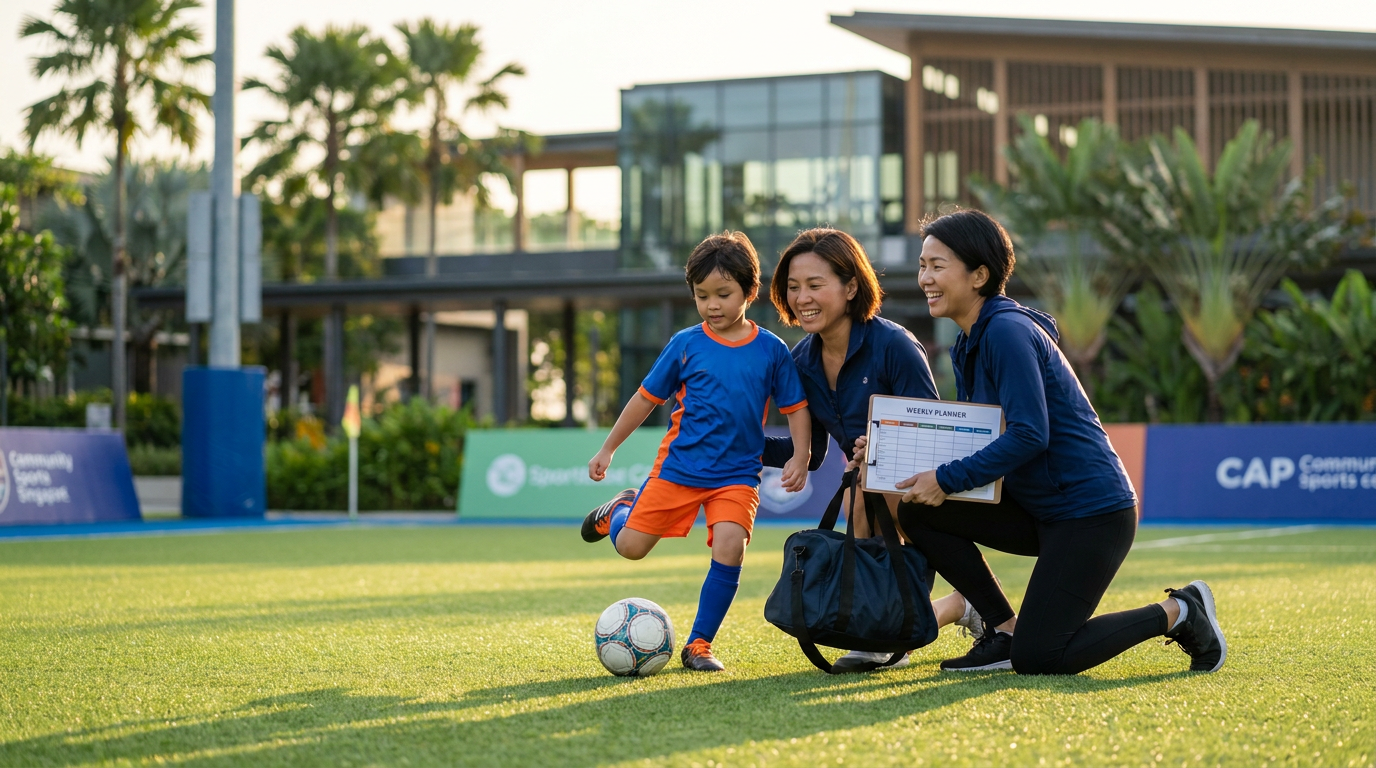
Ages 2 to 6: Build the Movement Foundation
This is not DSA preparation — and it should not be treated as such. But it is the most important developmental window for the physical literacy that underpins every sport. The goal in the toddler and preschool years is not to produce a champion or to specialise early. It is to help your child feel capable and genuinely enjoy moving, so that sport stays fun — children who build strong fundamental movement skills early tend to stay active for years afterward.
Multi-sport play programmes in these years — the kind that build balance, coordination, spatial awareness, and confidence through games — are the most developmental investment a parent can make. At Vivo Kinetics, the Vivo Kids multi-sports programme is designed exactly for this window: ages 2 to 6, play-based, expert-coached, and focused on the movement fundamentals that translate into every sport a child may later specialise in.
Ages 6 to 8: Sample Widely, Commit Lightly
Early primary is the sweet spot for sampling widely — a term of swimming, a term of multi-sport, a try at gymnastics or a beginner martial art. Children still do best in low-pressure, games-first settings rather than heavy competition. The broader the base of movement skills they build now, the easier any future sport becomes.
The worst thing a parent can do at this stage is pick a sport for their child and lock them in. A child performing someone else's interest is very easy to spot in a DSA interview at twelve.
For children who have developed a love for football specifically, the Vivo Kicks Academy offers structured, age-appropriate football development from age 6 — building technical skills, teamwork, and the kind of early sporting identity that becomes a genuine story to tell in years to come.
Ages 9 to 10 (P3 to P4): Back the Winner
When one sport clearly pulls ahead, this is the time to invest more seriously in it. Better coaching, a real team, actual competitions, and consistent training schedules. This is also the age when children learn whether they love a sport enough to push through a plateau — and that willingness to persist through difficulty is exactly what selection panels are trying to detect. Starting earlier is beneficial because it gives children more time to enjoy and explore their sport while gradually building strong foundations, confidence, and experience without rushing — and if DSA later becomes a goal, they will have a stronger foundation to work from.
For sports with strong DSA representation, Primary 4 is a good time to start having conversations with coaches about DSA aspirations and whether the child's trajectory supports it.
Ages 11 to 12 (P5 to P6): Build the Record, Then Trust the Work
This is the window for consolidation and documentation. Start a dedicated folder — competition results, training records, certificates, photographs, coach endorsements, and dates. Reconstructing four years of athletic history in May of P6, while managing PSLE preparation, is genuinely stressful, and the achievements lost in the rush are usually the most meaningful ones.
Some schools invite P5 students for talent identification trials as early as Primary 5, so staying connected to school sports teams and entering competitions at this stage matters. The portfolio should be ready before the portal opens, not assembled during the application window.
And keep the academics steady. An athletic offer accepted to a school whose PSLE requirement cannot be met helps nobody.
The DSA Sports Application Timeline
The DSA exercise runs on a fixed annual cycle. The 2026 exercise followed this timeline, and future cycles follow the same structure:
Stage | Approximate Timing |
Schools publish talent areas and criteria | January to April |
DSA-Sec portal opens for applications | Early May |
Application window closes | Early June |
Shortlisting notifications sent | From early July |
Sports trials and interviews | July to August |
School offers released | Late August |
Rank school preferences in portal | By late October |
Final results, alongside PSLE outcomes | November |
Always check MOE's DSA-Sec page directly for confirmed dates each year — they shift slightly and group-chat screenshots are often outdated. Note that Singapore Sports School runs its own admissions process with a separate timeline; check its website independently.
Financial Assistance for Sports Training
Quality sports coaching has a real cost, and it is worth knowing that support exists before ruling anything out.
The Junior Sports Academy, run by MOE with the National Youth Sports Institute, gives selected Primary 4 and Primary 5 students up to two years of coaching at no fee. Nomination comes through the child's primary school, so parents should ask the form teacher directly rather than waiting to be noticed.
Beyond this, the MOE Financial Assistance Scheme, the Opportunity Fund, and the Independent School Bursary (for independent schools) all exist to help families manage education-related costs. If training fees are the obstacle, talk to the school before making assumptions about what is or isn't possible.
Frequently Asked Questions
Can my child apply for DSA sports without medals or certificates?
While achievements are helpful, many schools look for potential and passion rather than just accolades. Some students are selected based on their performance during trials and interviews, even without prior medals or certificates — schools often value attitude, coachability, and natural aptitude.
How many schools can my child apply to through DSA sports?
Students can submit up to three DSA applications, each pairing a school with a talent area, with a maximum of two applications to the same school. Three strong, well-researched choices are more effective than three aspirational long shots.
Does a DSA sports offer mean my child can skip PSLE?
No. If multiple offers are received, only one can be accepted — and this is a binding commitment, meaning the child proceeds directly to the DSA school regardless of PSLE score. However, the PSLE score must still meet the school's stream requirements, so academic preparation cannot be deprioritised.
What if my child doesn't get a DSA offer?
Most DSA applications do not result in offers — the 20% cap ensures this is the outcome for the majority of applicants. A no from a selection panel reflects fit and available places, not a verdict on your child's sporting ability. They still get to keep playing the sport they love, and the S1 Posting Exercise remains a completely valid path to secondary school.
Start Building the Foundation Early
The families who navigate DSA sports most successfully are not the ones who started preparing hardest in P5. They are the ones whose children have spent years genuinely loving a sport — training because it is fun, competing because they want to, getting better because they chose to keep showing up.
That kind of authentic sporting identity does not get built in a DSA prep camp. It gets built in the early years, through movement-rich environments, encouraging coaches, and the freedom to explore and fail without it meaning too much. By the time a twelve-year-old walks into a trial room, the preparation is already mostly behind them.
If your child is still in those foundational years, that is the most valuable window you have. Give them broad, joyful movement experiences now — and the sport that sticks will build itself.
Ready to build your child's sporting foundation?
At Vivo Kinetics, we work with children from 20 months through to 12 years — developing the movement skills, confidence, and love of sport that lasts a lifetime. Whether your child is just starting out with the Vivo Kids multi-sports programme or ready to develop their game with the Vivo Kicks Academy, we have an expert-coached, age-appropriate programme designed for them.
Explore all Vivo Kinetics programmes →


Comments