


How to Choose the Right Sports Shoes for Kids: A Parent's Complete Guide
Table Of Contents
Why Sports Shoes Matter More Than You Think
How Kids' Feet Develop: What Every Parent Should Know
Key Features to Look for in Kids' Sports Shoes
Flexible Yet Supportive Sole
Wide Toe Box
Firm Heel Counter
Breathable Upper Materials
Secure Closure System
Choosing by Age: What Changes as Kids Grow
Sport-Specific Shoe Guide for Kids
Getting the Right Fit: A Step-by-Step Parent Checklist
Common Mistakes Parents Make When Buying Kids' Sports Shoes
Warning Signs Your Child's Shoes Aren't Working
Keeping Active Kids Moving: The Bigger Picture
Every parent knows the familiar scene: your child is about to race onto the field, bounce into a gym session, or sprint across the playground — and you find yourself wondering whether those shoes on their feet are actually up to the job. It's a question worth asking. The sports shoes kids wear during their most active years don't just affect comfort in the moment; they play a genuine role in supporting healthy foot development, building movement confidence, and protecting young bodies from unnecessary strain.
Choosing the right sports shoes for kids isn't as straightforward as picking the right size or going for a trusted brand name. It involves understanding how children's feet grow, what physical demands different sports place on developing feet, and how shoe features translate into real-world support. Whether your child is just starting to explore movement at 2 years old or is already deeply committed to a sport at 10, getting their footwear right is one of the most impactful decisions you can make for their active life.
In this guide, we break down everything parents need to know — from the science behind kids' foot development to sport-specific shoe features, age-by-age guidance, fit checklists, and common mistakes to avoid.
Why Sports Shoes Matter More Than You Think
It's easy to treat kids' shoes as just another item on the shopping list, especially when children seem to outgrow them every few months. But the footwear your child wears during active play and sport has a real influence on how their feet, ankles, and lower limbs develop. Children's bones are still forming throughout childhood — much of the foot structure remains cartilage-like until the late teenage years, making young feet genuinely susceptible to the pressures placed on them by poor-fitting or unsupportive shoes.
For active kids — especially those regularly participating in sports programmes, outdoor play, or structured fitness activities — this matters even more. The demands placed on a child's feet during running, jumping, and directional changes are significantly higher than during casual walking. A shoe that might be acceptable for a slow stroll around the mall can be inadequate on a soccer pitch or in a multi-sport training session. Getting this right isn't about overcomplicating a shopping trip; it's about giving your child the best foundation to move, play, and thrive.
How Kids' Feet Develop: What Every Parent Should Know
Children's feet are not simply smaller versions of adult feet — they are structurally different and still developing. At birth, most of the foot is made up of soft cartilage, which gradually ossifies (hardens into bone) throughout childhood and doesn't fully complete until late adolescence. This extended development window is both a strength and a vulnerability: feet can adapt beautifully to healthy movement patterns, but they can also be shaped negatively by ill-fitting shoes worn day after day.
One of the most common points of confusion for parents is the appearance of flat feet in young children. It's important to know that flat arches are entirely normal in toddlers and young children. The foot arch typically develops gradually up to around age 9, and a natural fat pad fills the arch area during this time. What looks like flat feet is often just healthy development in progress.
The brain also plays a critical role in how children learn to move. Sensory, proprioceptive, and tactile signals travel from the feet to the brain with every step, helping children build balance, coordination, and movement confidence. This is why sole thickness and material flexibility matter so much in younger children — their shoes need to allow enough ground feel to support this neurological learning process.
Key development phases to keep in mind:
Ages 1–2 (Early Walkers): Balance and sensory feedback are top priorities. Shoes should be flexible and lightweight, allowing the foot to feel and respond to the ground.
Ages 2–4 (Active Toddlers): As running and climbing begin, shoes need to balance flexibility with a bit more structure and heel support.
Ages 4–6 (Preschool Movers): Movement patterns become more complex. Shoes should support a developing heel-to-toe gait while remaining lightweight and flexible enough for active play.
Ages 6–12 (Sports-Active Kids): Foot structure is more defined. Sport-specific footwear becomes relevant, and proper fit, cushioning, and lateral support become key considerations.
Key Features to Look for in Kids' Sports Shoes
When you're standing in a shoe store with a wriggling child and a dozen options in front of you, knowing exactly what to evaluate makes all the difference. Here are the features that matter most.
Flexible Yet Supportive Sole
The sole of a sports shoe needs to strike a careful balance. For younger children especially, a sole that is too rigid prevents the natural flexion of the foot during movement, interfering with gait development and reducing the sensory feedback children rely on to build balance. The right test: hold the shoe and try to bend it. It should flex easily at the ball of the foot (the widest part behind the toes), not in the middle of the arch. If the shoe bends in the middle, it's too flexible where it needs structure. If it doesn't bend at all, it's too stiff for a growing foot.
For sports-active kids aged 6 and above, the sole also needs to provide adequate cushioning to absorb the impact of running, jumping, and lateral movement. Look for a midsole with some visible cushioning technology, particularly for children doing high-impact activities like running or multi-sport training.
Wide Toe Box
Children's toes need room to spread naturally during weight-bearing activities. A wide toe box supports proper balance, allows the intrinsic foot muscles to develop correctly, and prevents the long-term problems that come from crowded toes — including discomfort, ingrown toenails, and altered gait patterns. Many fashionable kids' shoes taper toward the toe for aesthetic reasons, but this design works against healthy foot development. When assessing fit, the toe box should align with the natural width of your child's forefoot, and there should always be a thumb's width of space between the longest toe and the end of the shoe.
Firm Heel Counter
While flexibility matters at the front of the shoe, stability is essential at the back. The heel counter is the firm structural component at the rear of the shoe that cradles the heel bone and prevents excessive side-to-side movement. To check it: press down on the back of the shoe with your thumb. A quality heel counter should hold its shape and resist compression. A heel counter that collapses easily under light pressure won't provide meaningful support during active running or sport. This is particularly important for children doing sports with frequent direction changes, like soccer.
Breathable Upper Materials
In Singapore's hot and humid climate, breathability isn't a bonus feature — it's essential. Children's feet have a high density of sweat glands and generate significant heat during physical activity, making the right upper material a genuine comfort and hygiene consideration. Look for mesh panels or breathable synthetic uppers for sports shoes, especially those worn during training or outdoor play. Shoes that trap heat and moisture create an environment for bacterial growth and can cause real discomfort that discourages active participation. For school sports and training sessions, washable shoes or removable, washable insoles are a practical advantage worth seeking out.
Secure Closure System
For younger children (ages 2–6), velcro closures are the gold standard. They allow parents to achieve a precise, adjustable fit, accommodate the natural foot swelling that occurs throughout the day, and are practical for kids who haven't yet mastered laces. Avoid slip-on designs for active sport use — they compromise fit security and can cause children to grip the shoe with their toes, which over time can lead to toe deformities. For older children (ages 7 and above) who have developed the fine motor skills to tie laces, traditional lace systems offer the most precise fit and the best lockdown during high-intensity sport activities.
Choosing by Age: What Changes as Kids Grow
The right sports shoe at age 3 looks very different from the right sports shoe at age 10. As children grow and their physical activity becomes more structured and demanding, their footwear needs to evolve with them.
Ages 2–4: Prioritise maximum flexibility, lightweight construction, and sensory feedback. At this age, the goal is to support natural movement exploration and balance development. Shoes should bend easily, have thin enough soles to allow ground feel, and feature velcro closures for a secure fit. Avoid overly structured or stiff shoes that restrict the natural strengthening process of foot muscles.
Ages 4–6: As children begin more structured physical play — including introductory sports programmes, playground activities, and movement-based learning — shoes need slightly more structure in the midsole and a firmer heel counter, while still maintaining forefoot flexibility. Breathability becomes more important as activity levels rise.
Ages 6–9: Children at this stage are often participating in organised sports for the first time. Shoes should provide meaningful cushioning, lateral support for multi-directional movement, and sport-appropriate outsoles. At this age, children often have a clearer sense of their dominant activities, making it worthwhile to consider sport-specific footwear alongside a good pair of everyday trainers.
Ages 9–12: Foot structure is increasingly defined and the physical demands of sport are more intense. Fit precision matters more, and children may begin to notice discomfort or performance differences from poorly suited footwear. This is also the age range where conditions like Sever's disease (heel pain related to growth plate stress) can emerge in active kids, making adequate cushioning and a well-supported heel especially important.
Sport-Specific Shoe Guide for Kids
Different sports place different demands on children's feet, and wearing the wrong shoe for the activity can affect both performance and safety. Here's a practical breakdown:
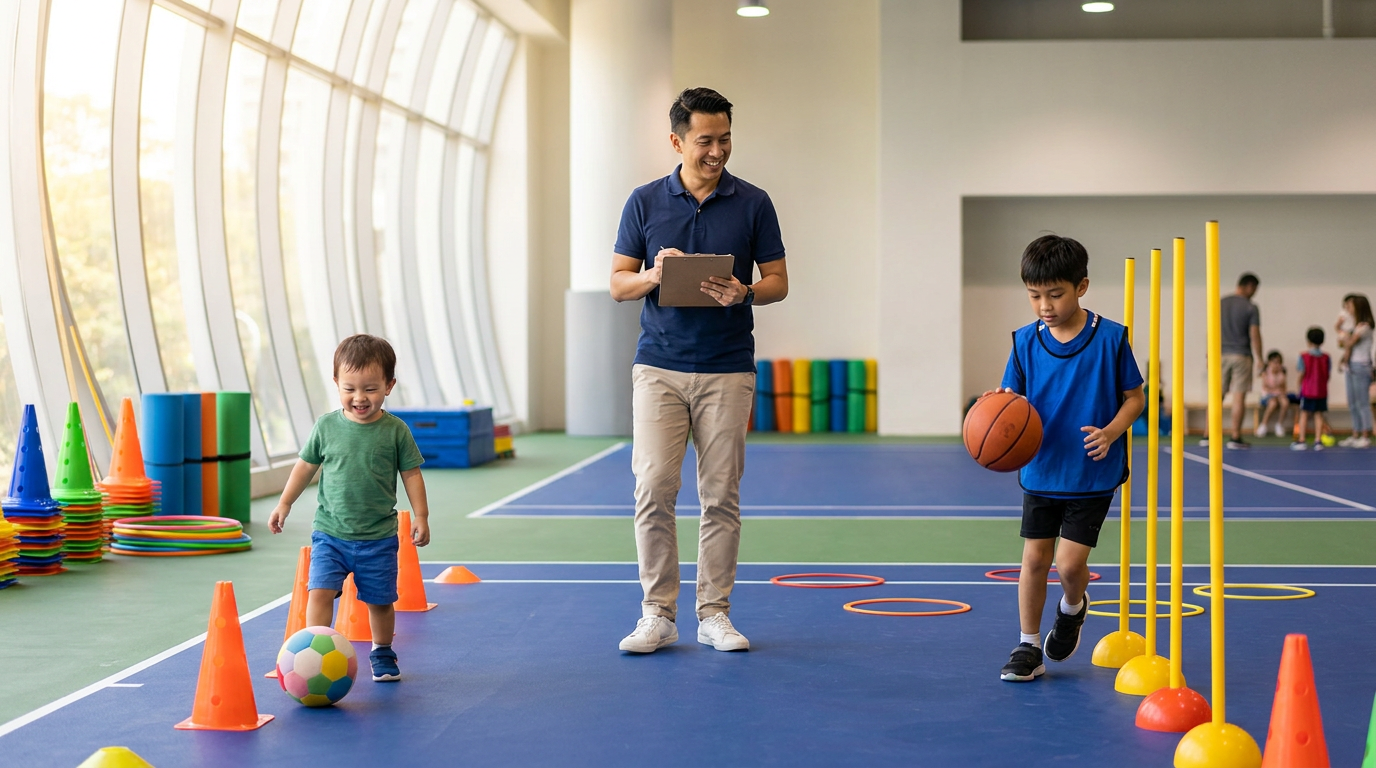
Multi-Sport Training and General Activity For children participating in multi-sport programmes that involve running, jumping, agility drills, and varied movement, a well-cushioned cross-trainer or athletic trainer is the ideal choice. These shoes are designed for versatility — combining cushioning for impact absorption, lateral support for side-to-side movement, and durable outsoles that perform on both indoor and outdoor surfaces. For younger children exploring movement across a range of activities, this is often the most practical and developmentally appropriate choice.
At Vivo Kinetics, children in the Vivo Kids multi-sports programme — which spans ages 2 to 6 and incorporates running, jumping, balancing, and coordination activities — benefit most from lightweight, flexible trainers that allow free movement while providing enough structure to support active play. A good velcro-fastened trainer with a breathable mesh upper and flexible forefoot is ideal for this age group.
Soccer and Field Sports For children playing on grass or turf, soccer-specific footwear makes a significant difference. Soccer cleats or turf trainers are designed with outsole patterns or studded configurations that provide grip during rapid direction changes, acceleration, and ball-striking movements. The upper material in soccer shoes is also important — it needs to be thin enough to provide ball feel without sacrificing durability. Firm-ground cleats (with moulded rubber or plastic studs) are appropriate for natural grass, while turf shoes (with smaller, more densely packed studs) are better for artificial surfaces.
For children in the Vivo Kicks Academy (ages 6–12), investing in a proper pair of soccer shoes is worthwhile. At this stage, children are developing technical skills that benefit from the feel and traction that purpose-built soccer footwear provides. Make sure cleats fit well — the same width and length guidelines apply — and replace them when the studs show significant wear, as worn-down studs compromise traction and increase injury risk.
Running and Athletics For children focused on running — whether in school athletics, fun runs, or running-based training — a dedicated running shoe provides the cushioning and biomechanical support that general trainers may not. Look for adequate heel-to-toe cushioning, a slightly higher midsole for impact absorption, and a roomy toe box. Running shoes should not be used for court sports or soccer, as they are designed for forward movement and lack the lateral support needed for multi-directional activities.
Indoor Sports (Basketball, Badminton, Indoor Games) Indoor sports shoes are typically flatter-soled with non-marking rubber outsoles designed for grip on smooth court surfaces. They tend to offer more lateral ankle support than running shoes, which is appropriate for sports involving rapid side-to-side movement. For children playing basketball, look for shoes with higher ankle collars and strong heel counters.
Getting the Right Fit: A Step-by-Step Parent Checklist
Fit is everything. The most technically impressive shoe will underperform — or even cause harm — if it doesn't fit properly. Use this checklist every time you buy sports shoes for your child:
Measure both feet – Most children have a slight size difference between their left and right foot. Always fit to the larger foot.
Shop in the afternoon or evening – Feet naturally swell throughout the day, so shoes bought in the morning may feel tight by the time your child is mid-training session.
Wear the right socks – Bring the socks your child typically wears for sport. Sock thickness significantly affects fit.
Check toe space – Press gently at the toe of the shoe. There should be approximately one thumb's width (around 10mm) between the longest toe and the front of the shoe.
Check width – You should be able to pinch a small amount of the upper material at the widest point of the foot without the foot bulging over the sole.
Test the heel – With the shoe properly fastened, have your child walk and check that the heel doesn't slip. There should be minimal movement at the heel.
Ask your child to wiggle their toes – If they can't move their toes freely, the toe box is too narrow or the shoe is too short.
Watch them move – Have your child walk, jog a few steps, or do a small jump. Their gait should look natural and comfortable, without any sign of compensation or discomfort.
Re-check every 2–3 months – Children's feet can grow quickly, especially during growth spurts. A shoe that fits well one month may be too small the next.
Common Mistakes Parents Make When Buying Kids' Sports Shoes
Even well-informed parents fall into some predictable traps when buying sports shoes. Here are the ones worth watching out for:
Buying too large to save money. It's understandable to want to get more wear out of a pair of shoes, but shoes that are significantly too big can cause tripping, alter gait mechanics, and fail to provide heel security during active sport. A shoe that's more than one size too large is doing more harm than a shoe that fits well today and needs replacing in four months.
Prioritising looks over function. Children (and parents) are naturally drawn to shoes that look exciting. But fashionable styles — particularly those with narrow toe boxes, flat soles, or minimal structure — are often the least appropriate for active use. Function should always come first, especially for shoes worn during sports or structured physical activity.
Using one pair of shoes for everything. A child who plays soccer, does multi-sport training, and wears their shoes to school every day is putting enormous wear on a single pair and using footwear in contexts it wasn't designed for. Where possible, having a dedicated pair for sport (rotated with a separate everyday pair) extends the life of both pairs and ensures the child always has appropriate support for the activity at hand.
Ignoring signs of wear. Shoes that look fine on the outside can be providing inadequate support if the midsole cushioning has compressed or the outsole has worn unevenly. Check soles regularly for unusual wear patterns — excessive wear on one edge, for instance, can indicate a gait pattern worth examining.
Warning Signs Your Child's Shoes Aren't Working
Children, especially younger ones, often can't articulate discomfort clearly. Instead, they show it through behaviour and movement. Watch for these signs:
Reluctance to wear certain shoes or requests to take them off during activity
Complaints of foot, heel, or ankle pain during or after sport
Changes in how your child walks or runs — limping, shuffling, or an unusual gait
Visible redness, blisters, or pressure marks after wearing
The shoe distorting in shape — bulging outward or tilting — after a few weeks of wear
Unusual or one-sided sole wear patterns
If any of these signs persist, it's worth reassessing the shoe fit and, if in doubt, consulting a podiatrist or healthcare professional who can assess your child's foot development and movement patterns.
Keeping Active Kids Moving: The Bigger Picture
The right sports shoes are one piece of a much larger picture when it comes to raising active, confident children. Shoes support the foot; but the experiences, encouragement, and environments that surround active kids are what truly shape their relationship with movement, sport, and physical wellbeing for life.
At Vivo Kinetics, we work with children from as young as 20 months through to 12 years, supporting them through age-appropriate sports and fitness programmes designed to build not just physical skills, but confidence, resilience, and a love of active living. Whether your child is finding their feet in our Vivo Kids multi-sports programme or developing their technical game at Vivo Kicks Academy, they deserve footwear that matches the quality and intentionality of the programme they're in.
Choosing the right sports shoes for your child doesn't need to be overwhelming. Focus on the fundamentals: a flexible forefoot, a wide toe box, a firm heel counter, breathable materials, and a secure closure system. Match the shoe to your child's age, foot development stage, and primary activity. Check the fit regularly, watch for warning signs, and don't be afraid to replace shoes more often than feels financially comfortable — the long-term benefits to your child's foot health and movement confidence are well worth it.
Children who move well, with proper support underfoot, are children who play more, explore more, and build a foundation of physical confidence that follows them throughout their lives. Start with the right shoes — and everything else follows from there.
Ready to Fuel Your Child's Active Journey?
At Vivo Kinetics, we've built Singapore's most trusted children's sports and fitness programmes to give every child the skills, confidence, and joy of movement — from their very first steps to their most competitive games.
Explore our programmes and find the perfect fit for your child at vivokinetics.com
Comments