


Infant Care Physical Activities: A Complete Guide to Early Physical Development
Table Of Contents
Why Physical Activity Matters from Day One
How Movement Shapes the Developing Brain
Understanding Gross and Fine Motor Skills in Infants
Physical Development by Stage: 0–12 Months
7 Play-Based Physical Activities to Boost Infant Development
1. Tummy Time
2. Guided Movement Play
3. Sensory Exploration
4. Reaching and Grasping Games
5. Rocking and Swaying
6. Soft Obstacle Exploration
7. Supported Standing and Cruising
Creating a Safe Movement Environment at Home
From Infant Activities to Structured Play: What Comes Next
Infant Care Physical Activities: A Complete Guide to Early Physical Development
Long before your baby takes a first step, their body is already hard at work. Every kick in the air, every reach for a dangling toy, every moment of wobbly head-lifting during tummy time — these aren't just adorable milestones to photograph. They are the building blocks of a lifetime of movement, learning, and confidence.
Infants experience more physical growth and neurological development in their first year than at any other time in their lives. The quality of physical activity they receive during this window doesn't just shape their muscles — it shapes their minds, their emotional regulation, and even their language skills. As a parent or caregiver, understanding what your baby needs at each stage means you can support that growth intentionally, playfully, and with confidence.
In this guide, we break down the science behind infant physical development, map out what to expect stage by stage from birth to 12 months, and share seven practical, play-based activities you can start using today. We'll also explore how the habits formed in infancy naturally evolve into the structured, joyful movement programs that help toddlers and young children truly thrive.
Why Physical Activity Matters from Day One
It can be tempting to think of infancy as a time for rest and feeding — and of course, it is. But it's also a critical period for physical engagement. Physical play is the cornerstone of early childhood development because it has a direct impact on a wide variety of physical, cognitive, social, and emotional skills that are essential for healthy growth. From the very first weeks, giving your baby opportunities to move freely and explore their body lays a foundation that supports every area of their development.
Play benefits every aspect of child development as infants and toddlers explore their world and their bodies, while also learning about and mastering relationships and social skills. Even simple activities — holding their gaze on a high-contrast pattern, batting at a hanging toy, or being gently rocked in your arms — are doing important neurological and physical work. The more varied and consistent these movement experiences are, the stronger the developmental foundation becomes.
Singapore's own clinical guidelines reflect this understanding. Physical activity provides many health benefits in early childhood, including motor and cognitive development, cardiometabolic, musculoskeletal, and psychosocial health. For families in Singapore, this reinforces what pediatric health professionals have long advocated: active babies grow into healthier, more capable children.
How Movement Shapes the Developing Brain
One of the most remarkable things about infant physical development is how inseparably it's linked to brain growth. In the early period of life, the brain and central nervous system grow rapidly as new connections or synapses between cells are formed. Every physical experience — a roll to one side, the feel of different textures, the effort of pushing up on tiny arms — sends signals that help build and reinforce those neural pathways.
Research has found a strong and consistent link between early motor skill development and later cognitive abilities. Levels of gross motor skills are positively associated with cognitive development in toddlers, and results reinforce the need for early commencement of gross motor skill promotion as this might be important for cognitive development in the early years. In other words, getting babies moving isn't just good for their bodies — it's one of the best investments you can make in their intellectual future.
The connection extends to language, too. Both gross and fine motor skills help foster language development from infancy to early childhood. When babies master a new physical skill — sitting independently, pulling to stand, learning to grasp — their expanded vantage point on the world opens up new social interactions, new vocabulary, and new ways of making sense of their environment. Movement and communication are not separate tracks; they develop together, side by side.
Understanding Gross and Fine Motor Skills in Infants
When we talk about infant physical development, two terms come up repeatedly: gross motor skills and fine motor skills. Both are essential, and both develop through active, engaged play.
Gross motor skills involve big movements like rolling, sitting, and standing, while fine motor skills are small hand movements like picking up food. In the early months, gross motor development takes the lead — your baby is working hard on head control, rolling, and eventually sitting and pulling to stand. Fine motor skills, like reaching, grasping, and eventually picking up small objects with a pincer grip, develop in parallel and are closely linked to hand-eye coordination.
Gross and fine motor experiences develop incrementally throughout early childhood, starting with sensory explorations and the development of a child's strength, coordination, and positional awareness through tummy time, crawling, and play movement with both objects and adults. Understanding this progression helps you choose activities that are well-matched to your baby's current stage — challenging enough to encourage growth, but not so advanced as to cause frustration.
Physical Development by Stage: 0–12 Months
Every baby develops at their own pace, and the ranges below reflect typical windows rather than strict deadlines. Use this as a general map, not a checklist.
0–3 Months
In these earliest weeks, your baby is just beginning to discover their body. Key milestones include turning their head from side to side when on their back, lifting their head during tummy time, moving their arms and legs off the floor when positioned on their back, and bringing their hands to their mouth. The nervous system is calibrating rapidly, and every gentle interaction — a sway, a stretch, a soft touch — contributes to that process.
3–6 Months
This is when movement really starts to come alive. Babies begin to hold their heads up with confidence, discover rolling, and develop the core strength that will eventually allow them to sit. By around 6 months, many babies roll over in both directions, can sit up unsupported, and pass objects from hand to hand. Play during this phase should encourage reaching, tracking moving objects, and weight-bearing through the arms.
6–12 Months
The second half of the first year is full of dramatic leaps. Key milestones include crawling (typically 7–9 months), pulling to stand (8–10 months), cruising along furniture (9–11 months), and independent standing (11–12 months). Babies at this stage are highly motivated explorers — they want to move toward things, into things, and through things. Your role shifts from providing movement for them to creating environments where they can discover movement themselves.
7 Play-Based Physical Activities to Boost Infant Development
The activities below are designed to meet your baby where they are developmentally and grow with them across the first year. They require no special equipment and just a few minutes of your undivided attention.
1. Tummy Time
Best for: 6 weeks and older Skills developed: Head and neck control, core strength, shoulder stability, visual tracking
Tummy time is one of the single most impactful things you can do for your baby's physical development. Placing your baby on their stomach — even for just a few minutes several times a day — builds the neck, back, and core strength that underpins almost every subsequent motor milestone. Singapore's 24-hour activity guidelines recommend that infants spend at least 30 minutes in the prone position daily, with the time spread throughout the day.
If your baby resists, try getting down on the floor with them, placing a small rolled towel under their chest for support, or propping a simple mirror in front of them. The reflection of their own face is a compelling motivation to lift that head just a little higher.
What you'll need: - A firm, flat surface (a play mat or folded blanket) - An infant-safe mirror or a high-contrast toy placed in front - Your presence and encouragement
2. Guided Movement Play
Best for: Birth to 8 months Skills developed: Leg and arm strength, balance, spatial awareness, caregiver bonding
Gentle, caregiver-led movements are one of the earliest forms of physical activity available to newborns and young babies. Rocking in a chair or holding your infant while bouncing gently on an exercise ball provides calming vestibular input, helping them learn about where their body is in space. As your baby grows, you can expand this to include bicycling their legs slowly while they lie on their back, gently stretching their arms in different directions, and supporting their weight as you sway from side to side.
These activities serve double duty: they stimulate physical development and deepen the bond between parent and child. Keep sessions short, playful, and always led by your baby's cues. If they turn away, fuss, or become still, it's a signal they need a break.
What you'll need: - A soft mat or comfortable flat surface - Your hands and gentle touch - A calm, unhurried pace
3. Sensory Exploration
Best for: 3 months and older Skills developed: Fine motor skills, grip strength, proprioception, hand-eye coordination
Touch is one of a baby's most powerful learning channels. Tactile feedback provided by receptors in the skin and joints plays a crucial role in dynamically adjusting both gross motor functions like walking and fine motor functions like grasping throughout early development. Offering your baby a variety of safe textures — a bumpy rubber teether, a crinkly fabric book, a smooth wooden rattle — gives their developing nervous system rich, varied input.
For slightly older babies, a shallow sensory exploration area with safe objects of different sizes, weights, and textures encourages them to squeeze, shake, bang, and transfer items between hands. Every one of those actions is strengthening grip, building coordination, and teaching the brain how to interpret the physical world.
What you'll need: - Safe objects with varied textures (soft, smooth, bumpy, crinkly) - A shallow container or soft play mat to contain the exploration - Close supervision at all times
4. Reaching and Grasping Games
Best for: 2–6 months Skills developed: Hand-eye coordination, midline crossing, shoulder and back strength
Suspending colourful toys or objects just within your baby's reach — whether from a play gym or simply held in your hand — encourages them to stretch, track, and grasp. This seemingly simple act works the back and shoulders, trains the eyes to follow movement, and begins to teach the brain the coordination between seeing something and moving to reach it. Simple rattles, easy-to-grasp balls, and soft books are great for getting a baby's visual attention, and as time goes on, their gaze will follow their grasp — the beginning of hand-eye coordination.
Vary the position of objects to encourage your baby to reach across the midline of their body — crossing from one side to the other — which is a foundational skill for later activities like writing, throwing, and sports.
What you'll need: - A simple play gym or dangling toy - High-contrast or brightly coloured objects - Soft rattles or fabric toys
5. Rocking and Rolling
Best for: 3–6 months Skills developed: Core strength, body awareness, rolling preparation
During diaper changes and floor play, gently rocking your baby from side to side — first from the shoulders and then from the legs — is a great way to help them learn how to feel and use different segments of their body to begin rolling. This simple activity is often overlooked precisely because it looks so easy, but it's doing meaningful work. It teaches your baby that their body has different parts that can move independently, and it develops the core rotation that rolling requires.
As your baby nears the 5-month mark, you'll likely notice them starting to initiate this movement themselves — rocking their legs back and forth while on their back as a precursor to that first full roll. Encourage it by placing an interesting toy just slightly to one side.
What you'll need: - A firm, flat mat on the floor - A colourful toy placed to the side to motivate the roll - Your hands and patience
6. Soft Obstacle Exploration
Best for: 6–12 months Skills developed: Upper and lower body strength, spatial awareness, problem-solving, crawling
Once your baby starts crawling — typically between 7 and 10 months — the world becomes an obstacle course waiting to be conquered. Creating a gentle, safe version of that in your home supports their growing strength and spatial reasoning. Arrange soft cushions, rolled blankets, and low padded surfaces in an open area and let your baby navigate through and over them at their own pace.
Physical play has a positive effect on purely mental activities like problem-solving — and soft obstacle exploration is a perfect example of this. As babies figure out how to navigate a cushion barrier or pull themselves up over a low bolster, they are developing persistence, spatial reasoning, and cause-and-effect thinking alongside their physical strength.
What you'll need: - Firm sofa cushions or foam bolsters - Rolled blankets or low padded wedges - A clear, carpeted space free from sharp edges
7. Supported Standing and Cruising
Best for: 8–12 months Skills developed: Leg strength, weight shifting, balance, walking preparation
As your baby approaches their first birthday, they'll begin pulling themselves up to stand against furniture. This is an exciting and important stage. Pulling into a standing position activates more muscles than crawling and makes those muscles stronger and more robust so that your child can perform the movement again — and better — next time. Supporting this with a clear, uncluttered "cruising path" — stable furniture pieces spaced just close enough for your baby to move between — gives them the opportunity to practise weight shifting and balance in a safe, confidence-building way.
Place a favourite toy on a low surface just out of reach to encourage standing and reaching, and stay close to offer a steadying hand when needed. This builds not just physical strength, but the confidence that will translate into those first independent steps.
What you'll need: - Low, sturdy furniture (coffee table, sofa edge) - Age-appropriate toys placed at standing height - Soft flooring or a play mat for safe landings
Creating a Safe Movement Environment at Home
The space you create matters as much as the activities you choose. A safe, inviting movement environment gives your baby the freedom to explore without constant intervention — and that independence is itself a developmental asset. By creating games and providing opportunities for play both indoors and outdoors, adults can support children to develop their core strength, stability, balance, spatial awareness, coordination, and agility.
Start by designating a clear floor space — away from sharp furniture edges and small objects — where your baby can stretch, roll, and move freely. Use firm but cushioned surfaces like interlocking foam mats or a quality play mat. Ensure the space is well-lit and at a comfortable temperature. As your baby grows into the crawling and cruising stage, do a floor-level safety audit: power cords, small objects, and unstable furniture all become hazards once your baby is mobile.
Key safety reminders for infant movement spaces:
Always supervise tummy time, especially in young babies with limited head control
Remove small objects (under 3cm) that could be a choking hazard
Ensure furniture used for cruising is stable and won't tip
Keep sessions short and follow your baby's lead — fussing is a signal to stop
Regularly clean and sanitise soft play surfaces
From Infant Activities to Structured Play: What Comes Next
The physical habits you build in your baby's first year don't stop at 12 months — they evolve. As your child grows into a toddler and then a preschooler, their developmental needs shift from caregiver-led exploration toward more structured, social, and skill-building play. Toddlers who engaged in at least an hour of moving freely each day had significantly stronger object and locomotor skills. But free movement alone, while essential, is only part of the picture.
Motor coordination and play do not simply emerge in all children as part of maturation; the environment and the people within it play a major role in determining whether or not children will acquire important motor skills and maintain physical health. This is where thoughtfully designed programs can make a real difference. Age-appropriate coaching, a structured curriculum, and a nurturing group environment give children the guided challenges they need to build on early foundations — and to discover what their bodies can really do.
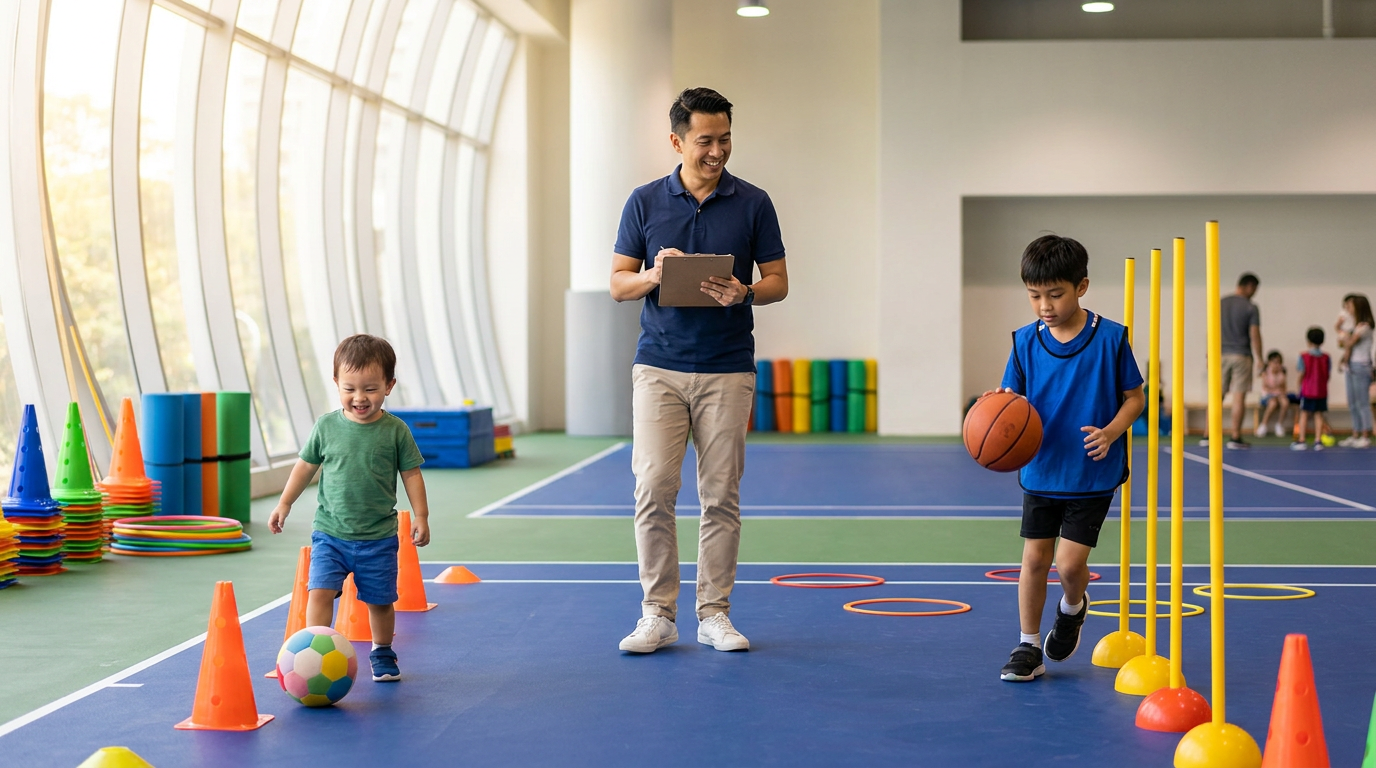
For children from 20 months onwards, programs like Vivo Kids — Vivo Kinetics' multi-sport program for ages 2 to 6 — offer exactly this kind of developmental bridge. Designed around movement skills and character development, Vivo Kids creates a safe, play-based environment where young children can channel the physical confidence built in infancy into games, coordination challenges, and the joy of moving with others. As children grow older and develop specific interests, programmes like Vivo Kicks — Vivo Kinetics' soccer academy for ages 6 to 12 — provide the structured, skill-building experiences that keep that love of movement alive and growing.
Every reach, roll, and wobble in your baby's first year is planting a seed. The goal is to nurture that seed into a lifelong love of active, healthy living.
Every Movement Is a Milestone
Infant physical development isn't something that happens to your baby — it's something that unfolds with them, shaped by every interaction, every safe space to explore, and every moment of playful engagement you provide. From the first weeks of tummy time to the triumphant wobble of early cruising, each stage builds on the last in a beautifully sequenced progression.
You don't need expensive equipment or a formal programme to support your infant's early development. You need presence, consistency, and the knowledge that those small, everyday moments of movement matter enormously. As your child grows, so too will their need for more structured, social, and skill-building physical experiences — and when that time comes, you'll be ready to take the next step with them.
Ready to Take the Next Step in Your Child's Physical Development?
At Vivo Kinetics, we believe that a love of movement starts early — and with the right environment, it lasts a lifetime. Whether your child is just stepping into toddlerhood or ready for their first multi-sport adventure, our award-winning, play-based programmes are designed to build confidence, coordination, and character at every stage.
Explore Our Programmes at Vivo Kinetics →
Comments