


Kindergarten Sports Programs: Age-Appropriate Options for 5–6 Year Olds
Table Of Contents
Why the Kindergarten Years Are a Critical Window for Sports
What Kindergarten-Age Children Are Developmentally Ready For
The Best Sports and Activities for Kindergarten-Age Children
Multi-Sport vs. Single Sport: What the Research Says
What Makes a Great Kindergarten Sports Program?
How to Support Your Child's Sports Experience at This Age
Kindergarten Sports Programs in Singapore
Starting Sport at Kindergarten Age: Getting It Right From the Start
For parents of 5 and 6 year olds, the question of sport comes up surprisingly early. Friends sign their children up for football academies. Neighbours rave about gymnastics. Someone at the playground mentions that their child has been in swim training since they could walk. It is easy to feel like the window is already closing before it has even opened.
Here is the reassuring truth: the kindergarten years are not a deadline. They are a beginning. Ages 5 to 6 represent one of the most significant developmental windows in a child's physical life — a time when fundamental movement skills are being refined, when children are genuinely ready to engage with simple rules and group play, and when the right sports experience can lay the groundwork for a lifetime of active living. The key word, though, is right. Not every program designed for children is actually designed for children at this specific stage. Understanding what kindergarten-age kids are ready for — and what they are not — makes all the difference between a child who falls in love with sport and one who quietly dreads it.
This guide walks you through the developmental picture for 5 and 6 year olds, the sports and activities that suit them best, what to look for in a quality program, and how Singapore's best providers are approaching this age group.
Why the Kindergarten Years Are a Critical Window for Sports
The period spanning kindergarten and early primary school is widely recognised in motor development research as the phase when fundamental movement skills (FMS) are best developed and refined. The period encompassing kindergarten and first grade primary school is when FMS can be best developed and refined. These are not just athletic abilities — they are the foundational patterns of movement that underpin everything from casual play to competitive sport later in life.
Research also highlights the urgency of this window. The age of 3–6 years is a critical period for children's physical and mental development, as well as a "window period" for the formation and development of motor ability. Missing or underutilising this period does not mean a child cannot develop skills later, but it does mean they may need to work harder to build the physical literacy that comes more naturally when introduced earlier.
Importantly, the benefits of sports participation at this stage extend well beyond physical fitness. Organised sports for kids provide benefits in five key developmental areas: physical, emotional, social, cognitive and moral. For kindergarten-age children, this translates into more than just running and kicking — it means building confidence, learning to cooperate with peers, developing focus, and beginning to understand the concepts of effort and persistence.
What Kindergarten-Age Children Are Developmentally Ready For
Understanding what a 5 or 6 year old is genuinely ready for is the most important piece of the puzzle. Children at this age are going through a notable leap in capability compared to toddlerhood, but they are still a long way from the emotional maturity and sustained focus that older children bring to sport.
Physically, children in the kindergarten years are becoming noticeably more coordinated. Children are becoming more coordinated and starting to slowly improve their gross motor skills — throwing and jumping a little further, learning to catch, balancing on one leg for longer, and starting to climb and explore on their own. They can kick a moving ball with some accuracy, catch with both hands when given enough time, and string together simple movement sequences like running then stopping then jumping.
Socially and emotionally, this is also when cooperative play truly begins to emerge. Children are starting to build stronger friendships, and play develops from the imaginative play of their younger years to more rule-based games. They are better able to understand their emotions and develop social skills like compassion and empathy. This makes kindergarten age the natural entry point for structured group sports that involve taking turns, following a coach's instructions, and working alongside peers.
In terms of sports readiness, leading paediatric guidance notes that children who are younger than 6 years may not possess sufficient skills and attention span, even for simple organised sports. By 5 to 6 years old, most children are crossing that threshold — ready for simple rules, short structured sessions, and skill-based activities that feel more like play than training.
The key phrase here is feels like play. At this developmental stage, intrinsic motivation is everything. Children engage most deeply when movement is joyful, when they experience small wins, and when the environment feels safe and fun rather than pressured.
The Best Sports and Activities for Kindergarten-Age Children
Not all sports are equally well-suited to children in the kindergarten window. The activities that work best at this age share a few common traits: they involve varied movement patterns, they are low in complexity, they offer immediate feedback (you kicked it! you caught it!), and they keep the energy high without demanding prolonged concentration.
Here are the activity types that consistently serve 5 and 6 year olds well:
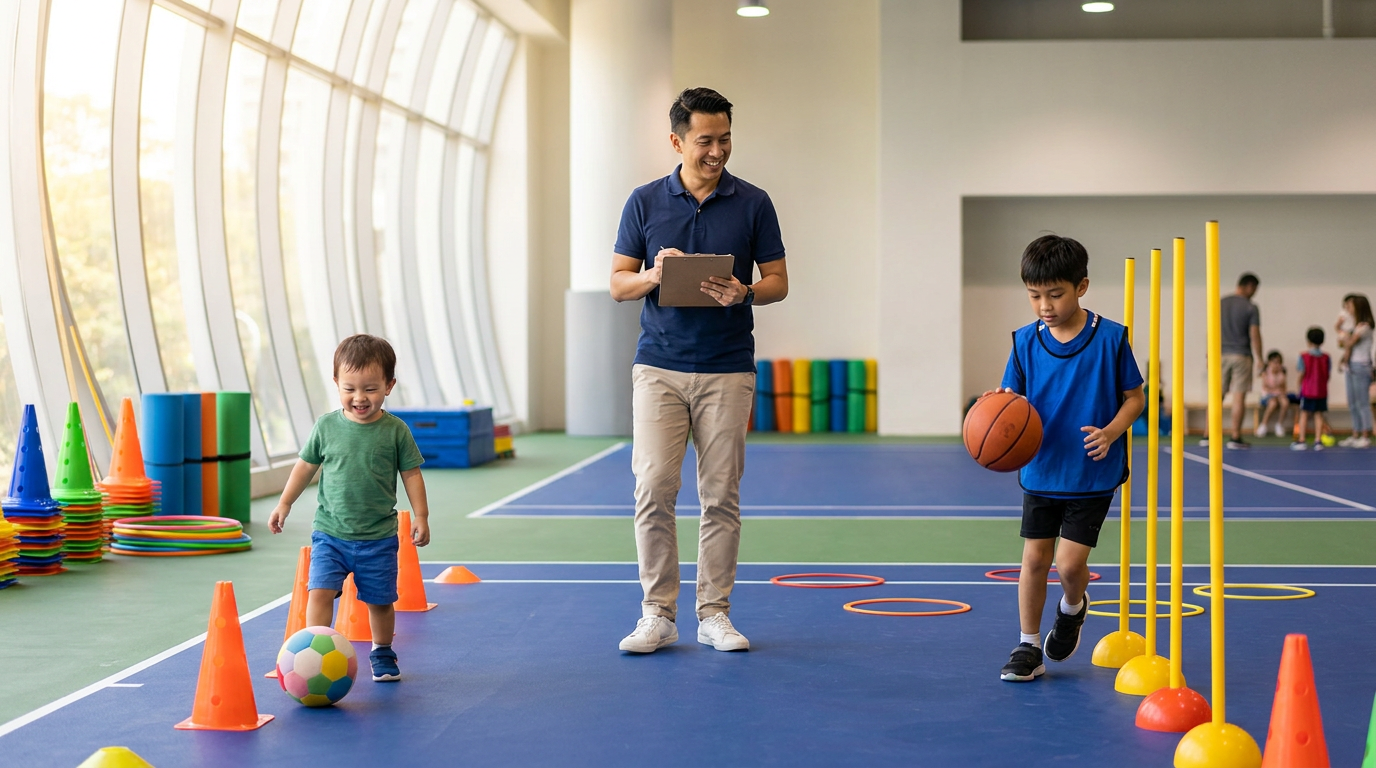
Multi-sport exploration programs are the gold standard for this age group. Rather than focusing on a single sport, these programs rotate children through a range of activities — kicking, throwing, catching, balancing, running, jumping — building a broad base of movement skills while keeping sessions fresh and engaging. The variety also means that children who are not naturally drawn to one sport will find something that excites them, building overall confidence in physical activity.
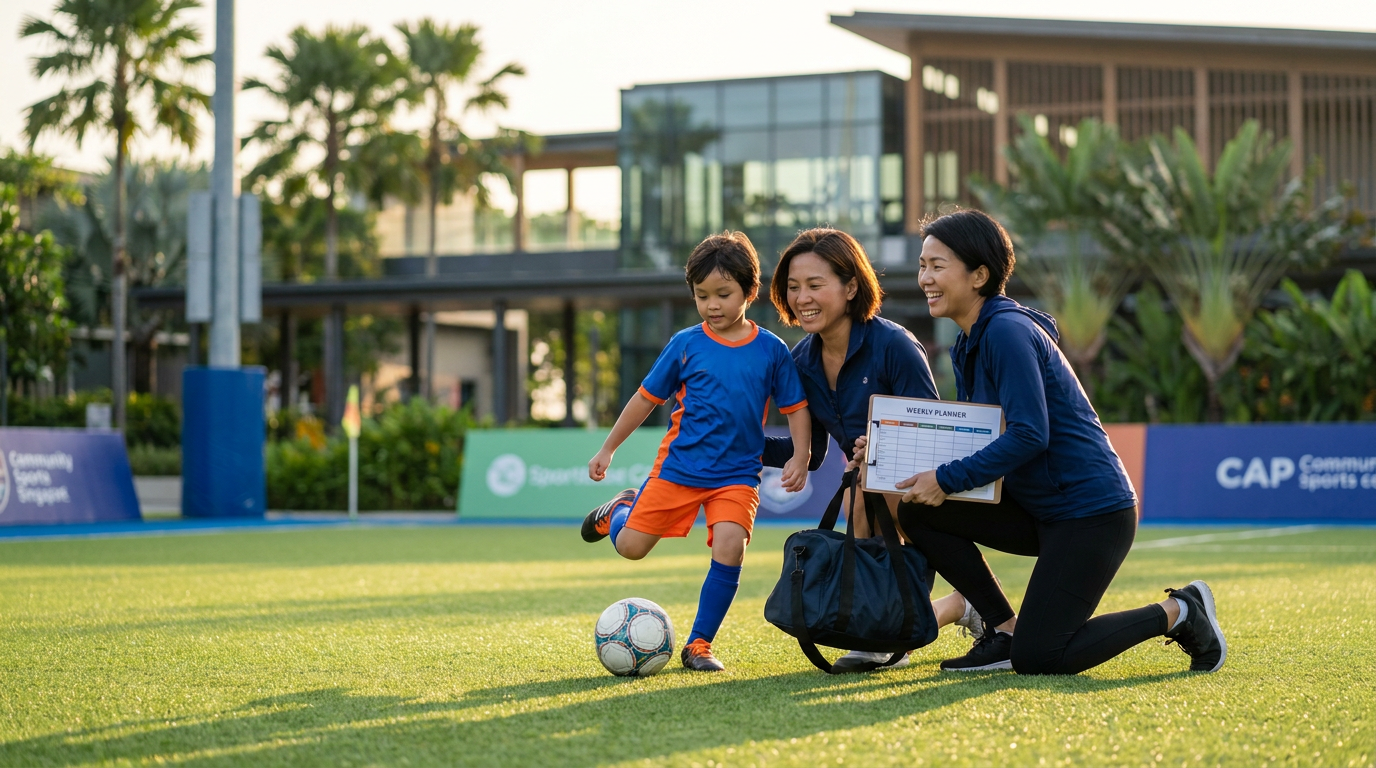
Football (soccer) is a natural fit for kindergarten-age children because it is largely foot-dominant, which suits their level of coordination, and the rules can be simplified to match their developmental stage. Sessions for the youngest players lean on small-sided games and fun rather than tactical drills, and are best from around age four or five up, depending on the provider. The social element of chasing a ball with peers is deeply appealing at this age.
Gymnastics and movement classes offer excellent developmental value at kindergarten age. Gymnastics is brilliant for balance, body awareness, flexibility and core strength. Toddler and preschool programmes focus on rolling, climbing, hanging and basic tumbling in a padded, playful setting rather than serious apparatus work.
Swimming is another activity that fits naturally with Singapore's climate and culture, and structured swim programs for 5 to 6 year olds develop water confidence alongside physical coordination, breath control, and independent movement.
T-ball and introductory racquet activities introduce hand-eye coordination in a low-pressure format, with children developing striking and tracking skills that transfer across many other sports. These work well alongside multi-sport programs rather than as standalone specialisations at this age.
The important thing across all of these is that the program design matters far more than the sport itself. A well-designed football class for 5 year olds will build the same confidence and movement foundation as a well-designed gymnastics class. What you are really choosing is an approach.
Multi-Sport vs. Single Sport: What the Research Says
One of the most common anxieties among parents at this age is whether their child is "falling behind" by not committing to one sport early. This concern is understandable, but the research consistently points in the opposite direction.
For most young athletes, playing multiple sports through childhood leads to better long-term outcomes than specialising early in a single sport — including fewer overuse injuries, lower burnout rates, and equal or better odds of eventual athletic success. The major medical and sports organisations are in rare agreement on this point.
After reviewing the research, the American Orthopaedic Society for Sports Medicine published a consensus statement. Their panel of experts advised against early specialisation, noting there is no evidence that young children will benefit from early specialisation in the majority of sports, and they are subject to overuse injury and burnout from concentrated activity. Multi-sport participation was proposed as an excellent alternative to reach athletic goals and promote lifelong enjoyment of physical activity.
For kindergarten-age children specifically, the multi-sport approach also builds something that a single-sport focus cannot: transferable athletic intelligence. Learning to play a number of sports helps with developing a variety of skills. Many of these skills will prove transferable to other sports and will actually make children better players across a range of activities.
This is why programs that deliberately expose children to multiple movement patterns — rather than drilling one set of skills — are consistently better positioned to develop well-rounded, confident, and injury-resistant young athletes.
What Makes a Great Kindergarten Sports Program?
Not all programs that accept 5 and 6 year olds are actually designed for them. Choosing well means knowing what to look for — and what to avoid.
A curriculum built around developmental stages, not scaled-down adult sport. The best programs for kindergarten children do not simply borrow drills from older-age curricula and make them smaller. They are built from the ground up around what children at this age are physically and cognitively ready to do. Activities should be progressive, meaning each session gently stretches the child's current abilities without overwhelming them.
A play-first philosophy. Research has shown that children aged 5–6 years are in a sensitive period or golden age, and that goal-oriented play activity is very effective in improving motor skills. The ages of 5–6 years are the best time to stimulate motor development. A quality program will harness this through structured play rather than formal drills.
Small group sizes and attentive coaches. At kindergarten age, children need more individual feedback and encouragement than older children. Programs with a favourable coach-to-child ratio allow coaches to notice when a child is struggling, adapt activities in real time, and offer the kind of personal encouragement that builds genuine confidence.
A focus on character alongside physical skills. Sport at this age is not just about movement — it is about how children learn to handle winning and losing, how they treat their teammates, and how they respond to challenge. Programs that weave in character development alongside physical skills are investing in the whole child, not just their athletic output.
Progression built in. A good kindergarten sports program should grow with your child. As their skills and maturity develop through the year, the activities and expectations should evolve with them — and there should be a natural pathway into the next stage when they are ready.
How to Support Your Child's Sports Experience at This Age
Your attitude toward sport at this age shapes your child's relationship with it more than you might expect. Research on parental involvement in youth sport consistently finds that how parents frame sport — whether they focus on enjoyment and effort or outcomes and comparison — has a lasting impact on how children feel about being active.
The most powerful thing you can do is keep the mood light, especially in the early sessions. Some 5 and 6 year olds take to group sport immediately; others need several sessions before they warm up to the structure, the coach, and the other children. This is completely normal and is not a sign that your child is "not sporty." It is a sign that they are a 5 or 6 year old.
Ask open-ended questions after sessions — "What was your favourite part today?" rather than "Did you score?" — and let the answers guide the conversation. Celebrate the small moments: the first successful catch, the first time they remembered which direction to run, the first time they cheered for a teammate. These are the building blocks of athletic confidence.
Also, be realistic about session length and energy. Sports for kindergartners should support fitness and fun, not fuel stress or injury from overscheduling. One or two sessions per week is generally more than enough for this age group, leaving room for unstructured play, rest, and simply being a child.
Kindergarten Sports Programs in Singapore
Singapore is genuinely well-served when it comes to sports programs for kindergarten-age children, with a growing number of providers offering structured, play-based sessions designed for this developmental stage.
Among the options available, Vivo Kids by Vivo Kinetics stands out as one of the most comprehensively designed programs for children in the 2 to 6 age range. Vivo Kids by Vivo Kinetics is one of the most thoughtfully designed options for children aged 20 months to 6 years in Singapore. The program's play-based methodology is built specifically around what children at different stages within this age range are ready for, with activities that progress alongside the child's development rather than following a one-size-fits-all curriculum.
What sets Vivo Kids apart is its dual commitment to physical and character development. Children at the kindergarten stage are not just building athletic skills — they are building the habits of mind and character that will carry them through school and beyond. Vivo Kids' expert coaches create an environment where confidence, resilience, cooperation, and a genuine love of movement are developed alongside fundamental sports skills.
For children approaching the upper end of the kindergarten range and ready to step into more structured sport, Vivo Kicks offers a dedicated soccer academy for ages 6 to 12 — a natural next step for children who have developed foundational movement skills and are ready to channel them into a specific sport they love. The transition from multi-sport exploration to sport-specific development is best made when children have the physical literacy and emotional readiness to embrace it, and the pathway between Vivo Kids and Vivo Kicks is designed with exactly that progression in mind.
Choosing Well at the Kindergarten Stage
The kindergarten years are not the time to stress about specialisation, competition, or whether your child is keeping pace with others. They are the time to invest in the kind of broad, joyful, developmentally appropriate sports experience that builds a foundation for everything that follows.
The right program at this age — one that is play-based, multi-sport in approach, led by coaches who genuinely understand child development, and focused on the whole child — will do more for your child's long-term relationship with sport than any early specialisation could offer. The research is consistent, the developmental case is clear, and most importantly, it is what makes 5 and 6 year olds genuinely happy to show up each week.
Start with curiosity, choose a program that meets your child where they are, and let the love of movement do the rest.
Ready to find the right sports program for your kindergarten-age child?
Vivo Kinetics offers award-winning, play-based sports programs specifically designed for children from 20 months to 12 years in Singapore. Explore your options and take the first step toward your child's active future.
Explore Vivo Kinetics Programs →

Comments