


Motor Skills Development in Singapore: Programs, Activities, and Milestones for Children
Table Of Contents
What Are Motor Skills — and Why Do They Matter?
Gross Motor Skills vs. Fine Motor Skills: Understanding the Difference
Motor Skills Milestones by Age: What to Expect from Toddlers to Primary Schoolers
The Bigger Picture: How Motor Skills Shape the Whole Child
Motor Skills Activities for Children in Singapore
What to Look for in a Motor Skills Development Program
How Vivo Kinetics Supports Motor Skills Development in Singapore
Tips for Parents: Supporting Motor Skills at Home
Building Strong Movers: Why Motor Skills Development Matters in Singapore
Every time a toddler chases a ball across the grass, a preschooler balances on a beam, or a primary schooler dribbles through a cone course, something important is happening beneath the surface. These aren't just moments of play — they are the building blocks of a child's physical, cognitive, and emotional future. Motor skills development is one of the most foundational aspects of early childhood, yet in Singapore's academically focused environment, it can sometimes be overlooked in favour of reading, writing, and numeracy. This guide explores everything parents need to know about motor skills development in Singapore: what the milestones look like at each age, which activities support healthy development, and how to find the right program to help your child thrive.
What Are Motor Skills — and Why Do They Matter?
Motor skills are the movements children use to interact with the world around them. At their most fundamental, they fall into two broad categories: gross motor skills, which involve large muscle groups and whole-body movement, and fine motor skills, which involve the precise coordination of smaller muscles in the hands, fingers, and wrists. Together, these abilities give children the physical tools they need to run, jump, write, draw, dress themselves, and eventually participate in sport and structured learning.
For young children, movement isn't separate from learning — it IS learning. Research consistently shows that early motor development supports not just physical growth but also cognitive function, emotional regulation, and social interaction. Children who develop strong motor skills tend to engage more confidently in school, manage their emotions better, and build relationships more easily. In Singapore's fast-paced, academically driven environment, investing in movement from an early age pays dividends far beyond the playground.
Gross Motor Skills vs. Fine Motor Skills: Understanding the Difference
Gross motor skills involve the large muscles of the arms, legs, and torso and are responsible for activities like walking, running, jumping, climbing, throwing, and balancing. These develop first and form the foundation on which more refined movements are built. When a two-year-old runs after a sibling or a five-year-old hops on one foot, they are exercising and strengthening their gross motor system.
Fine motor skills, by contrast, involve the small muscles of the hands and fingers working together with hand-eye coordination to complete precise tasks such as drawing, cutting, threading, buttoning clothes, and eventually handwriting. These skills are crucial for school readiness and everyday independence. Many parents focus heavily on early academics, but hand strength and coordination are equally important for a child's ability to participate in classroom activities.
The two are more connected than most people realise. Gross motor development lays the foundation for fine motor control, and research suggests that gross and fine motor competencies share overlapping neural pathways and higher-order neuromotor processes. A child who has built strong core stability through running and climbing will find it easier to sit upright at a desk and control a pencil.
Motor Skills Milestones by Age: What to Expect from Toddlers to Primary Schoolers
Understanding what to expect at each stage helps parents provide the right activities and recognise when additional support might be helpful. Every child develops at their own pace, but there are general windows during which most children reach key milestones.
Ages 20 Months to 3 Years
This is one of the most exciting periods for gross motor growth. Toddlers are rapidly refining their ability to walk, run, climb, and kick. By around 18 months, most children can walk independently and experiment with climbing stairs with help. By age two, many can kick a ball, run (though with less control), and stack blocks. At this stage, fine motor development is also accelerating: children begin practicing with crayons, pointing with purpose, and managing simple self-care tasks like drinking from a cup. The toddler years represent a critical window for physical and neurological development, and regular, joyful movement during this period has a lasting impact.
Ages 3 to 6 Years
Preschool-aged children become more coordinated and adventurous. Gross motor milestones include hopping, skipping, jumping with two feet, catching a ball with both hands, and navigating obstacle courses with growing confidence. By age six, most children can skip — a deceptively complex movement that requires muscle strength, balance, coordination, and timing working together. Fine motor skills develop considerably too: children begin using scissors, drawing recognisable shapes, and gradually developing the hand control needed for pre-writing. This age range is widely considered the prime window for building broad physical literacy through varied, play-based movement.
Ages 6 to 12 Years
Primary school-aged children refine and specialise their motor abilities. Gross motor skills become more complex and sport-specific, while fine motor skills reach higher levels of precision, supporting writing fluency, art, music, and hands-on learning. From age nine onward, research shows a major step-up in overall motor competence, making structured programs during primary school particularly valuable for consolidating skills developed in early childhood.
The Bigger Picture: How Motor Skills Shape the Whole Child
Motor skills are far more than physical — they are deeply intertwined with every domain of a child's development. Research shows that early motor development can predict later academic success, with children who have well-developed gross and fine motor skills tending to demonstrate better concentration, participation, and problem-solving skills in school. Engaging in movement also promotes brain development, neural connectivity, and the release of neurotransmitters vital for attention, memory, and mood regulation.
The social and emotional dimensions are equally significant. Children who develop strong motor abilities early on often demonstrate greater confidence, emotional regulation, and social interaction skills. The learning and training process of complex motor skills can improve peer relationships and stimulate positive emotional experiences. When a child learns to dribble a ball, navigate an obstacle course, or coordinate with a teammate, they are practising patience, resilience, communication, and trust — skills that serve them throughout their lives.
In Singapore, where limited space and busy schedules can sometimes reduce opportunities for active play, making intentional movement a daily priority is more important than ever. Simple, consistent opportunities to move — at home, in school, or through structured programs — can make a meaningful and lasting difference.
Motor Skills Activities for Children in Singapore
The good news for Singapore parents is that you don't need a large backyard or expensive equipment to support your child's motor development. Here are activities organised by type that work well across different ages and settings:
Gross Motor Activities: - Obstacle courses at home or outdoors using cushions, low furniture, and garden markers — these build spatial awareness, balance, and agility simultaneously. - Ball play (kicking, rolling, throwing, catching) develops foot-eye and hand-eye coordination while introducing concepts of distance, direction, and force in an intuitive way. - Jumping and hopping games such as hopscotch, jumping over chalk lines, or freeze-dance build leg strength, body awareness, and coordination. - Climbing at playgrounds or indoor facilities strengthens core muscles, spatial awareness, and confidence. - Swimming and water play is especially suitable for Singapore's tropical climate and engages the whole body for coordination, rhythm, and balance. - Dance and movement games develop rhythm, coordination, and spatial awareness without feeling like structured exercise — children simply enjoy themselves.
Fine Motor Activities: - Playdough and clay strengthen fingers and hands while encouraging creativity, especially effective for children ages two to five. - Drawing, painting, and cutting with age-appropriate tools develop precision, hand-eye coordination, and the pre-writing skills essential for school readiness. - Threading beads or lacing cards build pincer grip and focused finger control. - Sand and water play support coordination and fine motor development through scooping, pouring, and shaping — easy to set up outdoors in Singapore's parks and playgrounds.
Structured Program Activities:
For children aged three and above, structured beginner sports and movement programs offer a powerful complement to free play. These programs don't just teach physical skills — they teach focus, body control, cooperation, and how to handle both success and setbacks. Research suggests that early participation in multiple sports leads to better motor and athletic development and an increased ability to transfer skills across different activities. A multi-sport approach is particularly recommended for younger children, as it builds a broad movement foundation rather than narrowing too early into one discipline.
What to Look for in a Motor Skills Development Program
Not all children's programs are equally effective when it comes to motor skills development. With so many options available in Singapore, here are the key qualities to prioritise:
Age-appropriate curriculum: The program should be designed specifically for your child's developmental stage, not simply a scaled-down version of an older child's class. Activities must match the milestones and attention spans relevant to the age group.
Play-based methodology: Children learn best through play, especially at younger ages. Look for programs that embed skill-building within fun, exploratory activities rather than drilling technique prematurely.
Qualified coaches: Expert coaching matters. Coaches should understand child development principles and be skilled at creating a safe, nurturing environment where children feel encouraged rather than pressured.
Holistic focus: The best programs address more than physical skills — they also nurture confidence, character, social skills, and emotional resilience alongside movement development.
Multi-sport or multi-activity exposure: For children under six especially, broad exposure to varied movement patterns is more beneficial than early specialisation. Programs that rotate through different sports and activities build a stronger overall motor foundation.
How Vivo Kinetics Supports Motor Skills Development in Singapore
For parents searching for a trusted, structured motor skills development program in Singapore, Vivo Kinetics offers award-winning programs designed specifically with children's developmental needs at the centre.
Vivo Kids: Multi-Sport Program for Ages 2–6
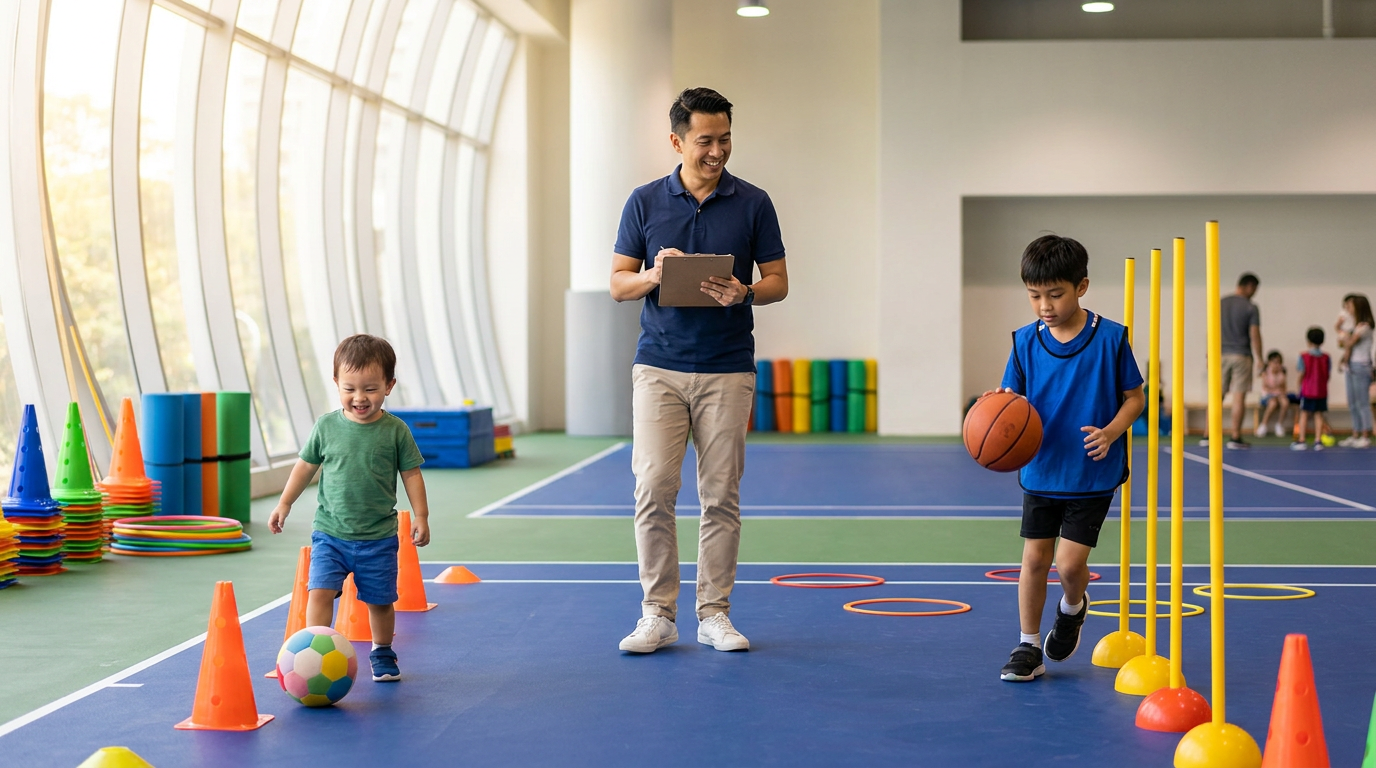
The Vivo Kids multi-sports programme is purpose-built for the critical early childhood window. Designed for children aged 20 months to 6 years, it introduces young movers to a wide range of sports and physical activities in a play-based, nurturing environment. Each session is crafted to develop fundamental movement skills — including locomotor skills, balance, and object control — while also encouraging character development, social confidence, and a love of active living. The multi-sport approach means children build a broad, well-rounded physical foundation rather than specialising prematurely, which is precisely what developmental research recommends for this age group.
With expert coaches trained in age-appropriate methodology, Vivo Kids creates a safe, warm space where even the shyest child can explore movement at their own pace, building competence and confidence together.
Vivo Kicks: Soccer Academy for Ages 6–12
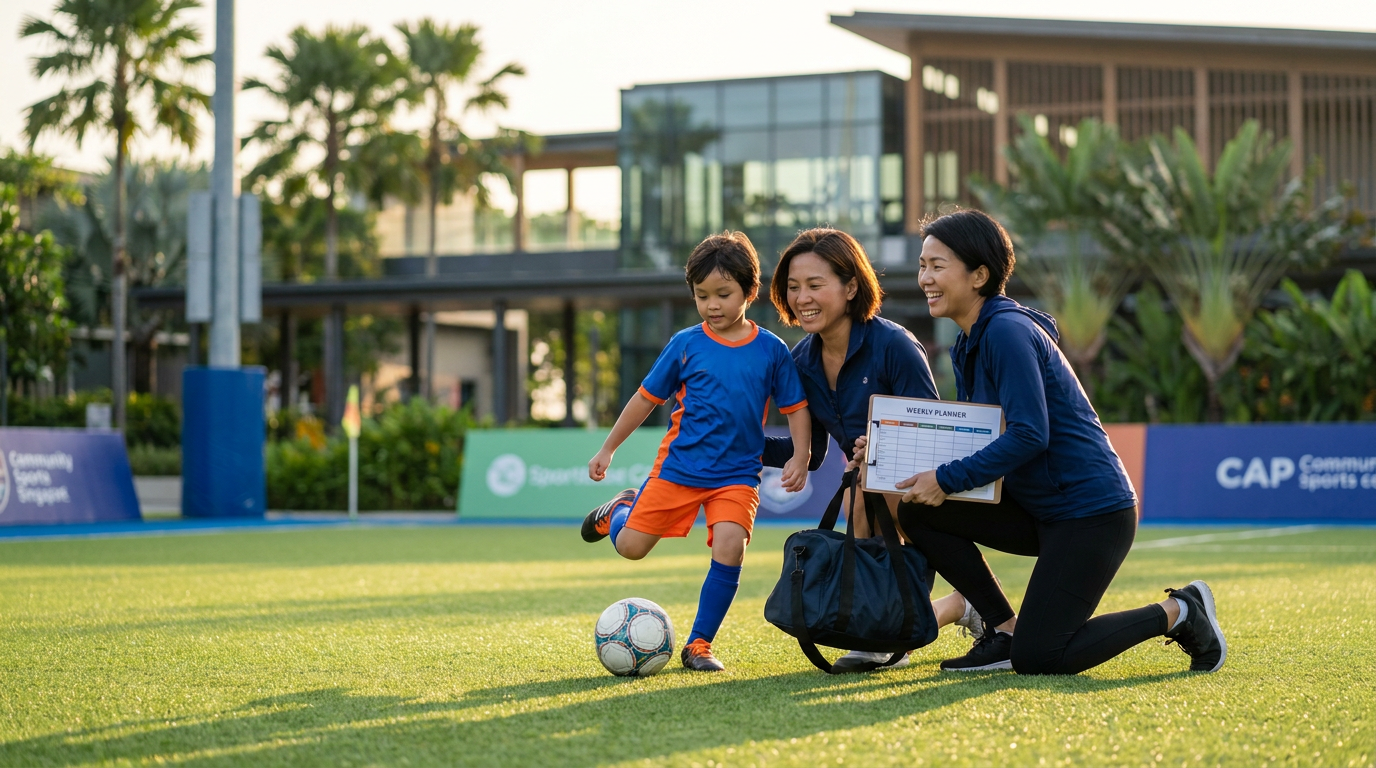
As children move into primary school age and their motor skills grow more sophisticated, the Vivo Kicks Academy provides a natural progression. Designed for children aged 6 to 12, Vivo Kicks builds on the fundamental movement skills developed in early childhood and channels them into the specific demands of soccer — footwork, agility, spatial awareness, teamwork, and strategic thinking. Sport-specific programs at this age are ideal for deepening confidence and competence within a discipline children are genuinely excited about.
Both programs reflect Vivo Kinetics' wider philosophy: that children develop most fully when they are intellectually, socially, emotionally, and physically engaged — not just physically active.
Tips for Parents: Supporting Motor Skills at Home
Structured programs are valuable, but the time children spend moving at home matters just as much. Here are practical ways Singapore parents can support motor development in everyday life:
Prioritise outdoor time daily, even if it's a short trip to the nearest playground. Singapore's parks, fitness corners, and green spaces are excellent resources for free, varied movement.
Create movement routines at home, such as a short obstacle course in the living room, a dance break between activities, or simple ball games in the corridor or void deck.
Praise effort and persistence, not just outcomes. A child who keeps trying after falling off the balance beam is building resilience alongside motor skill — both are worth celebrating.
Limit screen time and use it intentionally, replacing passive screen time with active alternatives whenever possible.
Involve children in hands-on tasks at home — stirring batter, folding laundry, threading pasta onto string — all support fine motor development naturally and build independence.
Follow your child's lead. Children are naturally motivated to move and explore. Providing a safe environment, age-appropriate challenges, and your enthusiastic presence is often enough to spark confident, joyful development.
Movement Today, Confidence Tomorrow
Motor skills development is not a single milestone to tick off — it is a continuous, layered journey that unfolds across every year of childhood. From a toddler's first confident steps to a ten-year-old's agile footwork on the soccer pitch, each movement builds on the last, shaping not just a stronger body but a more capable, confident, and emotionally resilient child. In Singapore, where the pressures of academic life can crowd out physical play, parents who make movement a priority give their children a genuine and lasting advantage. Whether through backyard play, park visits, fine motor crafts at the table, or a structured program designed by experts, every opportunity to move is an opportunity to grow.
Ready to Give Your Child the Best Start in Movement?
At Vivo Kinetics, we've built Singapore's most loved children's sports and fitness programs around one simple belief: active, playful children grow into confident, well-rounded people. Whether your child is taking their first steps into sport or ready to level up their skills, we have a program designed for them.
Ages 20 months – 6 years? Explore the Vivo Kids multi-sports programme — where movement, play, and character development come together.
Ages 6 – 12 years? Check out the Vivo Kicks Academy — Singapore's exciting soccer program for growing athletes.
Discover All Programs at Vivo Kinetics →

Comments