


Physical Activity and Academic Performance: The Connection Every Parent Should Know
Table Of Contents
Why Movement Matters Beyond the Playground
What the Science Says: Physical Activity and the Brain
Key Academic and Cognitive Benefits of Regular Exercise
Improved Focus and Attention
Better Memory and Information Retention
Stronger Executive Function
Reduced Stress and Better Emotional Regulation
How Much Physical Activity Do Children Actually Need?
Sports as a Classroom: Building Character That Drives Academic Success
How Structured Programs Maximise These Benefits
Tips for Parents: Supporting an Active Learning Lifestyle
Physical Activity and Academic Performance: The Connection Every Parent Should Know
Most parents know that running around is good for their child's health. But what if regular physical activity was also one of the most powerful tools for boosting grades, sharpening focus, and building the kind of character that leads to long-term academic success? The research increasingly says: it is.
The connection between physical activity and academic performance is one of the most exciting areas in children's health and education today. Study after study is revealing that children who move more tend to think more clearly, remember better, handle stress more effectively, and show up to the classroom more prepared to learn. For parents navigating busy school schedules in Singapore and beyond, understanding this connection isn't just interesting — it's actionable.
In this article, we explore the science behind exercise and brain development in children, break down the specific cognitive and academic benefits of staying active, and explain how structured, play-based sports programmes can be the most enjoyable way to give your child a genuine learning advantage.
Why Movement Matters Beyond the Playground
For generations, sport and academic study have been treated as two separate worlds — even competing ones. Extra physical education time was sometimes seen as time taken away from 'real' learning. Today, that view is being turned on its head.
Researchers and educators worldwide are finding that physical activity is not just compatible with academic success — it actively supports it. The body and the brain are far more connected than we once thought, and for children in the critical developmental years between toddlerhood and early adolescence, the way they move has a direct impact on the way they learn. This matters enormously for parents who want to give their children the best possible foundation, not just physically, but intellectually and emotionally too.
The good news is that the solution doesn't require expensive tutoring or longer study hours. Sometimes, it just requires getting kids moving in the right way.
What the Science Says: Physical Activity and the Brain
The scientific community has been building a compelling case for years. A landmark systematic review and meta-analysis published in Frontiers in Public Health found that researching the relationship between physical activity and academic performance is becoming an important research topic due to increasing evidence about the positive effect of physical activity on cognitive functioning.
The mechanisms behind this connection are physiological and measurable. Engaging in activities that get the heart pumping increases blood flow to the brain, delivering a surge of oxygen and nutrients — a boost in nourishment that enhances neural connections, fostering improved focus and attention spans. At the neurochemical level, physical activities release chemicals such as endorphins and dopamine, which enhance mood and focus — chemicals that not only help students stay attentive but also reduce stress, allowing them to approach academic challenges with a calm and focused mind.
Even more striking is what happens at a structural level inside the developing brain. A study from Boston Children's Hospital, which analyzed brain imaging data from nearly 6,000 9- and 10-year-olds, found that physical activity was associated with more efficiently organized, robust, and flexible brain networks. Perhaps most encouraging for parents was the finding that the more physical activity, the more 'fit' the brain — and it didn't matter what kind of physical activity children were involved in, only that they were active.
Further research has confirmed that low levels of physical activity are associated with a decline in academic performance, possibly due to the deterioration of brain structure and thus cognitive abilities and brain function. In other words, inactivity isn't neutral — it carries real costs for a child's learning potential.
Key Academic and Cognitive Benefits of Regular Exercise
Improved Focus and Attention
One of the most consistent findings across the research is the impact of physical activity on a child's ability to concentrate. The ability to focus attention is improved among children who participate in physical activities. For children sitting in classrooms for hours each day, this is no small advantage.
Physical activity increases oxygen flow to the brain, enhancing problem-solving abilities and concentration, and children who engage in sports experience less mental fatigue, making them more attentive during school hours. A telling example: one study showed that children walking 20 minutes at a moderate pace on a treadmill were able to respond better to spelling, reading, and math questions compared to students who remained sitting.
Better Memory and Information Retention
Exercise also plays a significant role in how well children retain and recall what they learn. A study by the University of British Columbia found that aerobic exercise has the unique ability to increase the size of the hippocampus — the area of the brain responsible for learning and memory — which is one reason why students who play sports tend to perform better on tests and retain information more effectively.
Exercise helps to increase the hippocampus and the basal ganglia, both structures of the brain which are involved with learning in children. These structural changes are not temporary — they reflect genuine growth in brain regions that children rely on every single school day.
Stronger Executive Function
Executive function is the set of mental skills that includes working memory, flexible thinking, and self-control. These abilities underpin a child's capacity to follow instructions, manage time, plan ahead, and stay organised — all essential for academic success.
Research has found that acute physical activity interventions significantly improved processing speed, inhibition, and attention, whereas chronic physical activity interventions significantly improved processing speed, attention, cognitive flexibility, working memory, and language skills. Sport in particular seems to be especially effective here. Research identified superior cognitive performance of soccer players over non-athletes in executive control, attention, working memory, vigilance, and cognitive flexibility.
Learning-related mechanisms focus on the cognitive demand that exists during the learning of motor skills and the coordination of complex movements, enhancing decision-making processes and flexible behaviour in response to demands. In other words, the mental effort required to learn a new sport skill is itself a form of cognitive training.
Reduced Stress and Better Emotional Regulation
Academic pressure is a very real experience for many children in Singapore. Physical activity offers a powerful, natural buffer. Inhibitory control — the ability to stop or modify an impulse — and selective attention are both shown to increase with exercise, while aggression and anxiety decrease and self-confidence and adaptability skills flourish.
Exercise also leads to short-term relaxation, which improves kids' moods as well as promoting increased concentration, better memory, enhanced creativity, and more effective problem-solving. When children are emotionally regulated and less anxious, they are far better positioned to engage with challenging schoolwork and bounce back from setbacks.
How Much Physical Activity Do Children Actually Need?
Understanding the benefits is one thing — knowing what to aim for is another. According to the World Health Organization, children and adolescents should do at least an average of 60 minutes per day of moderate- to vigorous-intensity, mostly aerobic, physical activity across the week. For younger children, the bar is even higher: the WHO recommends that preschool-aged children engage in 180 minutes of total physical activity including 60 minutes of moderate-to-vigorous physical activity each day.
The type of activity matters too. In children and adolescents, physical activity confers benefits for cognitive outcomes including academic performance and executive function, particularly when activity is consistent, appropriately intense, and varied. Research also highlights that interventions involving exercise of greater intensity and length as well as gross motor skills led to more pronounced improvements in academic performance.
Critically, studies found that physical activity interventions with significant positive effects on academic performance were more likely to be delivered by practitioners who held higher qualifications in physical education and exercise science, with those interventions producing higher population effects. This underscores the importance not just of activity, but of quality, structured programming delivered by knowledgeable coaches.
Sports as a Classroom: Building Character That Drives Academic Success
The cognitive benefits of physical activity are only part of the story. Organised sports provide a unique environment for character development — and the qualities children build on the field translate directly into academic habits and life skills.
Discipline and time management are two of the most valuable outcomes. Participating in sports requires commitment and discipline. Children learn to balance practices, games, homework, and family time — a necessity for organisation that helps them develop time management skills invaluable as they grow older.
Resilience is another cornerstone. Participating in sports teaches children resilience and how to cope with stress. In team sports, children learn how to handle both wins and losses gracefully — life lessons that help them navigate stressful academic situations with confidence and perseverance.
Teamwork and communication skills developed through sport also carry over into academic contexts. Team sports require communication, both verbal and nonverbal, and those same communication skills developed to maintain a functioning team can help kids succeed academically.
A recent study from the Netherlands found that children who play team sports tend to have better executive function, which includes things like memory, focus, ability to adapt, and emotional control. These are precisely the qualities that help children manage the demands of school life with confidence.
How Structured Programs Maximise These Benefits
Not all physical activity delivers the same results. While any movement is beneficial, structured programmes led by qualified coaches consistently produce stronger outcomes — both in fitness and in the broader developmental benefits we've discussed.
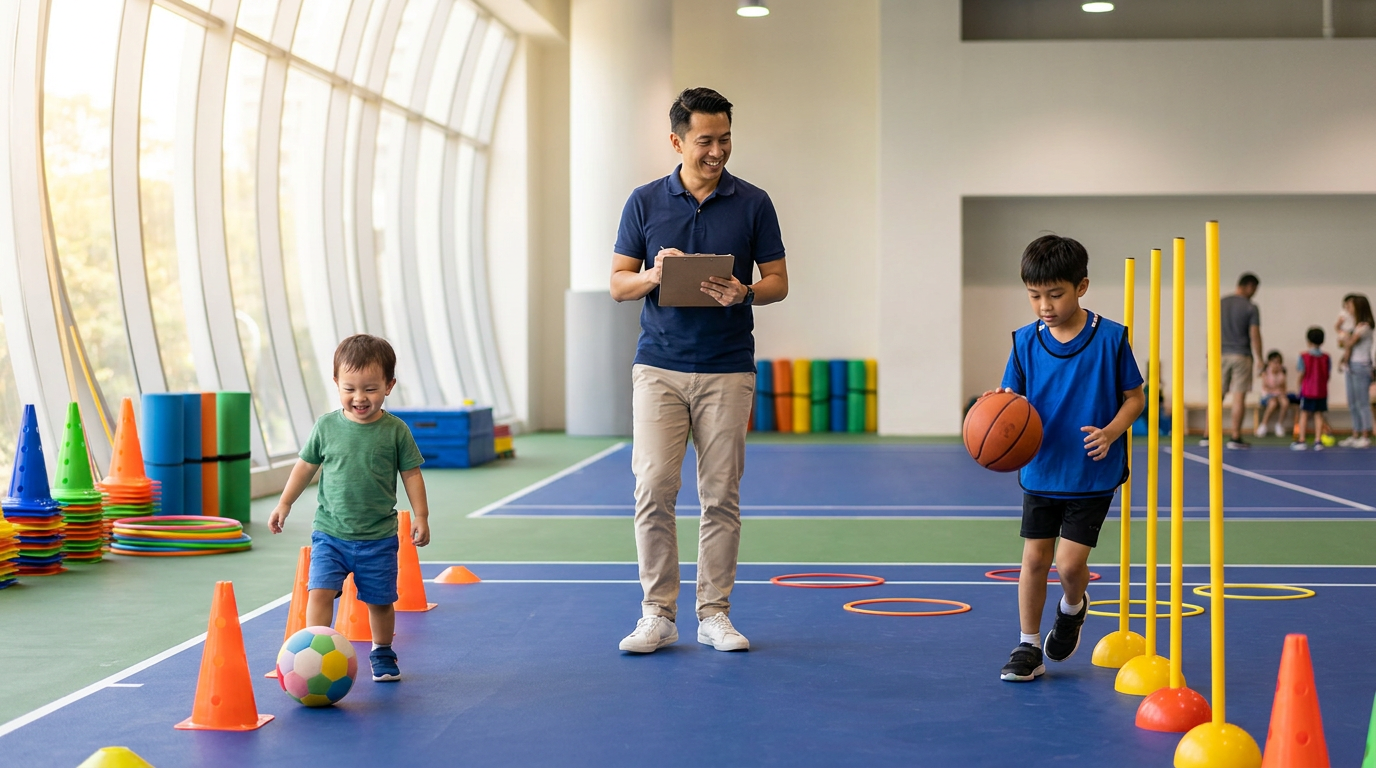
This is exactly the philosophy behind Vivo Kids, Vivo Kinetics' award-winning multi-sport programme for children aged 2 to 6. Designed around play-based learning and guided by expert coaches, Vivo Kids blends movement skill development with character-building activities, helping young children develop the focus, confidence, and social readiness they need when they enter formal schooling. By introducing children to a variety of sports and movement experiences in a nurturing, age-appropriate environment, the programme supports exactly the kind of varied, cognitive-demand-rich physical activity that research shows is most beneficial for brain development.
For older children aged 6 to 12, Vivo Kicks Academy offers a structured football (soccer) pathway that goes well beyond simply learning to kick a ball. Drawing on findings that children attending soccer sessions in a 6-month football intervention program showed greater gains than their sedentary counterparts in attention, working memory, planning, and inhibition, Vivo Kicks sessions are designed to develop the mental as well as physical athlete. Football demands split-second decision-making, spatial awareness, teamwork, and emotional control — all cognitive skills with direct parallels in the classroom.
With qualified, passionate coaches and an age-appropriate curriculum, both programmes reflect the research insight that the quality of instruction matters enormously for outcomes. Children in well-led programmes don't just get fitter — they grow intellectually, socially, and emotionally.
Tips for Parents: Supporting an Active Learning Lifestyle
For parents looking to maximise the academic and developmental benefits of physical activity, here are some practical steps:
Aim for 60 minutes of daily movement. This doesn't need to happen in one block. School PE, active play, and after-school programmes all count toward the daily target.
Prioritise variety and enjoyment. Children who enjoy their physical activity are more likely to stay consistent. Exploring different sports helps them discover what they love while developing a broad range of movement skills.
Choose quality programmes with qualified coaches. As research shows, the expertise of those delivering physical activity shapes its impact. Look for programmes with structured curricula designed for your child's specific age and developmental stage.
Balance active time with adequate rest. Sports boost memory function and cognitive function, in part because physical exercise improves the quality and duration of sleep — so ensuring your child winds down properly after activity is equally important.
Connect activity to values, not just outcomes. Let your child know that being active is about growing as a person — building courage, kindness, and persistence — not just getting fit or winning.
Limit excessive screen time. Excessive use of electronic devices by children may result in negative outcomes regarding physical health, behaviour, and intellectual skills including language, concentration, and memory. Active play is one of the best replacements.
The Bottom Line
The evidence is clear: physical activity and academic performance are not competing priorities. They are deeply connected. When children move regularly — and when they do so in structured, engaging, and well-coached environments — they develop the brains, habits, and character traits that set them up to thrive in school and in life.
For children in Singapore, where academic expectations are high and schedules are full, finding the right physical activity programme can feel like just another item on a long to-do list. But the research tells us it's one of the most worthwhile investments a parent can make. Getting your child moving more isn't taking time away from learning — in many ways, it is learning.
Give Your Child the Active Advantage
Ready to help your child build a stronger brain, better focus, and lasting character through sport? Vivo Kinetics offers expertly designed, play-based programmes for children aged 20 months to 12 years — from multi-sport foundations to football academies — all built around the science of how children learn and grow best.
Explore our programmes and book a trial today →
Comments