


Preschooler Physical Development: What to Expect from Ages 3 to 5
Table Of Contents
Why Physical Development Matters So Much Between Ages 3 and 5
The Big Physical Milestones: What Your Preschooler Is Learning to Do
Age 3: Building Confidence on the Move
Age 4: Coordination Takes Centre Stage
Age 5: Strength, Stamina, and Skill
Gross Motor vs. Fine Motor Skills: Understanding the Difference
What Physical Play Actually Does for a Preschooler's Brain
The Role of Structured Play in Physical Development
Signs Your Child May Need Extra Support
How to Support Your Preschooler's Physical Development at Home
Choosing the Right Programme for Your Preschooler
Preschooler Physical Development: What to Expect from Ages 3 to 5
If you've ever watched a three-year-old attempt to kick a ball—tongue out, full concentration, sometimes missing entirely and landing on their bottom—you'll know that physical development is not just adorable to watch. It's serious business. The years between three and five are one of the most dynamic windows of physical growth in a child's entire life, laying the movement foundations they'll carry into school, sport, and everything in between.
Yet for many parents, this stage raises more questions than answers. Should my child be catching a ball by now? Is it normal that they still trip over their own feet? When is the right time to introduce structured sport? And how do I know if they're on track?
This guide is here to answer all of that. We'll walk you through the key physical development milestones for preschoolers ages 3 to 5, explain what's actually happening in their bodies and brains during this period, and help you understand how the right kind of movement and play can set your child up for a lifetime of healthy active living.
Why Physical Development Matters So Much Between Ages 3 and 5
The preschool years are often called the "critical period" of motor development, and for good reason. Between the ages of three and five, children's nervous systems are rapidly maturing, their muscles are growing stronger, and the connections between their brains and bodies are becoming increasingly refined. Research from the World Health Organization confirms that early physical activity not only supports healthy growth but also contributes to better cognitive function, emotional regulation, and social skills.
What makes this stage particularly fascinating is that physical development doesn't happen in isolation. Every time a preschooler runs, jumps, throws, or balances, they're not just building muscle—they're building neural pathways, learning to manage their bodies in space, and developing the kind of body confidence that will shape how they approach new challenges for years to come. The skills gained between three and five become the raw material for everything from playground games to team sports to everyday coordination.
This is also a stage where children are primed to learn through movement. Abstract instruction doesn't land well with preschoolers, but show them something active and playful, and they'll absorb it with remarkable speed. That's why the environment and quality of physical experiences during these years matters enormously.
The Big Physical Milestones: What Your Preschooler Is Learning to Do
Development isn't a straight line—every child moves at their own pace—but there are broadly recognised milestones that give parents and educators a useful framework for understanding where a child is and where they're heading.
Age 3: Building Confidence on the Move
At three years old, most children have moved well beyond the wobbly toddler stage and are gaining real confidence on their feet. Here's what's typically emerging:
Running with greater control and the ability to stop and change direction
Jumping with both feet together, though landing is still developing
Climbing playground equipment with growing independence
Kicking a stationary ball with reasonable aim
Throwing overarm, though accuracy and distance are limited
Pedalling a tricycle using alternating leg movements
Standing on one foot briefly (around 2–3 seconds)
At this age, balance is still developing and children tire quickly, so short bursts of active play are more effective than extended sessions. The biggest driver of learning at three is imitation—children watch adults and peers and mirror what they see. This is why engaging, demonstrative coaching and parent involvement can make such a difference in a preschool movement programme.
Age 4: Coordination Takes Centre Stage
The leap from three to four can feel dramatic to parents. Suddenly, movements that seemed clunky become smoother, and children begin combining skills in more complex ways:
Hopping on one foot, typically managing several hops in a row
Catching a large ball with arms and body (hands-only catching comes later)
Galloping and beginning to skip (skipping usually solidifies closer to 5)
Throwing with more rotation of the body and improved aim
Running and kicking a moving ball (a huge developmental jump from kicking stationary objects)
Balancing on one foot for up to 5 seconds
Navigating obstacles like stepping stones or climbing frames with more precision
Four-year-olds are also developing the ability to follow multi-step instructions, which opens up exciting possibilities in structured play settings. They're starting to understand simple rules and enjoy the social dimension of games—not just playing alongside other children, but beginning to play with them. This shift from parallel play to cooperative play is closely tied to physical activity and is one of the reasons active group programmes can be so powerful at this age.
Age 5: Strength, Stamina, and Skill
By five, children are developing what developmental experts call "transitional movement skills"—the ability to combine two or more fundamental movements fluidly. This is when physical play starts to look genuinely athletic:
Skipping with coordination and rhythm
Catching smaller balls using hands alone
Throwing with clear arm swing, body rotation, and step-through
Jumping for distance and height, with controlled landing
Running with visible heel-to-toe movement and arm swing
Balancing on one foot for 8–10 seconds or more
Navigating climbing equipment, beams, and obstacle courses with confidence
At five, children also have greater stamina and can sustain moderate physical activity for longer periods. They respond well to gentle challenges and are beginning to develop a sense of personal achievement—noticing when they've improved and taking pride in new skills. This is also when some children start showing preferences for particular types of movement or sport, though it's far too early to specialise.
Gross Motor vs. Fine Motor Skills: Understanding the Difference
When we talk about physical development in preschoolers, we're primarily talking about gross motor skills—movements that involve the large muscle groups of the body, such as the legs, arms, and core. Running, jumping, catching, and climbing all fall into this category.
Fine motor skills, by contrast, involve the small muscles of the hands and fingers—things like drawing, using scissors, or doing up buttons. While both types of development matter enormously during the preschool years, gross motor development tends to precede fine motor development, and strong gross motor foundations actually support fine motor progress. A child who has good core stability from active play, for example, will find it easier to sit still and control a pencil when they start school. This interconnection is one reason that active physical programmes don't just benefit the body—they support school readiness in ways that parents often don't expect.
What Physical Play Actually Does for a Preschooler's Brain
There's a compelling body of research showing that movement and cognitive development are deeply intertwined in the early years. When preschoolers engage in physical activity, they're not just exercising their bodies—they're stimulating the release of brain-derived neurotrophic factor (BDNF), sometimes called "Miracle-Gro for the brain," which supports the growth of new neural connections.
Physical play also develops executive function skills—the cognitive abilities that allow children to plan, focus, remember instructions, and manage impulses. A child learning to wait their turn in a ball game, remember a sequence of movements, or follow the rules of a simple relay race is actively building these capacities. Research from institutions including Harvard's Center on the Developing Child highlights that executive function skills developed in early childhood are among the strongest predictors of academic and life success.
For preschoolers in Singapore and across Southeast Asia, where academic preparation often begins early, this is particularly important context for parents. Physical activity isn't a distraction from learning—it is learning, in the most foundational sense.
The Role of Structured Play in Physical Development
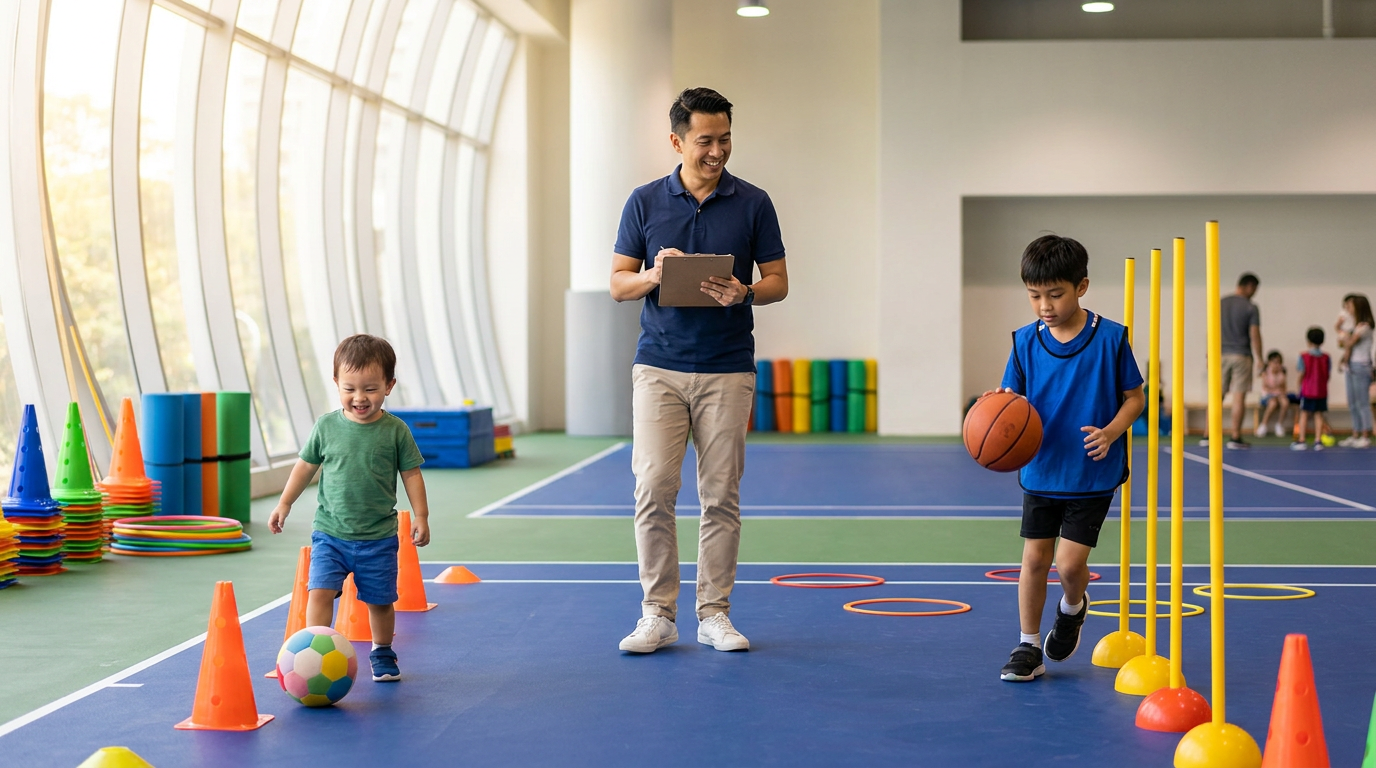
Pure free play is wonderful and important. But for preschoolers aged 3 to 5, a balance of free exploration and guided structured play tends to produce the best developmental outcomes. Structured play—activities led by a knowledgeable adult with clear (but flexible) goals—gives children the opportunity to encounter new movements they might not discover on their own, receive gentle feedback, and build skills progressively.
This is the philosophy behind programmes like Vivo Kids, Vivo Kinetics' multi-sport programme for children aged 2 to 6. Rather than throwing preschoolers into organised competitive sport before they're ready, Vivo Kids uses imaginative, play-based activities to introduce fundamental movement skills—running, jumping, throwing, balancing, and kicking—in a way that's developmentally appropriate, progressively challenging, and genuinely fun. The focus is always on exploration and confidence-building rather than performance or competition, which is exactly what the research supports for this age group.
Expert coaches who understand child development make a significant difference at this stage. They know when to step in with encouragement, when to let a child figure something out on their own, and how to frame physical challenges in ways that feel like play rather than instruction.
Signs Your Child May Need Extra Support
Most preschoolers will progress through physical milestones naturally with ample opportunity for active play. However, some children may benefit from additional support. It's worth speaking to your paediatrician or a developmental specialist if your child:
Consistently avoids physical activity or seems unusually fearful of movement
Has significant difficulty balancing or coordinating movements that peers manage easily
Frequently trips, falls, or bumps into things beyond what seems typical for their age
Shows very limited improvement in gross motor skills over several months
Has noticeably low muscle tone or tires much more quickly than peers
Early identification and support can make a real difference, and most challenges are very manageable with the right guidance.
How to Support Your Preschooler's Physical Development at Home
You don't need a gym or expensive equipment to make a meaningful difference in your preschooler's physical development. Here are some of the most effective things parents can do:
Make time for unstructured outdoor play daily. Even 30–60 minutes of running around a park or playground does wonders for gross motor development and overall wellbeing.
Play alongside your child. Preschoolers are wired to learn by watching and copying trusted adults. Kick a ball together, race to the tree, balance on a curb—your participation is powerful.
Introduce simple challenges progressively. Try hopping on one foot, jumping over a chalk line, or throwing a ball at a target. Small achievable challenges build both skill and confidence.
Limit sedentary screen time. The WHO recommends no more than one hour of sedentary screen time per day for children aged 3–4, and prioritising active play over passive entertainment supports healthy motor development.
Read their cues. Preschoolers are excellent at signalling when they're engaged or overwhelmed. Follow their lead and keep physical play positive and low-pressure.
Choosing the Right Programme for Your Preschooler
When the time feels right to explore a structured physical programme, there are a few key things to look for. The programme should be play-based rather than competition-focused, with coaches who understand preschool developmental stages and maintain a warm, encouraging environment. Class sizes should be manageable so that each child gets individual attention, and the curriculum should introduce a variety of movement skills rather than specialising too early.
Multi-sport approaches are particularly well-suited to the 3–5 age group. Exposure to a range of movements—running, jumping, throwing, kicking, balancing—builds a broader physical vocabulary than any single sport can offer, and children get to discover which activities light them up before any commitment to specialisation is necessary.
As children approach school age and beyond, programmes that progress with their growing capabilities—like Vivo Kicks, Vivo Kinetics' soccer academy for ages 6 to 12—allow the physical foundations built in the preschool years to translate into real sporting skills and a love of active living that lasts well beyond childhood.
Giving Your Preschooler the Best Physical Start
The ages of 3 to 5 are a window unlike any other in your child's physical development. The movement skills being built right now—balance, coordination, strength, agility, body awareness—aren't just about sport. They're the infrastructure for a healthy, active, confident life.
As a parent, your most powerful role isn't finding the perfect programme or drilling skills at home. It's creating an environment where movement feels joyful, achievable, and worth coming back to. When children associate physical activity with fun, encouragement, and success at their own level, they carry that positive relationship with movement into every stage that follows.
Trust the process, celebrate the small wins (even the falls-on-the-bottom moments), and know that every kick, jump, and wobbly balance attempt is exactly the kind of hard work that matters most right now.
Ready to Watch Your Preschooler Thrive?
At Vivo Kinetics, we've built our entire approach around what preschoolers actually need: expert coaches, age-appropriate activities, and a whole lot of joy. Whether your child is just finding their feet or ready to leap into something new, we'd love to be part of their journey.
Explore our programmes and find the right fit for your child at Vivo Kinetics.
Comments