


Racquet Sports Comparison: Which One Is Right for Your Child?
Table Of Contents
Why Racquet Sports Are Great for Kids
The Main Racquet Sports for Children: A Quick Overview
Tennis: The Classic All-Rounder
Badminton: Light, Fast, and Perfect for Beginners
Table Tennis: The Indoor Brain-and-Body Sport
Squash: High-Energy and Laser-Focused
Pickleball: The Rising Star
How to Choose the Right Racquet Sport for Your Child
Age-by-Age Guide: When to Start Each Sport
Building Foundations Before the Racquet
Final Thoughts
Which Racquet Sport Is Right for Your Child?
Your child picks up a racquet at a friend's birthday party and their eyes light up. Now you're standing in the sports aisle wondering: tennis or badminton? Squash or table tennis? The world of racquet sports is wonderfully varied, and that's both exciting and a little overwhelming for parents trying to make the right call.
Choosing the right racquet sport for your child isn't just about what's trendy or what courts are nearby. It's about understanding your child's age, personality, energy levels, and how they learn best. The good news? Almost every racquet sport offers incredible developmental benefits for growing kids, from sharpening hand-eye coordination to building resilience and social confidence.
In this guide, we break down the most popular racquet sports for children, compare them across the factors that matter most to parents, and help you figure out which one is the best fit for your child right now. Whether your little one is a natural competitor, a creative mover, or someone who just loves to have fun with friends, there's a racquet sport with their name on it.
Why Racquet Sports Are Great for Kids
Before diving into the comparisons, it's worth understanding why racquet sports in general are such a fantastic choice for children. Unlike many team sports where a child can "hide" in a crowd, racquet sports require active engagement every single moment of play. This builds focus, quick decision-making, and personal accountability in a way that's both challenging and rewarding.
From a physical development standpoint, racquet sports improve hand-eye coordination, agility, balance, and cardiovascular fitness. The repeated action of tracking a moving object and making contact with it is one of the best ways to develop fine and gross motor skills in children. Research in sports science consistently links early racquet sport participation with better spatial awareness and reaction time later in life.
Beyond the physical, these sports teach children how to handle both winning and losing gracefully. Whether they're rallying with a friend or competing in a match, children learn patience, strategy, and emotional regulation. These are exactly the kinds of life skills that good sports programs are designed to nurture.
The Main Racquet Sports for Children: A Quick Overview
Here's a snapshot comparison to help you orient yourself before we go deeper:
Sport | Best Age to Start | Indoor/Outdoor | Physical Demand | Social Format | Skill Pickup Speed |
Tennis | 5–6 years | Outdoor (mostly) | High | Singles & Doubles | Moderate |
Badminton | 4–5 years | Indoor | Moderate–High | Singles & Doubles | Fast |
Table Tennis | 5–6 years | Indoor | Low–Moderate | Singles & Doubles | Fast |
Squash | 7–8 years | Indoor | Very High | Singles | Moderate |
Pickleball | 6–7 years | Outdoor | Moderate | Singles & Doubles | Very Fast |
Now let's look at each sport up close.
Tennis: The Classic All-Rounder
Tennis is one of the most globally recognised sports, and for good reason. It develops a wide range of physical skills simultaneously: footwork, upper body strength, coordination, and endurance. Children who play tennis also tend to develop strong mental focus because they must track a fast-moving ball, position themselves correctly, and choose their shot all within a split second.
For younger children aged 5 to 7, mini tennis (played on a smaller court with softer, low-compression balls) is an excellent entry point. This scaled-down version makes the game accessible and fun without the frustration of dealing with full-court distances. Most tennis clubs in Singapore offer junior programmes that use this format, which significantly speeds up the learning curve.
One thing to keep in mind is that tennis requires a fair amount of space and equipment, and court fees can add up. That said, if your child takes to it, tennis is a sport they can play competitively at national and international levels, or simply enjoy recreationally for their entire life. It suits children who enjoy both individual challenges and the occasional doubles partnership.
Best for: Children who are energetic, competitive, and enjoy outdoor activity. Also great for kids who appreciate a sport with clear structure and rules.
Badminton: Light, Fast, and Perfect for Beginners
Badminton is often the first racquet sport children in Singapore try, and it's easy to see why. The equipment is lightweight, the shuttlecock moves more slowly than a ball (making it easier to track), and the rules are straightforward. Kids can get a satisfying rally going much faster in badminton than in tennis, which keeps enthusiasm high during the early stages of learning.
Don't be fooled by its reputation as a casual backyard game, though. Competitive badminton is one of the fastest racquet sports in the world, demanding explosive footwork, sharp reflexes, and tactical thinking. As children grow and improve, the sport scales beautifully from casual fun to serious competition.
Badminton is typically played indoors, which makes it a great year-round option that isn't affected by Singapore's unpredictable weather. Courts are also widely available at community centres and sports halls across the island, keeping costs reasonable for families.
Best for: Younger children starting out, kids who prefer indoor activities, and families looking for an affordable sport with a gentle learning curve that still has a high skill ceiling.
Table Tennis: The Indoor Brain-and-Body Sport
Table tennis (or ping pong, as it's affectionately known) is unique among racquet sports because it places as much demand on the mind as it does on the body. The game is played at lightning speed over a small table, which means children must think and react incredibly quickly. This makes it one of the best sports for developing concentration, fast reflexes, and strategic thinking.
Because the playing area is compact and the movement is relatively contained, table tennis is accessible to children across a wide range of physical abilities and fitness levels. It's a particularly good fit for children who love puzzles, strategy games, or who find large, open-field sports a little overwhelming.
Another bonus: you can set up a table tennis table at home, making it easy to practise without heading to a facility. This encourages self-directed play and lets children improve at their own pace. Schools and community clubs across Singapore often have tables available, so finding a game is rarely an issue.
Best for: Children who are detail-oriented, enjoy strategy, or prefer lower-impact physical activity. Also great for kids who want to improve their concentration and focus.
Squash: High-Energy and Laser-Focused
Squash is arguably the most physically demanding sport on this list. Played in an enclosed court where both players share the same space, squash demands constant movement, explosive bursts of speed, and sharp spatial awareness. Because of this intensity, it's generally recommended for children aged 7 and above, when they have enough physical coordination and stamina to handle the pace safely.
What makes squash so rewarding for older children is the sense of flow and rhythm that develops with practice. Learning to read the ball off the walls, control the pace of play, and outmanoeuvre an opponent is deeply satisfying once the basics click. It's a sport that rewards patience and consistent practice.
Squash facilities are less common than tennis or badminton courts in Singapore, but many private sports clubs and some community centres offer access. If your child is older, physically active, and thrives on high-intensity challenge, squash is worth exploring seriously.
Best for: Older children (7+) who are physically confident, love a challenge, and enjoy fast-paced, high-energy activities.
Pickleball: The Rising Star
Pickleball is the newest entry on this list, but it's growing rapidly in popularity across all age groups, including children. Played on a court roughly the size of a badminton court using solid paddles and a perforated plastic ball, pickleball borrows elements from tennis, badminton, and table tennis. The result is a sport that's immediately fun, easy to pick up, and highly social.
One of pickleball's biggest strengths is that children can experience success very quickly. The smaller court, slower ball speed, and simplified scoring system mean that even beginners can sustain rallies and enjoy competitive points within their first few sessions. This early taste of success is a powerful motivator for children who are still finding their confidence in sport.
While pickleball is still finding its footing in Singapore's sports landscape, its accessibility and multi-generational appeal make it an exciting option to watch. It's also a sport the whole family can play together without a huge skill gap between adults and children, which adds a lovely social dimension.
Best for: Children aged 6 and above who enjoy social, team-friendly sports and respond well to early wins and quick progression.
How to Choose the Right Racquet Sport for Your Child
With so many great options, how do you actually decide? Here are a few key questions to guide your thinking:
Consider your child's personality. Does your child thrive in intense, fast-paced situations, or do they prefer methodical, strategic play? High-energy children often love squash or tennis, while thoughtful, focused children may gravitate toward table tennis or badminton.
Think about their social preferences. Some children love one-on-one competition, while others come alive when playing alongside a partner. Badminton and pickleball are particularly strong choices for children who enjoy doubles play and team camaraderie.
Factor in the learning curve. If your child gets frustrated easily when they can't pick something up quickly, start with badminton or pickleball where early success comes more naturally. If they love mastering complex skills over time, tennis or squash will keep them engaged long-term.
Practical considerations matter too. Think about court availability near your home, equipment costs, whether the sport can be practised indoors, and whether other friends or family members play the same sport.
Most importantly, remember that the "best" sport is simply the one your child enjoys and wants to keep playing. Enthusiasm is the engine of long-term development.
Age-by-Age Guide: When to Start Each Sport
Starting a sport at the right developmental stage makes a huge difference to how quickly a child progresses and how much they enjoy the experience.
Ages 3–4: Focus on basic movement skills (running, jumping, throwing, catching) rather than sport-specific training. Multi-sport play programmes are ideal at this stage.
Ages 4–5: Badminton and informal paddle-and-ball games are a great introduction to racquet sports, building coordination without the complexity of formal rules.
Ages 5–6: Mini tennis and table tennis work well. Children at this age can handle simple game structures and are motivated by short, fun rallies.
Ages 6–7: Pickleball is excellent at this stage, as is continuing to develop badminton and tennis skills. Children can begin to understand scoring and basic tactics.
Ages 7–8 and above: All sports on this list are appropriate. Squash becomes a viable option, and children are ready for more structured training, longer sessions, and club-level participation.
Building Foundations Before the Racquet
Here's something many parents don't realise: the best preparation for any racquet sport isn't picking up a racquet early. It's building broad movement foundations first. Children who develop strong agility, balance, coordination, and body awareness across multiple sports and activities tend to pick up racquet sports significantly faster when the time comes.
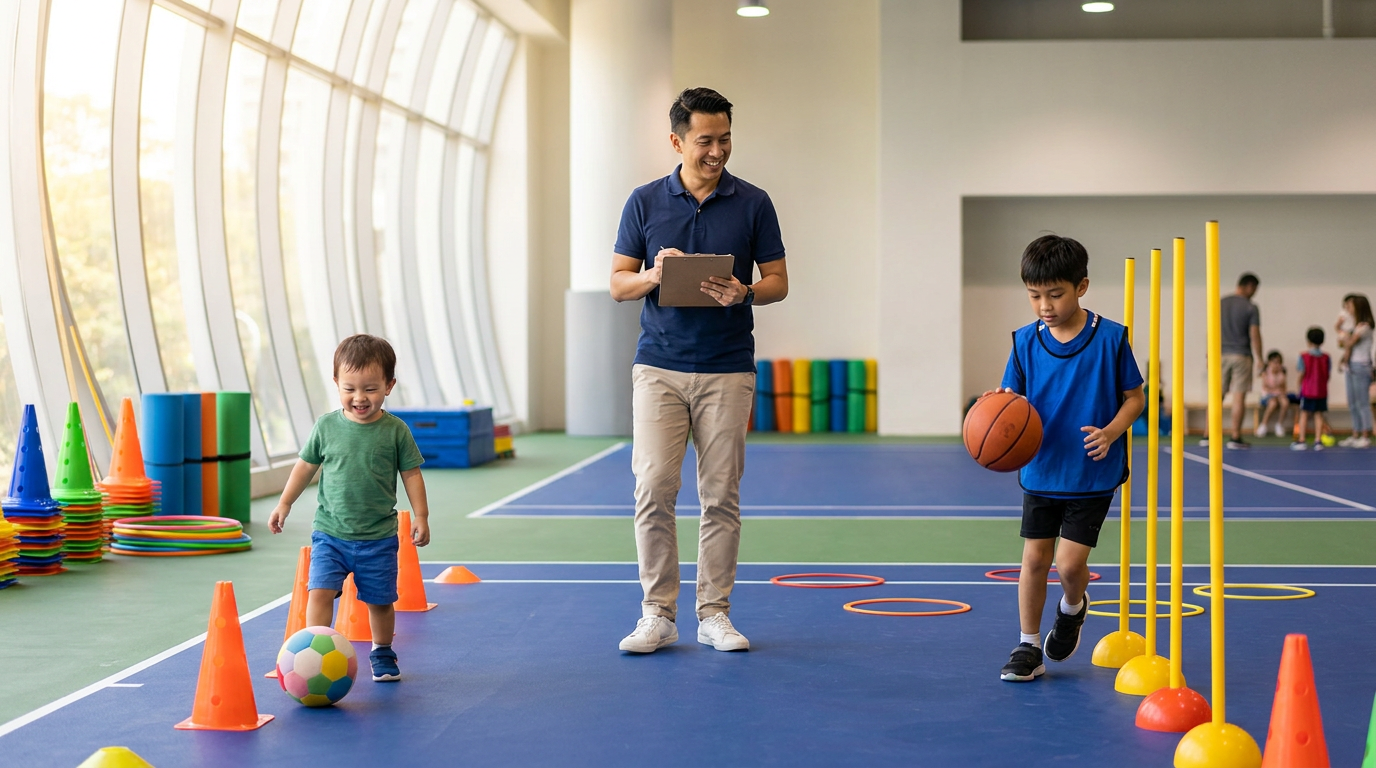
This is the philosophy behind programmes like Vivo Kids, Vivo Kinetics' multi-sport programme for children aged 2 to 6. Rather than specialising early, Vivo Kids exposes children to a wide range of movement experiences, helping them build the fundamental motor skills that underpin success in any sport, racquet or otherwise. When a child has already developed spatial awareness, reaction time, and hand-eye coordination through playful, age-appropriate activities, stepping onto a badminton court or picking up a table tennis paddle feels natural rather than daunting.
For children aged 6 to 12 who are ready for more structured sport, Vivo Kicks offers a focused, skill-building environment that develops athletic confidence and team skills. While soccer is the primary focus, the physical literacy developed through Vivo Kicks, including footwork, spatial awareness, and competitive mindset, translates beautifully to racquet sports and any other athletic pursuit your child decides to explore.
Final Thoughts
There's no single "best" racquet sport for children, because every child is different. Badminton offers the gentlest entry point. Tennis provides the richest long-term pathway. Table tennis sharpens the mind as much as the body. Squash delivers unbeatable intensity. And pickleball makes sport immediately joyful and social.
The real secret is to let your child try, explore, and play. Exposure to multiple sports and movement experiences in the early years builds the confidence and coordination that makes any racquet sport more accessible. And when they do find the one that makes their face light up, you'll know it was worth the journey.
At Vivo Kinetics, we believe that every child deserves to discover the joy of movement in a safe, nurturing, and expertly guided environment. Whether your child is just beginning to move and explore or is ready to sharpen sport-specific skills, our programmes are designed to meet them exactly where they are.
Ready to Help Your Child Find Their Sport?
Explore our age-appropriate programmes at Vivo Kinetics and give your child the movement foundations they need to thrive in any sport they choose. From our award-winning Vivo Kids multi-sport programme for toddlers and preschoolers to Vivo Kicks for school-age children, we're here to make active living a lifelong love.
Discover Our Programmes Today →
Comments