


Rainy Season Sports Activities for Kids in Singapore: The Best Indoor Alternatives
Table Of Contents
Why the Rainy Season Shouldn't Sideline Your Child's Active Lifestyle
Indoor Sports & Active Play for Ages 2–6
Indoor Sports & Active Play for Ages 6–12
Structured Sports Programs vs. Drop-In Activities: What's Better for Your Child?
Other Indoor Activities to Balance Out Active Play
Rainy Season Tips for Sporty Families in Singapore
Keep the Momentum Going, Rain or Shine
The moment dark clouds roll in over Singapore, outdoor plans tend to unravel fast. Football sessions get cancelled, park visits are ruled out, and before you know it, the kids are on the couch with a tablet. Sound familiar? Here's the thing — Singapore's rainy season doesn't have to mean a break from active, healthy living for your child.
Singapore is no stranger to wet weather. The island experiences two distinct monsoon seasons each year: the Northeast Monsoon from December to March, and the Southwest Monsoon from June to September. With rain falling on an average of 171 days a year, waiting for a dry spell to keep your child moving simply isn't a strategy. The good news is that Singapore has no shortage of fantastic indoor sports activities for kids — from structured multi-sport programs to gymnastics, indoor futsal, rock climbing, and more.
In this guide, we break down the best rainy season sports alternatives for children aged 2 to 12, with practical tips to help parents keep their little ones active, engaged, and developing — whatever the weather.
Why the Rainy Season Shouldn't Sideline Your Child's Active Lifestyle
It can be tempting to treat a rainy afternoon as downtime, but for growing children, consistent physical activity matters far more than the weather outside. Regular movement supports stronger muscles and bones, sharper concentration, better sleep, and healthier emotional regulation — benefits that don't take a seasonal break. The early years, in particular, are a critical window: the physical and social habits children develop between ages 2 and 12 lay the groundwork for their wellbeing long into adulthood.
There's also a practical concern every Singapore parent knows well: a cooped-up, under-stimulated child has enormous energy reserves and very few constructive outlets for them. Defaulting to screen time might keep the peace for an hour, but it doesn't burn off energy, build movement skills, or foster the kind of peer interaction that helps children grow socially and emotionally. Indoor sports and structured physical play are the far better alternative — and Singapore has some truly excellent options.
Indoor Sports & Active Play for Ages 2–6
Young children between 2 and 6 are in a prime developmental stage for movement exploration. At this age, the goal isn't mastery of a single sport — it's building fundamental movement skills like balance, coordination, spatial awareness, and body control through varied, playful experiences. Here are the best indoor activity categories for this age group:
Multi-Sport Movement Programs
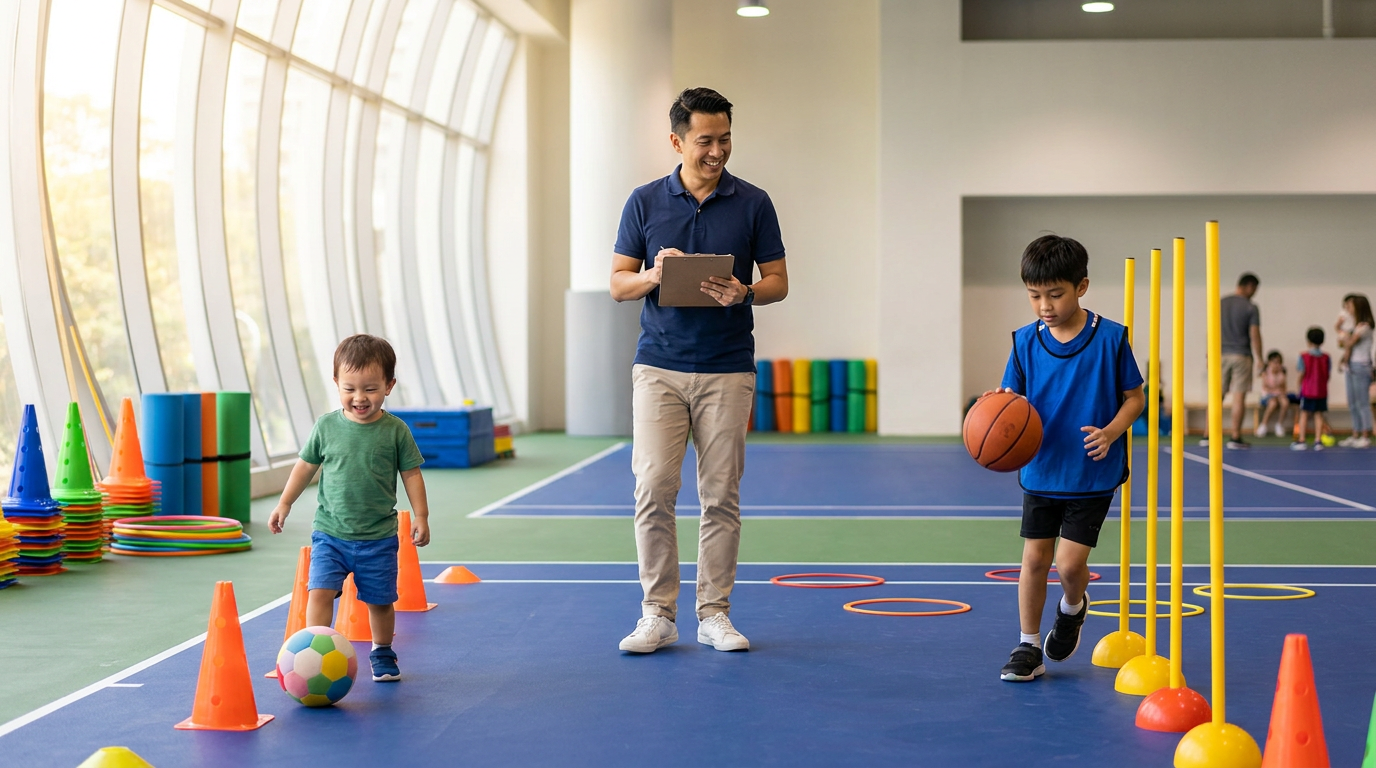
For toddlers and preschoolers, multi-sport programs offer the richest developmental return. Rather than drilling one sport, children rotate through a variety of age-appropriate activities — throwing, kicking, jumping, catching — in a structured yet playful setting. This variety builds a broader physical foundation and keeps young learners engaged and excited from session to session.
At Vivo Kids, Vivo Kinetics' multi-sport programme for ages 2 to 6, children explore movement skills across multiple sports disciplines in an environment designed around play-based learning and character development. Expert coaches guide little ones through each session with a nurturing approach, making it an ideal rainy-season staple that works just as well year-round. Best of all, it's fully indoors — so a downpour won't cost your child a session.
Gymnastics and Movement Classes
Gymnastics-style classes are another outstanding option for young children. They build flexibility, body awareness, coordination, and core strength in a controlled, padded environment that's naturally safe for energetic little bodies. Many gyms in Singapore offer programmes for children as young as 3, with KinderGym-style sessions that focus on fun movement exploration rather than competitive performance. Look for small class sizes and experienced coaches who understand early childhood development.
Indoor Swimming
Swimming is a perennial favourite for good reason — it's one of the most complete full-body activities a young child can do, and Singapore's network of air-conditioned indoor pools makes it genuinely weather-proof. Beyond the physical benefits, learning to swim is a critical life skill. Many swim schools in Singapore offer structured learn-to-swim programmes starting from infancy, making the rainy season a great time to enrol if you haven't already.
Trampoline and Soft Play
For the youngest children (under 3), soft play and trampoline parks offer a more unstructured but still highly active option. Bouncing, climbing, crawling, and rolling all contribute to gross motor development, and the sensory-rich environment is deeply stimulating for curious toddlers. While these venues don't replace a structured programme, they work well as a complementary outing on a particularly wet afternoon.
Indoor Sports & Active Play for Ages 6–12
As children move into primary school age, they're ready for more sport-specific skills, competitive elements, and team dynamics. The rainy season is actually a fantastic opportunity to introduce or deepen engagement with indoor sports — especially for kids whose outdoor activities have been disrupted.
Indoor Soccer and Futsal
For football-mad kids, the rain doesn't have to mean no game. Indoor futsal courts are widely available across Singapore, giving children aged 6 and up a chance to keep their skills sharp regardless of the weather. But beyond just staying active, structured football training in an indoor setting allows coaches to focus on technical fundamentals — passing, dribbling, positioning — in a more controlled environment.
Vivo Kicks, Vivo Kinetics' dedicated soccer academy for ages 6 to 12, offers expert coaching with an age-appropriate curriculum that develops both technical skills and the character traits that make a great athlete: teamwork, discipline, resilience, and confidence. Whether your child is a complete beginner or a budding striker, Vivo Kicks provides the structured progression that ad-hoc park sessions simply can't replicate.
Rock Climbing
Indoor rock climbing is one of the most holistic activities a school-age child can take up. Each climb is a physical and mental challenge combined — children must plan their route, problem-solve in real time, manage height-related nerves, and build genuine upper-body and core strength. Indoor climbing facilities with auto-belay systems allow children to climb independently while remaining safe, and bouldering walls (shorter routes without ropes, with thick mats below) are an excellent entry point for beginners. Many facilities in Singapore welcome children from age 4, with structured youth programmes available for older kids who want to progress.
Badminton
Badminton is a sport that scales beautifully with age and skill level — beginners can enjoy cooperative rallies, while more advanced players engage in competitive singles and doubles strategy. Indoor courts make it a completely weather-proof option, and it's one of the most accessible racquet sports for children in Singapore given the abundance of sports halls island-wide. It builds hand-eye coordination, quick reflexes, agility, and spatial awareness in ways that complement almost any other sport a child might be playing.
Gymnastics and Martial Arts
For primary-school-age children, recreational gymnastics and martial arts programmes offer structured pathways with clear skill progression. Gymnastics classes at this level combine strength, flexibility, balance, and coordination training — and many academies in Singapore offer a spectrum from recreational to competitive tracks. Martial arts (taekwondo, judo, karate) add the dimension of self-discipline, respect, and mental resilience, alongside physical fitness. Both are excellent choices for children who thrive with individual skill development rather than team sport dynamics.
Trampoline Parks
For older kids who need to burn serious energy, trampoline parks are a crowd-pleaser that genuinely delivers a solid workout. Many parks offer structured jump sessions, and some incorporate fitness-based challenges, dodge ball, or freestyle zones. The low-impact nature of trampolining makes it kind on growing joints while still building cardiovascular fitness, core strength, and coordination.
Structured Sports Programs vs. Drop-In Activities: What's Better for Your Child?
One question parents often wrestle with is whether a spontaneous trip to an indoor playground or trampoline park is 'enough' to keep their child active during the rainy season. The honest answer is: it depends on what you're trying to achieve.
Drop-in activities like indoor playgrounds, trampoline parks, and bowling alleys are great for burning energy, providing sensory stimulation, and making rainy afternoons fun. They absolutely have a place in any child's activity mix — especially for younger kids who benefit from unstructured free play.
Structured sports programs, on the other hand, offer something qualitatively different: progressive skill development, expert coaching, and social learning in a peer group. A child who attends a structured program consistently over weeks and months doesn't just stay active — they build competence, confidence, and habits. They learn to follow instructions, manage frustration, celebrate teammates, and persevere through difficulty. These are outcomes that a drop-in visit simply can't replicate.
The ideal approach for most families is a combination of both: regular enrolment in a quality structured programme (which continues rain or shine because it's indoors), supplemented with occasional drop-in activities for variety and fun. This keeps children physically active, developmentally stimulated, and genuinely excited about movement — not just on rainy days, but throughout the year.
Other Indoor Activities to Balance Out Active Play
Active play is the priority, but a well-rounded rainy day doesn't have to be wall-to-wall sport. Here are a few complementary activities that work beautifully alongside physical programmes:
Indoor playgrounds – Great for free-form active exploration, especially for toddlers and younger children. Singapore has excellent options across the island, from nature-inspired playscapes to sports-themed multi-level playgrounds.
Public libraries – Underrated and genuinely excellent in Singapore, with dedicated children's sections, interactive kiosks, and storytelling sessions. A great wind-down after a morning of active play.
Museums and science centres – The Science Centre Singapore, Children's Museum Singapore, and ArtScience Museum all offer engaging, hands-on experiences that stimulate curiosity and learning in a very different way from sport — which is exactly the point.
Art and creative workshops – Art jamming, pottery, and craft classes give children's bodies a rest while engaging their fine motor skills and creative thinking. Many studios in Singapore welcome children.
Holiday sports camps – Worth a special mention for school holiday periods: Vivo Kinetics' Camposaur holiday camps combine active sports sessions with creative play in a themed, immersive format — a brilliant option for the December-January rainy season when school is out and parents need structured, stimulating programmes for their children.
Rainy Season Tips for Sporty Families in Singapore
Keeping children consistently active through Singapore's wet weather requires a bit of planning. Here are some practical tips:
Enrol in a regular indoor programme. The simplest strategy is to ensure at least one or two weekly activities are permanently indoors — so the rain never becomes a reason to skip. Vivo Kinetics' programmes run year-round regardless of weather.
Check school holiday schedules in advance. The Northeast Monsoon peak (December–January) coincides with the school year-end holidays. Book holiday camps and classes early, as popular programmes fill up quickly.
Use the rain as a training opportunity. For older children in structured programmes like Vivo Kicks, rainy periods can actually be valuable training time — more sessions, more focused skill work, without the distraction of outdoor adventures competing for attention.
Keep a rainy day activity list handy. Having 3–4 go-to venues pre-bookmarked (an indoor playground, a sports class, a library, a museum) means you're never scrambling when the weather changes suddenly — which in Singapore, it always does.
Balance active and quiet. Young children especially need a balance of high-energy physical play and calmer, restorative activities in the same day. A morning at sports class followed by quiet reading or creative play in the afternoon is a great rhythm to build.
Keep the Momentum Going, Rain or Shine
Singapore's rainy season is longer and wetter than many families anticipate — but it doesn't have to mean disrupted routines, restless kids, or hours of screen time. With the right mix of structured sports programmes and fun indoor activities, your child can stay physically active, socially engaged, and developmentally on track no matter what the weather does outside.
The key is being intentional: choose at least one high-quality structured programme that runs indoors consistently, layer in complementary drop-in activities for variety, and enjoy the rainy days as an opportunity to deepen skills and build habits that will last long after the monsoon clouds clear. For children aged 20 months to 12 years, Vivo Kinetics offers award-winning, play-based sports programmes designed specifically for Singapore's young learners — and they're just as energetic and effective on a rainy Tuesday as they are on a sunny Saturday morning.
Ready to keep your child active all year round? Explore Vivo Kids for multi-sport programmes (ages 2–6) and Vivo Kicks for our soccer academy (ages 6–12). Find out more and register your interest at vivokinetics.com.
Comments