


Small Space Sports Activities: Fun Apartment-Friendly Ideas for Active Kids
Table Of Contents
Why Small Spaces Don't Mean Small Movement
Safety First: Setting Up Your Home Activity Zone
Ball Skills & Throwing Games (No Broken Vases, We Promise)
Balance, Agility & Obstacle Challenges
Dance, Rhythm & Movement Games
Imaginative Active Play
Yoga, Stretching & Mindful Movement
Classic Indoor Sports Mini-Games
Age Guide: Matching Activities to Your Child's Stage
When Home Play Isn't Enough: Take It to the Next Level
Small Space Sports Activities: Fun Apartment-Friendly Ideas for Active Kids
If you're raising children in a Singapore apartment, you already know the challenge: your child has energy to burn, the afternoon downpour has locked out the playground, and your living room is not exactly Bishan Park. The good news? Keeping kids physically active doesn't require a garden, a sports hall, or even particularly wide corridors. With a little imagination and the right activity ideas, a compact HDB flat or condo unit becomes a space where your child can jump, balance, kick, dance, and grow — in every sense of the word.
Regular movement matters enormously for children. Physical activity supports not just fitness, but also brain development, emotional regulation, social skills, and confidence — all the building blocks of a well-rounded child. And when outdoor time is limited by Singapore's unpredictable tropical weather, having a reliable set of indoor, apartment-friendly sports activities becomes an essential part of your parenting toolkit.
In this guide, we've pulled together 20+ small space sports activities that work beautifully in Singapore apartments, grouped by type and matched to developmental goals. Whether your child is a toddler testing their first hops or a primary schooler who needs a proper workout before dinner, there's something here for every stage — and every square metre.
Why Small Spaces Don't Mean Small Movement
There's a common misconception that meaningful physical activity requires a lot of room. In reality, some of the most developmentally rich movement experiences happen in contained, focused spaces. Research consistently shows that physical activity in children supports cognitive development, gross motor skills, balance, coordination, and emotional well-being — none of which need a basketball court to flourish. For Singapore families living in flats, townhouses, or compact condos, the priority isn't finding more space. It's making smarter use of the space you already have.
The key is variety. Children benefit most from activities that challenge different movement patterns — throwing and catching, balancing, jumping, crawling, and rhythmic movement. By rotating through a mix of these across the week, your child gets the kind of well-rounded physical development that prepares them for everything from school sports to social play. Think of your apartment not as a limitation, but as a curated movement studio.
Safety First: Setting Up Your Home Activity Zone
Before the jumping and throwing begins, a quick once-over of your space makes everything safer and more fun. You don't need to redecorate — just a few simple steps:
Clear a movement zone. Push furniture to the edges of the living room or hallway to create a dedicated open area. Even 2 x 3 metres is enough for most activities.
Use soft alternatives. Swap hard balls for foam balls, rolled socks, or scrunched tissue paper to protect walls, furniture, and younger siblings.
Non-slip surfaces matter. If your floors are tiled or polished wood (common in Singapore apartments), have kids play in socks with rubber grips, or lay down a yoga mat or playmat as a base.
Remove fragile items. Take vases, photo frames, and electronics off low surfaces before any throwing or swinging activity begins.
Supervise by age. Toddlers need active supervision throughout; older children can be given slightly more independence once rules are established.
With these basics in place, you're ready to turn your apartment into a small but mighty movement space.
Ball Skills & Throwing Games (No Broken Vases, We Promise)
Ball play is one of the most effective ways to develop hand-eye coordination, reaction time, and throwing mechanics in young children — and it absolutely can be done indoors, safely, with the right equipment.
Catch and Clap is a brilliant starter for children aged 3 and up. The setup is simple: toss a soft foam ball or beanbag back and forth, but the catcher must clap once before catching. For solo play, your child throws the ball upward and claps before catching it. You can add layers — clap twice, spin around, touch the ground — making it progressively more challenging as coordination improves. This activity sharpens bilateral coordination and timing in a way that feels purely like play.
DIY Velcro Catch takes the game a step further for slightly older children. Purchase a basic Velcro mitt-and-ball set from a toy shop, or improvise with a textured glove and a wiffle ball with Velcro dots attached. Alternate between throwing and catching roles, varying speed and distance. The unpredictability of where the ball will land keeps children alert, reactive, and genuinely engaged.
Newspaper Ball Basketball is a perennial favourite for apartments. Crumple sheets of newspaper or tissue paper into balls and set up a "basket" — a laundry basket, a large pot, or a cardboard box turned on its side. Children score points by tossing their balls in from different distances or angles. You can tape a shooting line on the floor with masking tape and change its position to increase the challenge.
Target Toss works beautifully in hallways. Arrange a row of plastic cups or empty containers at one end and have children toss beanbags from a set distance to knock them down or land inside them. For younger toddlers, move the target closer. For older children, mix in a timed challenge — how many can they knock down in 60 seconds?
Balance, Agility & Obstacle Challenges
Balance and agility are foundational physical skills that children develop throughout the early years, and they respond brilliantly to play-based training in small spaces. These activities are especially valuable because they also build concentration and spatial awareness.
Tape Obstacle Trails are one of the most versatile apartment activities you can set up. Use coloured masking tape or painter's tape to create trails, lines, and shapes on your floor — a balance beam to walk along, a hopscotch grid to jump through, circles to land on, or zigzag paths to navigate. The beauty of tape games is that they can be rearranged in minutes to create fresh challenges. Children can walk, hop, jump, or even crawl through the trail, and the visual structure of the tape helps them understand their body in relation to space.
Beanbag Balance Challenge targets posture, core strength, and focus. Can your child walk from one end of the room to the other with a beanbag balanced on their head? Can they try two beanbags? Walk backwards? Tiptoe? The progressive nature of the challenge — always one step harder than what they just mastered — is exactly how children build confidence through physical play.
Hopping Obstacle Course turns household objects into a mini agility circuit. Line up shampoo bottles, rolled towels, stuffed animals, or cardboard tubes along a hallway or living room, and challenge your child to hop around each one — then hop on one foot, then backwards, then while counting aloud. You can time the run and encourage them to beat their own score, which introduces a lovely element of self-motivated improvement.
Pillowcase Sack Race is a classic for a reason. Step into a reusable shopping bag or a large pillowcase and hop from one end of the space to the other. In an apartment, even a short course of 4–5 hops is plenty — especially when you're both trying to do it and laughing at each other.
Dance, Rhythm & Movement Games
Dance and rhythm-based games are among the most joyful ways to get children moving in small spaces, and the developmental payoff is substantial. Rhythmic movement builds coordination, listening skills, and emotional expression all at once.
Musical Statues needs nothing more than a phone, a speaker, and a slightly silly family. Play music and encourage your child to dance as freely as possible — the sillier the better. When the music stops, everyone freezes, no matter what position they're in. If anyone giggles or moves, they become the DJ for the next round. This game is wonderful for body awareness and impulse control, and it translates beautifully across ages from toddler to tween.
Choreography Challenge invites older children (ages 5 and up) to pick their favourite song and create a full dance routine to perform. Encourage them to choose costumes, rehearse, and put on a proper show at dinner. The process of planning, practising, and performing builds creativity, self-expression, and — crucially — the kind of confidence that extends far beyond the living room stage.
Movement Songs for Toddlers provide structured, guided physical activity for younger children. Action songs that involve pointing, clapping, stomping, spinning, and jumping give toddlers a framework for movement that feels safe and joyful. Songs that name body parts or directions are particularly useful because they layer in early learning alongside physical activity.
River Bank is an excellent indoor game for 3–7 year olds that combines movement with listening. Place a strip of tape or a rope along the centre of the room, designating one side as the "river" and the other as the "bank." A caller shouts "river!" or "bank!" and everyone jumps to the correct side as quickly as possible. The caller can try to trick players by calling the same side twice. The child who jumps the wrong way becomes the new caller. It's fast, funny, and requires sharp listening and quick movement.
Imaginative Active Play
Some of the most physically engaged children are also the most imaginatively engaged. Play that combines storytelling with movement keeps children active for longer, because they're not thinking of it as exercise — they're thinking of it as an adventure.
Living Room Obstacle Adventure invites children to transform the furniture into a landscape. Sofa cushions become stepping stones across a lava floor, a blanket draped over two chairs becomes a mountain tunnel, a line of books becomes a river to leap over. Children directed a narrative while moving their bodies continuously — and for parents, the setup takes about three minutes. This kind of play builds gross motor skills, problem-solving, and creative thinking simultaneously.
Story Movement pairs active physical response with listening and literacy. As you read a picture book aloud, your child acts out every action in the story in real time. If the character runs through the jungle, your child jogs on the spot. If the hero jumps over a river, your child jumps. If the animal crawls under a log, down they go. It's an especially effective approach for high-energy children who find sitting still during story time challenging.
Charades in Motion takes the classic party game and gives it a full-body workout. Children act out animals, sports, household activities, or favourite characters — no words, only movement. For younger children, use simple categories (animals or transport). For older children, add a competitive element by timing each round. The physical commitment required to convincingly mime a swimming dolphin or a charging elephant is surprisingly exhausting, in the best way.
Yoga, Stretching & Mindful Movement
Physical activity isn't only about high energy output. Yoga and mindful movement activities teach children to control their bodies, build flexibility, and develop calm focus — skills that complement all the jumping and running beautifully.
Animal Yoga is the most child-friendly entry point into yoga practice. Pose names like Downward Dog, Cat-Cow, Cobra, Tree, and Boat translate perfectly for children when framed as animal imitation. Print out animal yoga cards (widely available online) or take turns calling out animals and seeing who can hold the pose the longest. This builds core strength, balance, and body awareness in a format that feels entirely like play.
Stretch and Breathe Challenges introduce basic breathing and body awareness exercises that help children transition between high-energy play and calmer activities. Simple sequences — big breath in while stretching arms wide, big breath out while curling into a ball — help regulate the nervous system and are genuinely useful for children who struggle with overstimulation. Even five minutes of guided stretching before bedtime can meaningfully improve a child's sleep quality.
Balance Challenges can be woven into yoga-style play: standing on one leg and counting to ten, closing eyes while balancing, trying to balance while holding a soft toy above their head. These micro-challenges are endlessly adaptable and can fill small pockets of time throughout the day.
Classic Indoor Sports Mini-Games
Some of the most satisfying physical activities for apartment kids are simply scaled-down versions of the sports they'll eventually play on bigger stages. Introducing sport-like movement patterns at home lays the groundwork for structured programmes later on.
Mini Hockey turns a laundry basket on its side as a goal and uses a rolled-up sock or a lightweight toy as a puck. Children use a paper towel roll or a short plastic bat as a stick and take turns defending or shooting. The spatial constraints of a hallway actually make this more exciting — tight turns and quick reactions are required.
Over-the-Door Mini Basketball is one of the best investments for an apartment family. A small basketball hoop that hooks over a door frame costs very little and provides hours of solo or competitive play. Children can shoot from different distances, one-handed, sitting on the floor, or backwards. For younger children, adjusting the height of the basket makes scoring achievable and confidence-building.
Hallway Bowling lines up empty plastic bottles or cardboard tubes at one end of a corridor. Children roll a soft ball from the other end to knock them down. For toddlers, the bottles stay upright the moment they wobble — which is thrilling. For older children, set a scoring system, introduce a gutter line made of tape, and track scores across rounds.
Blanket Parachute Toss needs at least two people and one large bedsheet or lightweight blanket. Place soft toys, balloons, or rolled socks in the centre and wave the sheet up and down rhythmically to send the objects flying. Children love the unpredictability of what will soar and what will roll off. It's a wonderful coordination and cooperation activity, especially for siblings or playdate groups.
Age Guide: Matching Activities to Your Child's Stage
Not every activity suits every age, and understanding what your child is developmentally ready for makes the experience more satisfying for both of you.
Ages 20 months – 3 years: Focus on gross motor exploration — rolling, crawling, walking along tape lines, tossing soft balls into baskets, action songs, and sensory obstacle trails. Keep activities short (5–10 minutes) and expect happy chaos. The goal at this stage is exposure to movement patterns, not mastery.
Ages 3 – 5 years: This is the golden age of imaginative active play. Story Movement, Living Room Adventures, Animal Yoga, Musical Statues, and simple catching games are ideal. Children this age are developing coordination rapidly and respond brilliantly to activities that combine movement with narrative or music.
Ages 5 – 8 years: Children at this stage are ready for rule-based games with scoring, timing, and some competition. River Bank, Mini Hockey, Hallway Bowling, Catch and Clap progressions, and Choreography Challenges are all excellent. Introduce self-timed challenges ("Can you beat your record?") to build a growth mindset around physical performance.
Ages 8 – 12 years: Older children benefit from activities that mirror real sports mechanics and provide genuine physical exertion. Over-the-Door Basketball, Velcro Catch progressions, Blanket Parachute Toss, Charades in Motion, and Minute-to-Win-It fitness challenges (how many burpees, jumping jacks, or balance poses can they complete?) are all age-appropriate. They're also ready to start thinking about structured programmes that give their natural energy and skills a proper channel.
When Home Play Isn't Enough: Take It to the Next Level
Apartment activities are brilliant for keeping children active day-to-day, but there comes a point where a child's energy, curiosity, and emerging skills need more than a living room can offer. That's where structured, expert-led programmes become genuinely transformative.
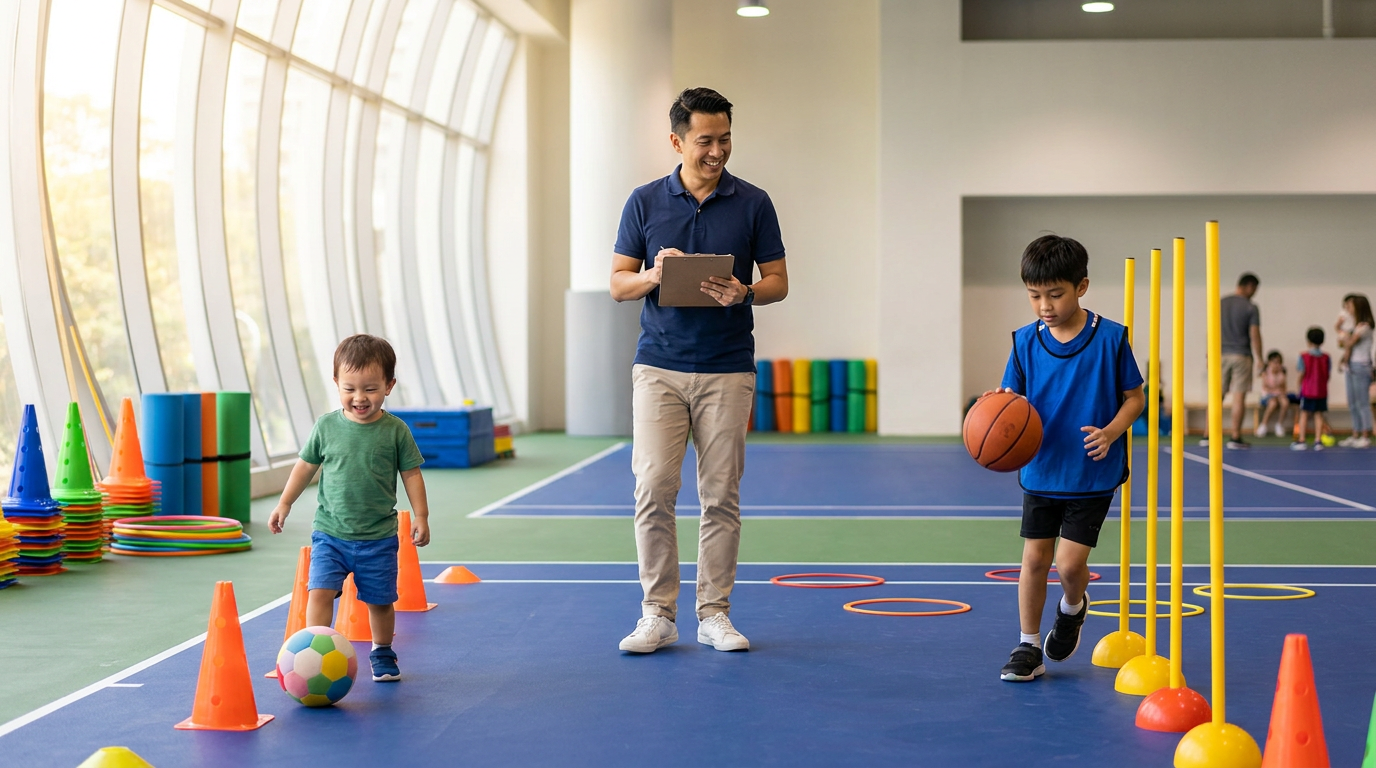
For children aged 2–6, Vivo Kids from Vivo Kinetics is a multi-sport programme designed specifically to build the movement foundations — agility, balance, coordination, and spatial awareness — that home play begins but can't fully develop. With expert coaches and an age-appropriate curriculum, Vivo Kids gives young children a safe, nurturing environment to explore a range of sports while also growing their confidence, social skills, and character.
For older children aged 6–12 who are showing a passion for the beautiful game, Vivo Kicks is a dedicated soccer academy that channels that energy and love of movement into skill development, teamwork, and real competitive experience. Whether your child is just starting out or already showing strong potential, Vivo Kicks provides the coaching structure to help them grow as both a player and a person.
The activities in this guide are a wonderful starting point. Professional coaching is where the foundation becomes something truly lasting.
Keep Them Moving, One Small Space at a Time
Living in a Singapore apartment doesn't have to mean sitting still. As this guide shows, the space between the sofa and the front door holds more athletic possibility than most parents realise. From catching games and tape obstacle courses to yoga challenges and mini soccer shootouts, there are dozens of ways to keep children physically engaged, developmentally supported, and genuinely having fun — without stepping outside.
The most important thing isn't the size of the space. It's the consistency of the movement, and the joy that comes with it. Children who are physically active at home are more likely to embrace sport and exercise as they grow. And when they're ready to take those skills beyond the apartment walls, the right programme will be waiting for them.
Start with one or two activities from this list today. Watch what your child gravitates toward. Follow their curiosity — and let the movement begin.
Ready to Go Beyond the Living Room?
When your child is ready to take their love of movement to the next level, Vivo Kinetics has expert-led programmes designed for every stage — from curious toddlers to competitive young athletes. Explore what's on offer and find the perfect fit for your child.
Discover Vivo Kinetics Programmes →
Comments