


Staircase Workouts for Kids: Fun Cardio Activities That Build Real Fitness
Table Of Contents
Why Staircase Workouts Are Perfect for Kids
Developmental Benefits of Stair Exercises for Children
Safety First: Getting Ready for Stair Workouts
Fun Staircase Workout Ideas for Kids
1. Stair Climbing With a Twist
2. Step-Ups
3. Jumping Challenges
4. Toe Raises
5. Incline Push-Ups
6. Tricep Dips on the Bottom Step
7. Sideways Stair Shuffle
How to Turn Stair Workouts Into Games Kids Love
Age-Appropriate Stair Workouts: A Quick Guide
Sample 15-Minute Staircase Circuit for Kids
Beyond the Staircase: Building a Love for Active Living
Staircase Workouts for Kids: Fun Cardio Activities That Build Real Fitness
You don't need a gym membership, a bag of equipment, or a dedicated play space to give your child a genuinely great workout. Sometimes, the most effective fitness tool in your home has been there all along — right at the end of the hallway. Staircase workouts for kids are one of the most accessible, versatile, and surprisingly fun forms of cardio available, turning an everyday household feature into a full-body movement playground. Whether your home has a full flight of stairs or just a few steps leading to the patio, there's plenty of room to get little hearts pumping, muscles working, and big smiles happening.
In this guide, we'll walk you through the developmental benefits of stair exercises for children, share creative and age-appropriate workout ideas, offer practical safety tips, and show you how to gamify the whole experience so your child actually wants to do it again tomorrow.
Why Staircase Workouts Are Perfect for Kids
Kids are natural movers. They climb, jump, run, and explore — so stair-based activities fit beautifully into their instinctive play patterns. If you have even one single step in your home, you can create a convenient and effective heart-pumping workout. That's the beauty of it. There's no setup time, no special clothing required (though supportive shoes help), and the "equipment" is already part of your living environment.
For parents in Singapore especially, where tropical heat and sudden rainstorms can cut outdoor play short, a staircase offers a reliable indoor alternative. Taking the stairs instead of the lift or escalator is a habit that Singapore's Health Promotion Board actively encourages — and turning stair use into a deliberate, playful workout takes that recommendation one step further. The goal is simple: make movement feel less like exercise and more like adventure.
Developmental Benefits of Stair Exercises for Children
Before we get to the workouts themselves, it's worth understanding why stairs are such a powerful developmental tool — not just for fitness, but for your child's overall growth.
Aside from being a basic life skill, learning to climb stairs has a lot of developmental benefits, such as building leg muscles, strengthening balance and coordination, and boosting spatial awareness. These are foundational physical competencies that serve children across every sport and activity they try, from swimming to soccer to dance.
Aerobic activities like stair workouts improve essential skills, such as fine and gross motor skills, balance, endurance, concentration, memory, hand-eye coordination, and social-emotional skills. That's a remarkable return on something as simple as going up and down a few steps.
There's also a brain benefit worth highlighting. Cardio workouts increase blood flow to the brain, which helps kids concentrate better, retain information, and solve problems more effectively. So a quick staircase session before homework? That's actually a smart strategy.
From a cardiovascular standpoint, the research is compelling too. A 2005 study found that walking 200 steps twice a day, five days a week, for eight weeks can cause a 17-percent increase in VO2 max — a key measure of aerobic fitness. For children building their fitness foundations, those kinds of gains matter enormously.
Motor skills are important not only for children's physical development, but also serve as crucial developmental catalysts for executive functions, prosocial behaviors, and intellectual abilities. This is exactly the kind of holistic, whole-child development that great children's fitness programmes are built around.
Safety First: Getting Ready for Stair Workouts
Before any stair activity begins, a few simple precautions will keep the fun going and the risks low.
Wear proper footwear. Grip-soled trainers or sports shoes are ideal. Socks alone on smooth stairs increase the risk of slipping.
Check the staircase condition. Make sure the handrail is secure, steps are clear of toys or clutter, and the lighting is adequate.
Supervise consistently. Stay close to your child at all times to prevent falls. When working on stairs, always position yourself between your child and the bottom of the stairs.
Match the difficulty to your child's ability. Start with two to three steps at a time and gradually increase the number of stairs as your child's skill improves.
Keep it playful, not pressured. If safe and supervised, kids can climb stairs, count steps, or do gentle step-up games. Avoid speed races on stairs. The goal is movement, not risk.
Once these basics are in place, you're ready to play.
Fun Staircase Workout Ideas for Kids
1. Stair Climbing With a Twist
Basic stair climbing is the cornerstone of any staircase workout — but a small creative twist makes it infinitely more engaging. Write the letters of your child's name on sticky notes and place them randomly on different steps. Challenge your child to find each letter in order, climbing up and coming back down to deliver each one. Initially, younger children will place both feet on each step; alternating feet with stair climbing does not generally occur until the age of three. Celebrate whichever technique your child uses — the climbing itself is what counts.
You can also try counting steps aloud, reciting the alphabet, or calling out animal names with each step to layer in a cognitive challenge alongside the physical one.
2. Step-Ups
Step-ups are a brilliant single-step exercise that builds cardio endurance and leg strength at the same time. Have your child start with the right foot leading — step up with the right, up with the left, down with the right, down with the left. Repeat ten times, then switch the leading leg. To keep things fun, swap out counting for spelling: have them spell their name, their pet's name, or their favourite food with each rep. This simple modification transforms a repetitive exercise into an engaging mental challenge, which is key for maintaining a child's attention.
3. Jumping Challenges
Jumping exercises play a crucial role in children's physical development. Activities like jump challenges not only enhance cardiovascular fitness but also improve agility and coordination in children. The staircase is ideal for this because you can literally measure progress: a standard stair rise is around 20cm. Can your child jump confidently from the first step? Can they land softly with bent knees? Progress to the second step only when they've mastered the first. This gives children a visible, achievable goal to work toward — which is deeply motivating at every age.
For younger children, jumping onto the bottom step (both feet together) and back down is a fantastic starting point that builds power and body awareness.
4. Toe Raises
Toe raises are a simple but effective lower-leg strengthener. Have your child stand with the balls of their feet on the edge of a step while holding the handrail lightly for balance. They rise onto their tiptoes slowly, hold for a second, then lower back down. Aim for ten repetitions. To make it more playful, challenge them to do it as slowly as possible — this builds muscular control and focus alongside strength. You can also try it with eyes closed (holding the rail) to add a balance challenge for older kids.
5. Incline Push-Ups
This is a fantastic upper body and core exercise that uses the stairs as support. Have your child place both hands on the second or third step (wider steps are better) and walk their feet back until the arms are fully extended. From this elevated plank position, they bend their elbows to lower their chest toward the step and then push back up. Five repetitions is a solid starting goal. For children who find this difficult, simply holding the elevated plank position with straight arms builds core strength and proprioception without the pressing movement.
6. Tricep Dips on the Bottom Step
This exercise targets the back of the arms and is perfect for school-age children. Have your child sit on the floor in front of the bottom step, place the heels of their hands on the step behind them, then extend their arms to lift their bottom off the floor. They then bend at the elbows to lower back toward the floor. Bent knees make it easier; straight legs make it harder. Ten repetitions is a great target. This exercise is particularly beneficial for building the upper-body strength that underpins everything from handwriting grip to throwing and catching.
7. Sideways Stair Shuffle
Facing sideways toward the handrail, have your child step up the stairs sideways — leading with the uphill foot and bringing the other foot to meet it on each step. Stand facing the railing, go up the steps sideways, and work your way back down the steps the same way. Repeat each side three times. This movement activates the hip abductors and inner thighs — muscle groups that often miss out during standard stair climbing — and challenges coordination in a new and interesting way.
How to Turn Stair Workouts Into Games Kids Love
The biggest challenge with any children's fitness activity isn't the exercise itself — it's keeping engagement high. Here are some creative ways to make stair workouts feel less like training and more like playtime.
Stair Colour Challenge: Stick coloured dots or stars on each step. Call out a colour and have your child run to that step and back. Mix up the calling speed to adjust intensity.
The Animal Walk Relay: Assign a different animal movement to each direction — hop like a frog going up, walk like a bear on all fours coming down, tiptoe like a cat on the landing. This combines imaginative play with movement variety.
Beat Your Best: Time how long it takes your child to do a circuit (up, down, five step-ups, back up). Write down the time and challenge them to beat it next session. Progress tracking is deeply satisfying, even for young children.
Fitness Dice: Write six stair exercises on a piece of paper numbered one to six. Roll a die (or use a digital dice app) to pick the next exercise. This randomness adds novelty and anticipation to every round.
Stair Spelling Bee: Tape a letter on each step. Call out a word and have your child run to each letter that spells the word, in order. This cross-curricular approach means learning and movement happen at the same time.
Entertainment is the most effective form of motivation for children, so the more game-like the session feels, the more consistently your child will want to participate.
Age-Appropriate Stair Workouts: A Quick Guide
Not all stair activities suit every age group. Here's a general framework to help you tailor the workout to your child's developmental stage.
Ages 2–3: Focus on basic climbing with hand support, stepping on and off the bottom step, and simple toe-touch challenges. According to the CDC, between the ages of two and three, your child should be able to safely go up and down the stairs on their feet while holding onto support, whether it's your hand or the railing. Keep sessions short — three to five minutes of guided play is plenty.
Ages 4–6: Introduce step-ups, toe raises, and simple jumping from the first step. By age three, most children should be able to alternate their feet on the steps without using the rail, so this age group can begin working on fluency and rhythm. Sessions of five to ten minutes work well, broken up with rest and play.
Ages 7–12: Most exercises in this guide are suitable for this age group. Introduce tricep dips, incline push-ups, the sideways shuffle, and timed circuits. According to the World Health Organization and the CDC, children and adolescents between five and seventeen years old should do at least 60 minutes of moderate to vigorous physical activity each day, and stair circuits are a great way to contribute meaningfully to that daily target.
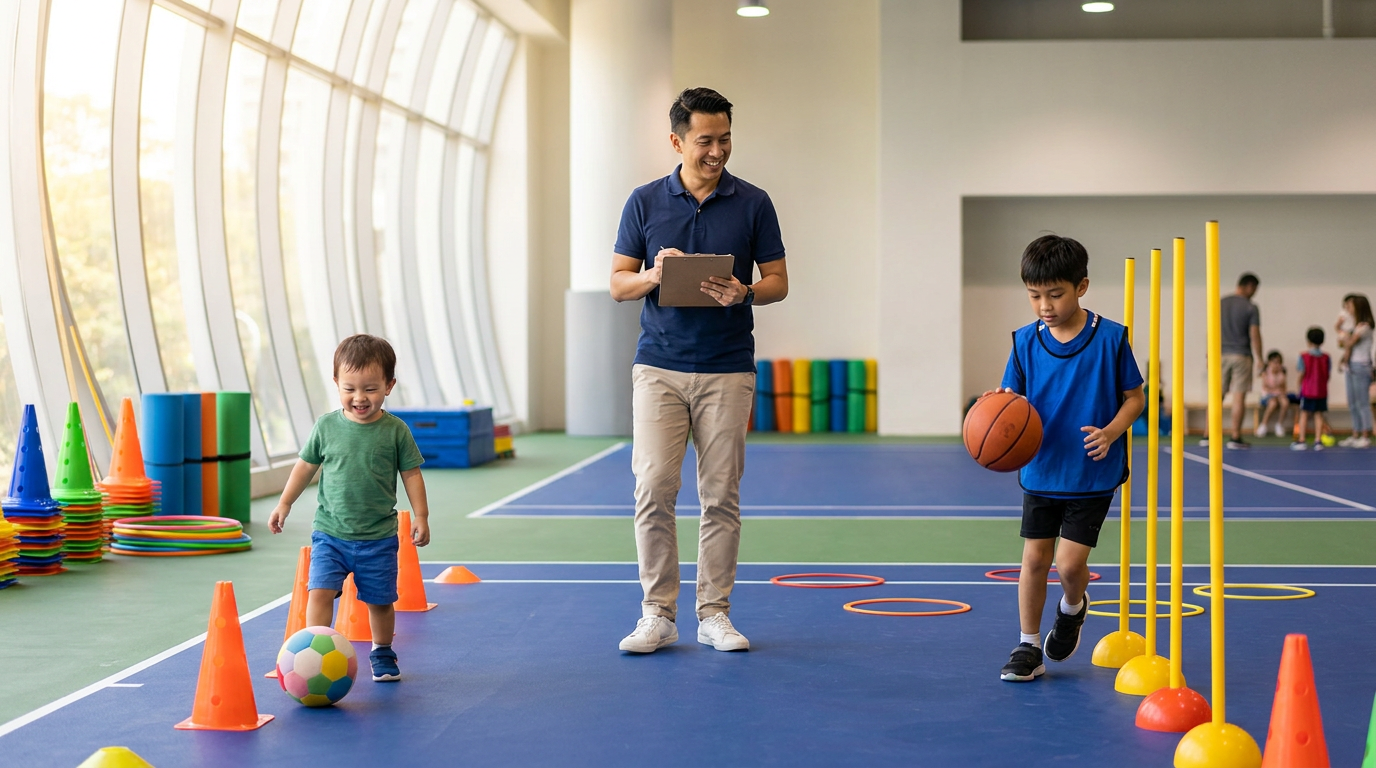
For children involved in structured sports programmes, these home stair workouts complement their training beautifully. If your child is already part of a programme like Vivo Kids — Vivo Kinetics' multi-sport programme for ages 2 to 6 — stair exercises at home reinforce the balance, coordination, and cardiovascular fitness being developed in class. Similarly, for budding footballers in Vivo Kicks Academy (ages 6–12), stair sprints and step-ups are excellent complementary conditioning tools that support on-pitch agility and stamina.
Sample 15-Minute Staircase Circuit for Kids
Here's a simple, no-fuss staircase circuit that works well for children aged 5 and above. Adjust repetitions and rest times to suit your child's fitness level and energy on the day.
Warm-Up Walk — Walk up and down the stairs twice at a comfortable pace to get the blood flowing.
Stair Climbing (Alternating Feet) — Climb up and down twice, focusing on placing one foot per step.
Step-Ups (Right Leg Leading) — 10 repetitions, then switch to left leg leading for 10 more.
Rest — 30 seconds. Shake out the legs and take a water sip.
Jumping from Bottom Step — Jump from step to floor and back up, 8 times.
Toe Raises — 10 slow repetitions, holding the rail for balance.
Incline Push-Ups — 5 repetitions on the second step.
Rest — 30 seconds.
Sideways Stair Shuffle — Up and down once on each side.
Cool-Down Walk — One final gentle climb and descent, breathing deeply.
Total active time: approximately 12–15 minutes. You can repeat the circuit for older, fitter children, or turn individual exercises into timed challenges (30 seconds on, 15 seconds rest) for a higher-intensity session.
Beyond the Staircase: Building a Love for Active Living
Staircase workouts are a wonderful tool — but they're just one piece of a bigger picture. Cardio workouts are vital to strengthening kids' hearts and lungs, making sure oxygen effectively reaches cells as they develop. They're also an easy way for kids to build strength, endurance, and bone health that will benefit them for decades to come.
The most powerful thing a parent or caregiver can do is to make movement a normal, joyful part of daily life — not something reserved for PE class or organised sport. The best routine is the one your child enjoys enough to do again tomorrow. For parents, the goal is simple: reduce sitting time, add more active play, and make movement a normal part of the day. Stair workouts, play in the park, backyard games, dance sessions in the living room — all of it counts.
When children experience movement as fun rather than a chore, they carry that attitude into adolescence and adulthood. That foundation — built one step at a time — is genuinely one of the greatest gifts you can give them.
Step Up to a Healthier, Happier Childhood
A staircase is so much more than a way to get from one floor to another. With a little creativity and enthusiasm, it becomes a cardio circuit, a strength-training zone, a balance challenge, and a whole lot of fun — all without spending a cent on equipment. Whether your child is two or twelve, there's a stair workout here that fits their ability and excites their imagination.
Start small. Pick one or two activities from this guide, do them together, and let your child's enjoyment lead the way. The fitness benefits will follow naturally — because when movement feels like play, children always want more of it.
Want to Take Your Child's Active Development Further?
At Vivo Kinetics, we believe every child deserves expert coaching, a nurturing environment, and the joy of active play. Whether you're looking for a play-based multi-sport programme for your toddler or a focused football academy for your school-age child, we have programmes designed to develop the whole child — physically, intellectually, socially, and emotionally.
🏅 Best Children's Multi-Sport Programme 2024 🌏 Recognised Leaders in Children's Health & Fitness in Southeast Asia
👉 Explore Our Programmes at Vivo Kinetics and give your child the active start they deserve.
Comments