


Weekend Warriors: How to Make the Most of Saturday Sports for Kids
Table Of Contents
Why Saturday Mornings Are Prime Time for Young Athletes
What Happens in the Body and Brain During Sports Play
Age-by-Age Guide: Getting the Most Out of Weekend Sports
Ages 20 Months to 5 Years: Explore Everything
Ages 6 to 9: Build Foundations, Sample Broadly
Ages 10 to 12: Deepen Skills, Keep Variety Alive
Multi-Sport vs. Single-Sport: What the Evidence Says
How to Prepare Your Child for Saturday Class
What to Look for in a Weekend Sports Programme
After the Whistle: Making the Most of the Drive Home
Turning Saturday Sport Into a Lasting Habit
Why Saturday Mornings Are Prime Time for Young Athletes
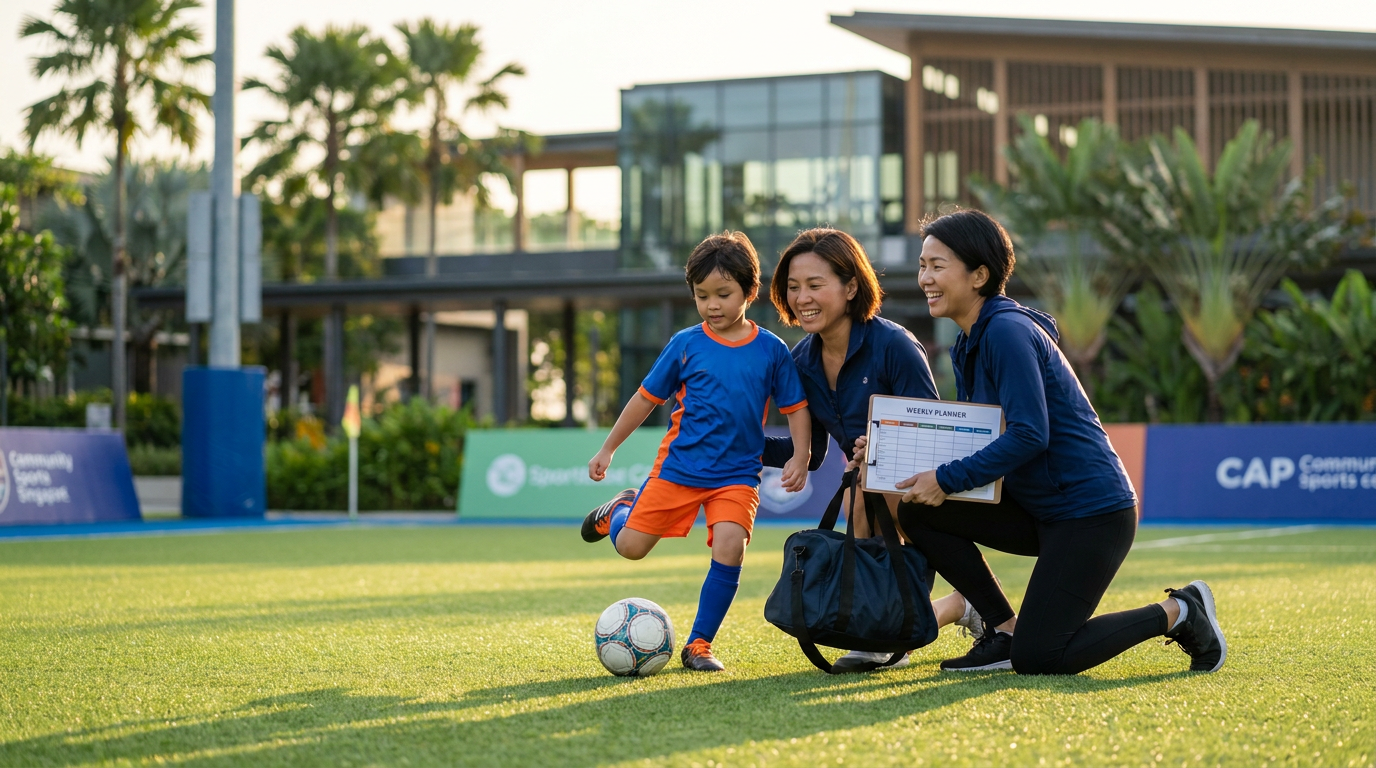
There's something almost magical about a Saturday morning on a sports field. The cones are out, the grass is still damp, and somewhere in the middle of it all is your child — arms windmilling, completely absorbed, wearing a grin that no screen could ever produce. For families across Singapore, that weekly ritual has become one of the most valuable investments they make in their children's development. But getting the most out of those precious 60 to 90 minutes takes more thought than simply showing up.
This guide is for parents who want Saturday sports to mean something beyond burning off energy. Whether your toddler is taking their first kicks or your ten-year-old is refining their game, we'll walk through the developmental science, the age-by-age thinking, and the practical habits that help children genuinely thrive on the weekend sports field.
What Happens in the Body and Brain During Sports Play
Before diving into age-specific advice, it helps to understand why structured weekend sports are worth protecting in your family's schedule in the first place. The benefits reach considerably further than cardiovascular fitness.
Physically, regular participation in sport builds stronger bones and muscles, improves coordination and balance, and lowers the risk of lifestyle diseases later in life. Research consistently links childhood physical activity with better development of hand-eye coordination, functional movement skills, endurance, and strength. These aren't just sports outcomes — they're the building blocks of a body that can sit comfortably in a classroom, carry a heavy schoolbag, and stay energetic through a long school day.
The mental and emotional gains are equally compelling. Studies show that children who participate in organized sports demonstrate lower stress levels, reduced anxiety, and greater self-confidence compared to their less active peers. Academically, the connection is real too: research published in peer-reviewed journals has found that regular sport participation is associated with improved school performance and better classroom behavior, driven in part by gains in attention, concentration, and self-regulation. Socially, a well-run sports session teaches children to take turns, communicate under pressure, handle losing with grace, and celebrate others' wins — skills that follow them directly into the classroom and friendships.
In Singapore, where academic enrichment often dominates the weekly schedule, weekend sport offers something irreplaceable: a space where children are assessed not on what they know, but on how they move, cooperate, and persist.
Age-by-Age Guide: Getting the Most Out of Weekend Sports
Ages 20 Months to 5 Years: Explore Everything
If you've ever watched a two-year-old try to kick a ball and end up sitting on it instead, you've witnessed exactly the kind of joyful, unpredictable learning that defines this stage. At this age, the goal of weekend sport is not skill acquisition in any traditional sense — it's movement exploration. Children this young are mastering fundamental motor patterns: running, jumping, balancing, throwing, and catching. The specific sport is almost beside the point.
What matters far more is that movement feels safe, joyful, and varied. Short attention spans mean sessions should feel more like play than training, with frequent transitions, lots of encouragement, and no pressure to perform. Parent participation is often a genuine asset here — young children take their emotional cues from the adults they trust most, and a parent who's engaged and enthusiastic on the sideline (or on the field alongside them) sets a tone that shapes how a child feels about sport for years to come.
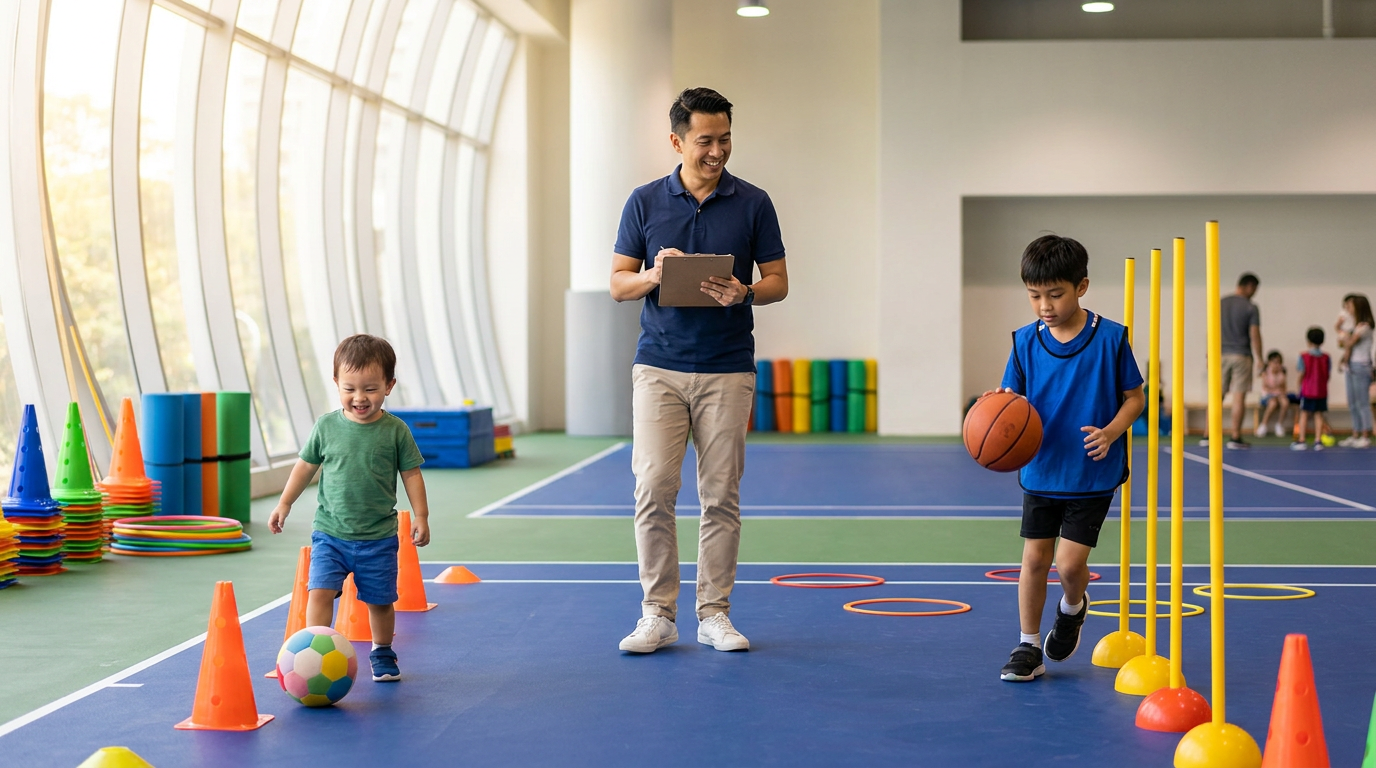
Multi-sport formats work exceptionally well at this stage. Rather than locking a three-year-old into a single discipline, a well-designed programme rotates through different movement patterns — kicking, throwing, climbing, balancing — giving children a broad physical vocabulary and the chance to discover what lights them up before anyone tries to specialize. This is exactly the philosophy behind Vivo Kids, Vivo Kinetics' award-winning multi-sport programme for children aged 2 to 6. Designed around play-based learning and age-appropriate curriculum, Vivo Kids focuses on building movement skills and character development together — because confidence and coordination grow in the same space.
Ages 6 to 9: Build Foundations, Sample Broadly
Something shifts around age six. Children begin to understand rules more reliably, they can follow multi-step instructions, and they start to genuinely enjoy the social dimension of being on a team. This is the stage where sport becomes a richer experience — and also where parents begin to feel the pull toward specialization.
Resist that pull, at least for now. Developmental sports science is unusually consistent on this point: for most young athletes, playing multiple sports through the early childhood years leads to better long-term outcomes than specializing early, including fewer overuse injuries, lower burnout rates, and equivalent or better athletic development down the track. The sampling years between ages six and twelve are exactly that — a time to build broad physical competence across different movement patterns, rather than narrow mastery in one discipline.
That said, this age range is also the right time to introduce more structure. Sessions can be longer, coaching can be more deliberate, and children can begin working toward genuinely measurable skill milestones. Look for programmes that offer progressive, age-appropriate curriculum — not simply the same drills repeated week after week, but a structured pathway that builds on what a child learned the session before.
Ages 10 to 12: Deepen Skills, Keep Variety Alive
By ten, many children have developed a clear sporting preference. They may love football, or live for athletics, or have decided that they don't actually enjoy team sports at all and would rather swim. All of this is healthy information, and it's worth following. At this stage, a child's intrinsic motivation — what they actually want to do on a Saturday morning — becomes the most reliable predictor of whether they'll stick with sport long-term.
The question isn't whether to allow deeper engagement in a preferred sport, but whether that deeper engagement is crowding out all variety. Research points to waiting until at least age 12 to 15 before fully committing to a single sport year-round, and most sports medicine guidance recommends keeping multiple activities in the mix through the pre-teen years to reduce overuse injury risk and maintain enjoyment. A child who loves football can absolutely train with a dedicated football academy — but mixing in another sport, or even a non-competitive movement activity, keeps their athletic development well-rounded and their enthusiasm intact.
For families whose child has caught the football bug, Vivo Kicks Academy offers exactly this kind of structured, developmentally grounded pathway. Designed for children aged 6 to 12, Vivo Kicks builds genuine footballing skills through age-appropriate curriculum guided by expert coaches — with the nurturing, confidence-first environment that distinguishes quality youth sport from the kind of pressure-heavy training that burns kids out by thirteen.
Multi-Sport vs. Single-Sport: What the Evidence Says
The debate between multi-sport participation and early specialization is one of the most common dilemmas in youth sport. Social pressure — the sense that your child will fall behind if they don't pick a lane early — is real, but the evidence that it's warranted is much weaker than parents are often led to believe.
Major medical and sports science organizations, including the American Academy of Pediatrics and the American Orthopaedic Society for Sports Medicine, have both concluded that early specialization in a single sport raises the risk of overuse injury and burnout, and does not generally produce better long-term outcomes for young athletes. Research has also found that early sport specialization can reduce long-term enjoyment of physical activity — children who specialize before their teens are more likely to report burnout and, in some cases, walk away from sport entirely by adolescence. Multi-sport participation, by contrast, has been linked to better overall motor and athletic development, greater creative decision-making, and longer, more enjoyable athletic careers.
For Singaporean families navigating a packed weekly schedule, the practical translation is straightforward. Before age twelve, the priority is breadth over depth: a varied movement diet, a nurturing coaching environment, and a genuine love of being active. Single-sport specialization can come later, when a child is physically and emotionally ready for its demands, and when it's driven by the child's own enthusiasm rather than parental anxiety.
How to Prepare Your Child for Saturday Class
The session itself is only part of the equation. How the morning starts — from the moment your child wakes up to the first minute they step onto the field — shapes how much they get out of it.
A light, balanced breakfast about 60 to 90 minutes before class supports both energy and focus without the heaviness that slows young bodies down. Hydration matters too, especially in Singapore's heat — sending your child with a water bottle and reminding them to drink before they feel thirsty is a simple habit with meaningful impact. Appropriate footwear and comfortable, breathable clothing might seem obvious, but they make a genuine difference in how freely and confidently a child moves.
Just as important is the emotional preparation. Children take their anxiety cues from parents, so the tone of the car ride matters. Keep conversation light and curious — ask what they're looking forward to, not what they think they'll find hard. For younger children trying a new programme, arriving a few minutes early to settle in without rush removes a significant source of first-day nerves. And for the parents of children who are reluctant to try new things: watching your own attitude is one of the most effective things you can do. Enthusiasm is contagious, and so is apprehension.
What to Look for in a Weekend Sports Programme
Not all programmes are created equal, and the Saturday morning decision deserves careful thought. A few key questions are worth asking before you sign up:
Is the curriculum age-appropriate? The programme should be designed around what children at your child's developmental stage are genuinely ready for — not a scaled-down version of adult training, and not so unstructured that it offers no progression.
What is the coach-to-child ratio? Lower ratios mean more individual attention, more coaching feedback, and a safer environment. This matters more at younger ages, where attention management is its own skill.
Does the programme prioritize fun and skill-building over winning? At every age under twelve, a love of movement is the most valuable outcome a weekend sports class can produce. Programmes that introduce competitive pressure too early tend to produce the opposite of what parents hope for.
Can you try before you commit? Reputable programmes offer trial sessions. Watch your child during the class — not just at the end of it. Their in-the-moment engagement is the most honest signal of whether a programme is the right fit.
Does the programme have a clear philosophy? Quality providers should be able to articulate what children will develop over a full term, not just in a single session. Character development, social skills, and movement confidence should feature alongside specific sport skills.
After the Whistle: Making the Most of the Drive Home
The conversation that happens in the ten minutes after a session can reinforce — or quietly undermine — everything the coach just worked to build. It's a small window, but it's worth being intentional about.
Start with curiosity, not evaluation. "What was your favourite part today?" lands very differently from "Did you do well?" or "Why didn't you try harder at that drill?" Children at every age are more likely to stay engaged with sport when the adults around them focus on effort and enjoyment rather than performance outcomes. Praising specific effort — "I noticed you kept trying even when that bit was tricky" — is more developmentally useful than generic praise and more motivating than outcome-based feedback.
If your child had a hard session — a fumble, a conflict with a teammate, a moment of frustration — resist the urge to fix it immediately. Acknowledge the feeling first. Sport is one of childhood's richest learning environments precisely because it generates real emotions in real time, and learning to process those emotions — not avoid them — is part of what makes it so valuable. A parent who models equanimity after a tough class is teaching something far more important than any drill.
Turning Saturday Sport Into a Lasting Habit
The children who get the most out of weekend sport are rarely those who are the most talented. They're the ones who keep showing up — who've developed enough genuine enjoyment of movement that sport feels like a welcome part of the week rather than an obligation.
Building that habit is less about finding the perfect programme and more about protecting the conditions that make sport feel good: consistency, a nurturing environment, coaches who see children as whole people rather than performance metrics, and parents who cheer for effort rather than outcome. In Singapore, where the pressure to fill every hour with academically productive activity is very real, Saturday sport is an act of faith in a different kind of development — one that happens on a field rather than a worksheet, and shows up in character, confidence, and a child who genuinely loves being active.
The good news is that when children start early, in the right environment and at the right pace, that love of movement tends to stick. And one Saturday morning at a time, you're building something that will serve your child long after the final whistle of childhood.
Saturday sports aren't just about what happens between warm-up and cool-down. They're about the habits, the mindset, and the environment you build around those sessions — week after week, year after year. When the programme is right, the coaching is nurturing, and the expectations are age-appropriate, those weekend mornings become some of the most formative hours in a child's development. That's a Saturday morning worth protecting.
Ready to give your child the best possible start on the weekend sports field?
At Vivo Kinetics, Singapore's award-winning children's sports and fitness company, every programme — from the play-based Vivo Kids multi-sport experience for ages 2 to 6, to the skill-building Vivo Kicks football academy for ages 6 to 12 — is designed around how children at each stage actually learn, move, and grow. Expert coaches, age-appropriate curriculum, and a nurturing environment that builds confidence alongside competence.
Explore Vivo Kinetics programmes and book a trial class today.

Comments